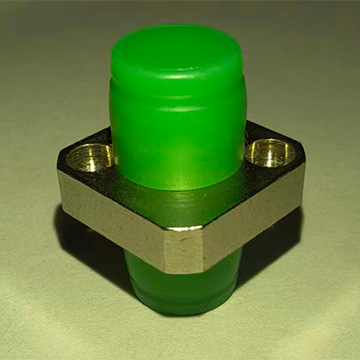
If the jumper is clean but the signal is poor, how should the inside of the adapter be cleaned?
In fiber optic communication and sensing systems, when the fiber jumper end-face is confirmed clean but the optical signal transmission quality remains substandard (e.g., high insertion loss, abnormal return loss), the cause is often contamination within the fiber optic adapter’s (ferrule) ceramic sleeve or the mating connector.
I. Technical Principles of Fiber Optic Adapter Internal Contamination
The core structure of a fiber optic adapter is an internal high-precision ceramic or metal alignment sleeve. When two fiber optic connectors (Ferrules) are inserted into the adapter, the sleeve ensures precise alignment of the two fiber cores (the core diameter of a single-mode fiber is only about 9\ \mu\text{m}).
If dust, oil, wear debris, or residual moisture adheres to the inner wall of the sleeve or the end-face of the connector deep inside:
- Optical Interference and Scattering: Impurities directly obstruct the optical path, leading to optical power attenuation (increased insertion loss) and signal reflection (reduced return loss).
- Cross-Contamination: Even when a clean jumper is inserted, residual contaminants inside the adapter can re-contaminate the jumper end-face, or even scratch the fiber end-face under tight pressure.
II. Cleaning Tools and Standard Operating Procedures for Adapter Interiors
Due to the narrow space deep inside the sleeve of fiber optic adapters, conventional wiping materials cannot be used. Specialized dust-free cleaning tools are required:
1. One-Click Cleaner
- Operating Principle: The cleaning pen’s probe is inserted directly deep into the adapter port. Pressing the pen body triggers the internal ultra-fine dust-free tape to automatically rotate and advance for wiping, efficiently removing micro-dust and light oil stains from the internal end-face of the sleeve.
- Applicable Scenarios: Quick on-site maintenance, cleaning of patch panels or equipment interfaces.
2. Specialized Fiber Optic Swabs
- Size Selection:
- For adapters like \text{FC/SC/ST}: Select a 2.5\text{ mm} spec dust-free cleaning swab with a matching outer sleeve diameter.
- For adapters like \text{LC/MU}: Select a 1.25\text{ mm} spec dust-free cleaning swab.
- Operating Method:
- Dry Wipe: Insert the swab vertically into the adapter sleeve, rotate it 1 to 2 turns in the same direction (clockwise or counter-clockwise), and then gently remove it.
- Wet Wipe: If there is stubborn oil contamination, apply an extremely small amount of high-purity anhydrous isopropyl alcohol (IPA, purity > 99.9\%) to the tip of the cleaning swab. Insert it into the sleeve and wipe with a single rotation; immediately follow with a dry swab to absorb any residual liquid.
3. Auxiliary Cleaning Tools
- Dust-Free High-Purity Compressed Gas (Air Duster): Before wiping, short bursts of dust-free compressed gas can be used to blow out loose dust from the adapter port.
III. Engineering Operational Red Lines and Precautions
- Strictly Prohibit the Use of Ordinary Cotton Swabs or Hard Tools: Ordinary medical/industrial cotton swabs easily shed fibers and leave residues inside the sleeve; hard metal or plastic rods can scratch the inner wall of the ceramic sleeve.
- Strictly Prohibit Reciprocating Friction and Excessive Force: Wiping should be done with unidirectional rotation. Dragging back and forth will drag the removed dust back into the fiber core alignment area.
- Use with a Fiber Inspection Scope: Whenever possible, use a fiber optic microscope to observe in real-time and confirm that the sleeve’s inner wall and end-face are completely clean before connecting the optical path.
IV. Related Product Information
Specialized fiber optic cleaning pens, dust-free cleaning swabs, and high-purity isopropyl alcohol are common optical installation and maintenance tools and are not part of OFSCN®'s core product line.
OFSCN® focuses on the research and development of industrial-grade, high-temperature resistant fiber optic ferrules and connectors, providing highly repeatable and stable connection components for fiber optic sensing systems:
- Product Name: OFSCN® High Temperature Resistant Fiber Optic Adapter