Can fiber Bragg gratings measure aircraft engine vibration? What is the frequency upper limit?
Fiber Bragg Gratings (FBGs) can measure vibrations in aircraft engines. In the field of structural health monitoring (SHM) for aero-engines, Fiber Bragg Grating (FBG) sensors are a key technological means for monitoring dynamic strain on engine blades and casing vibrations due to their physical characteristics such as immunity to electromagnetic interference (EMI), high-temperature resistance, small size, and light weight (hardly altering blade aerodynamics and dynamic stiffness).
Regarding the upper frequency limit of vibration measurement, in optical engineering and metrology, the upper frequency limit is determined by the weakest link among the ‘physical limit of the grating itself’, ‘mechanical structure packaging’, and ‘optical demodulation system sampling rate’:
I. What Physical Factors Determine the Upper Frequency Limit?
1. Physical Response Limit of the Fiber Bragg Grating Itself (Theoretical Upper Limit: Hundreds of \text{kHz} to \text{MHz})
- Optical Transit Time: The group velocity of light in fused silica optical fiber is approximately 2 \times 10^8 \text{ m/s}. For a fiber grating with a length of 10 \text{ mm}, the time required for light to travel back and forth through the grating region is only about 0.1 \text{ ns}, imposing virtually no delay limitation on the optical response.
- Elastic Wave Propagation Limit: The process of fiber deformation caused by vibration is limited by the propagation speed of elastic strain waves in the quartz medium (speed of sound is approximately v \approx 5000 \text{ m/s}). For fiber gratings with a typical grating region length of L = 5 \text{ mm} \sim 10 \text{ mm}, the time for strain waves to pass through the grating region is on the order of microseconds. Therefore, the upper limit of the strain physical response bandwidth of the bare grating itself can reach hundreds of \text{kHz} or even \text{MHz} levels.
2. Sensor Packaging and Mechanical Resonance Frequency (Typically Hundreds of \text{Hz} to a Few \text{kHz})
- If measuring blade vibrations by surface-mounting to measure dynamic strain, the frequency response is mainly affected by the shear lag of the adhesive and the strain transfer efficiency, which can generally cover the entire mechanical vibration analysis frequency band (tens of \text{kHz}).
- If packaged as a fiber grating accelerometer as a mass-spring-damper system, its frequency upper limit is strictly limited by the sensor’s mechanical natural frequency (Resonance Frequency). To ensure a linear measurement range, the sensor’s operating bandwidth is typically limited to 1/3 \sim 1/2 of its natural frequency. Conventional structures are generally around a few hundred \text{Hz} to 2 \sim 3 \text{ kHz}.
3. Demodulation System Sampling Frequency (The Core Bottleneck in Practical Engineering)
According to the Nyquist-Shannon Sampling Theorem, the sampling rate f_s of the demodulation system must be at least 2 times the highest frequency f_{\max} of the vibration to be measured:
f_{\max} < \frac{f_s}{2}
For engineering signal fidelity and waveform analysis, it is generally recommended that the sampling rate satisfies f_s \ge 5 f_{\max} \sim 10 f_{\max}.
- Conventional Spectral Scanning Demodulation Techniques: Based on tunable lasers (Swept Laser) or spectrometers. Beijing Dacheng Yongsheng Technology Co., Ltd.'s standard models use this mechanism, with sampling frequencies generally at 10 \text{ Hz}, 50 \text{ Hz}, 100 \text{ Hz}. These devices are mainly used for static temperature, static strain, or ultra-low frequency vibration monitoring, and cannot be directly used for high-frequency vibration measurement of engines.
- High-Speed Edge Filtering / Interferometry Techniques: If high-frequency vibrations of engine blades or casings (typically in the range of 1 \text{ kHz} \sim 20 \text{ kHz}) need to be measured, non-spectral scanning methods must be employed (e.g., using fixed filters or unbalanced interferometers to convert grating wavelength shifts into light intensity changes, coupled with high-speed photodetectors). The system’s sampling rate can reach 100 \text{ kHz} to tens of \text{MHz}, which is necessary to capture the high-frequency vibrations, flutter, and harmonics of rotating engine blades.
II. Environmental Challenges in Aero-Engine Vibration Measurement
In addition to frequency response requirements, the engine operating environment also imposes extremely high temperature resistance and fatigue requirements:
- High-Temperature Resistance: The temperatures surrounding the compressor and combustion chamber of an engine are extremely high. Ordinary UV-written FBGs are prone to thermal erasure of their reflection spectra when exceeding 300^\circ \text{C}. Femtosecond laser point-by-point writing (Femtosecond FBG) or regenerated FBGs (RFBG) must be used.
- Temperature Resistance of Optical Fiber and Coating: Conventional acrylate-coated optical fibers have a temperature resistance of only about 85^\circ \text{C}. Polyimide-coated or metalized optical fibers must be used in high-temperature areas.
III. Official Related Products and Specifications
Beijing Dacheng Yongsheng Technology Co., Ltd. (OFSCN®) manufactures fiber Bragg grating substrates and demodulation equipment suitable for high-temperature environments:
1. High-Temperature Fiber Bragg Gratings
For harsh temperature environments, Beijing Dacheng Yongsheng Technology Co., Ltd. offers temperature-resistant bare gratings and polyimide specialty fiber products:
- OFSCN® Standard Femtosecond Fiber Bragg Gratings / FBG Strings (Bare): After special process treatment, the maximum operating temperature range can reach -270^\circ \text{C} to 800^\circ \text{C}, with a usable strain range at room temperature of \le 15000 \ \mu\varepsilon, suitable for strain measurement in high-temperature environments.
- OFSCN® 300℃ SM Polyimide Optical Fiber: The operating temperature range is -200^\circ \text{C} to 350^\circ \text{C}. The coating material is polyimide, which can withstand harsh thermal environments.


2. Demodulator Systems (Quasi-Static/Low-Frequency)
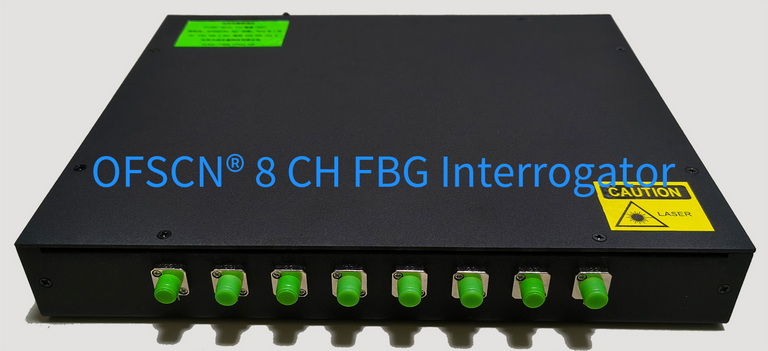
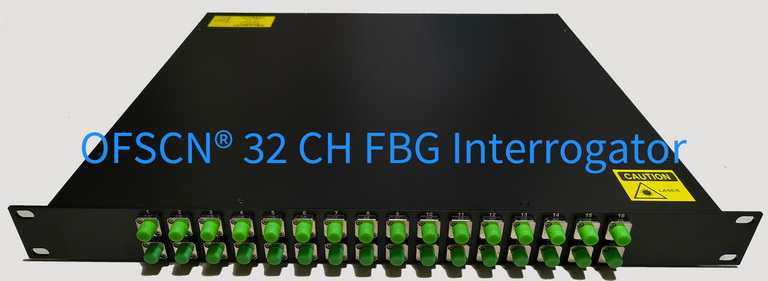
- OFSCN® Fiber Bragg Grating Interrogator: Channel counts available are 4, 8, 16, 32. Data sampling frequencies of 10 \text{ Hz}, 50 \text{ Hz}, 100 \text{ Hz} are optional, with a wavelength resolution of 1 \text{ pm} or 0.1 \text{ pm}. This equipment is designed for static and quasi-static monitoring of general structures. If used for vibration monitoring, its effective measurement upper limit is approximately 10 \text{ Hz} \sim 20 \text{ Hz}.