Why are encapsulated sensors placed in a high-temperature furnace to be
“baked” for dozens of hours?
Placing the encapsulated sensor in a high-temperature furnace to “bake” for tens of hours is a process known as High-Temperature Annealing in optical engineering and sensor manufacturing.
It is an indispensable core process in the manufacturing of high-quality Fiber Bragg Grating (FBG) sensors, primarily for the following two core physical and engineering reasons:
1. Releasing Residual Stress from Encapsulation (Stress Relaxation)
During the encapsulation of FBG sensors, various materials are typically used (e.g., fused silica optical fiber, seamless stainless steel protective sleeves, adhesives, or high-temperature solders). These materials have significantly different coefficients of thermal expansion (CTE). For instance, the CTE of stainless steel is much greater than that of fused silica optical fiber.
When the encapsulated sensor cools down after heating, curing, welding, or assembly, significant residual stresses are generated within the fiber and the sleeve due to inconsistent material shrinkage. If the sensor is put into use directly, these residual stresses will gradually release (relax) over time during subsequent temperature cycles, causing minor changes in the additional strain experienced by the grating region. This manifests macroscopically as long-term, uncertain drift in the sensor’s center wavelength \lambda_B , greatly reducing measurement accuracy. By baking in a high-temperature furnace for an extended period, the relaxation of the material’s molecular structure is accelerated, releasing these internal residual stresses completely, thereby ensuring long-term zero-point stability.
2. Stabilization of Grating Spectrum’s “Thermal Decay” (Grating Thermal Decay & Stabilization)
FBGs written by ultraviolet (UV) lithography are realized by introducing periodic refractive index modulation within the fiber core. At a microscopic level, this change in refractive index is caused by defects generated in the crystal lattice by UV light exposure, trapping electrons in different energy level traps.
In a high-temperature environment, some electrons trapped in shallow energy levels (unstable states) will escape due to the thermal energy gained. This causes the refractive index modulation depth of the grating to gradually decrease, physically manifesting as a reduction in grating reflectivity, a degradation in spectral quality, and a shift of the center wavelength \lambda_B towards shorter wavelengths, a phenomenon known as “Thermal Decay”.
To prevent such performance degradation during actual service, the sensor must undergo accelerated aging (Pre-aging). The annealing temperature is usually set in the range of 20\ ^\circ\text{C} to 50\ ^\circ\text{C} above the sensor’s rated operating temperature. Through these tens of hours of continuous high-temperature baking, unstable electrons in shallow energy levels are intentionally made to escape and recombine, leaving only the refractive index modulation in deep energy levels (highly stable states). After annealing, the grating will exhibit extremely high spectral and wavelength stability within the rated operating temperature range, with no further drift caused by grating degradation even after long-term service.
OFSCN®'s High-Temperature Annealing Practices and High-Stability Sensor Products
As a pioneer in high-quality Fiber Bragg Grating sensor technology, every FBG sensor produced by Beijing Dacheng Yongsheng Technology Co., Ltd. must undergo rigorous high-temperature annealing treatment and multi-cycle temperature stabilization calibration before leaving the factory, ensuring the product’s high stability and zero drift in various harsh industrial environments.
Here is a series of FBG temperature sensor products designed with different temperature gradients and manufactured through high-standard annealing processes:
- OFSCN® 300°C Fiber Bragg Grating Temperature Sensor
Encapsulated in a seamless stainless steel tube, using temperature-resistant polyimide fiber internally, with an operating temperature range of -200\ ^\circ\text{C} to 300\ ^\circ\text{C} . It undergoes long-term annealing before factory shipment to ensure stable wavelength output in a 300\ ^\circ\text{C} environment.

- OFSCN® 500°C Fiber Bragg Grating Temperature Sensor
Encapsulated using a single-layer seamless steel tube or a customized nested multi-layer seamless steel tube process, with a temperature resistance range of -200\ ^\circ\text{C} to 500\ ^\circ\text{C} . It is suitable for precision temperature monitoring in medium to high-temperature environments.
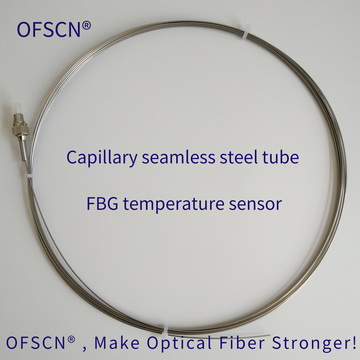
- OFSCN® 800°C Fiber Bragg Grating Temperature Sensor
Utilizes special materials and manufacturing processes, with a wide temperature measurement range from -270\ ^\circ\text{C} to 800\ ^\circ\text{C} . To cope with extreme ambient temperatures up to 800\ ^\circ\text{C} , this model requires a more rigorous and special high-temperature annealing process to completely address grating thermal degradation and structural stress release issues at ultra-high temperatures.