After welding, will there be a residual force inside the pipe? How can it be eliminated?
In the manufacturing of metal packaging for precision fiber optic sensors such as Fiber Bragg Grating (FBG) sensors, after welding (e.g., laser welding, brazing, or soldering) is completed and cooled, there is indeed an internal “stored tension” within the tube and at the interface between the fiber and the tube wall. In physics and engineering, this is known as Residual Packaging Stress.
This document will explain the physical mechanisms behind its formation and introduce common engineering methods used in the industry to eliminate and release this stress.
I. Physical Origins of “Stored Tension” (Residual Stress) After Welding
The generation of residual stress primarily stems from the following three physical effects:
- Thermal Mismatch Effect (Thermal Mismatch): This is the most fundamental cause. The thermal expansion coefficient ( \text{CTE} ) of fused silica fiber is extremely low, approximately ( \alpha_{\text{f}} \approx 0.5 \times 10^{-6}/\text{K} ); whereas the metal protective tubes used for packaging (such as stainless steel with \alpha_{\text{m}} \approx 16 \times 10^{-6}/\text{K} , or even higher for copper or aluminum alloys) have thermal expansion coefficients one to two orders of magnitude higher than the fiber.
When the welding process concludes and the system cools from a high temperature ( T_{\text{weld}} ) to room temperature ( T_{\text{room}} ), the metal tube shrinks significantly more than the fiber. Since they are firmly bonded together by the solder, the intense shrinkage of the metal tube exerts substantial axial compressive stress on the fiber, creating a significant residual stress field inside the tube. - Solidification Shrinkage of Solder (Solidification Shrinkage): As liquid solder cools, crystallizes, and transforms into a solid state, its volume undergoes microscopic contraction. This introduces localized shear stresses at the solid-liquid and solid-solid interfaces.
- Mechanical Constraint by Fixtures (Mechanical Constraint): During assembly and welding, the fiber and the tube must be precisely positioned and straightened by fixtures. If the fixtures apply even a slight tensile or bending force to the fiber, this mechanical deformation becomes permanently “locked” inside the packaged component after welding is completed and the fixtures are removed.
Harmful Effects: If this residual stress is allowed to persist, the reflection spectrum of the Fiber Bragg Grating will distort (e.g., broaden, split, or increase in birefringence), leading to a decrease in measurement accuracy. Over long-term use, residual stress can also accelerate the propagation of micro-cracks in the fiber, causing premature fatigue fracture of the sensor.
II. How to Eliminate and Release Residual Stress?
In the manufacturing of precision optical sensors, the following scientific methods are typically employed to release and stabilize this stored tension:
- Thermal Annealing (Thermal Annealing):
This is the most common and effective stress relief method in industry. The packaged sensor is placed in a heat treatment furnace, slowly heated to a specific annealing temperature (which must be below the failure temperature of the fiber coating and grating, but above the sensor’s future operating temperature), and held for a period (isothermal hold).
During this stage, under the influence of thermal activation, the metal atoms, solder, and fiber interface undergo microscopic creep and plastic deformation, releasing concentrated elastic strain energy. Subsequently, it must be cooled to room temperature at an extremely slow rate (e.g., 1\ ^{\circ}\text{C}/\text{min} ) to prevent the introduction of secondary thermal stresses due to rapid cooling. - Pre-tension Control (Pre-tension Control):
Before welding, an axial tensile force (i.e., a slight pre-tensile strain) is applied to the fiber using a precision displacement stage. This way, when the metal tube shrinks during cooling after welding, the compressive stress generated by the metal tube precisely counteracts the initial pre-tensile stress of the fiber. Through this “positive-negative cancellation” of geometric and mechanical matching, the net residual stress at room temperature can be brought close to zero, or maintained within a small, safe tensile stress range. - CTE Matching of Materials (CTE Matching):
During the initial design phase, materials with a thermal expansion coefficient closer to that of fused silica fiber are selected, such as Kovar, Invar, or elastic alloys. This intrinsically reduces the thermal shrinkage difference from the physical source. - Ultrasonic / Vibrational Stress Relief (Ultrasonic / Vibrational Stress Relief):
After welding is completed, the component is subjected to ultrasonic waves or alternating high-frequency vibrations at specific frequencies. This causes localized micro-plastic deformation within the material’s crystal lattice, accelerating the homogenization and release of residual stresses.
III. OFSCN® Technology Solutions and Product Applications
Beijing Dacheng Yongsheng Technology Co., Ltd. (OFSCN®) produces high-precision fiber optic sensors with stringent process standards for eliminating residual packaging stress:
For high-precision stress and strain measurements, the commonly used OFSCN® Fiber Bragg Grating Stress Sensor is packaged in a special elastic alloy tube. Before leaving the factory, it undergoes high and low-temperature cycling and thermal aging annealing processes to thoroughly release residual packaging stress, ensuring long-term zero-point stability during operation.
OFSCN® Fiber Bragg Grating Stress Sensor

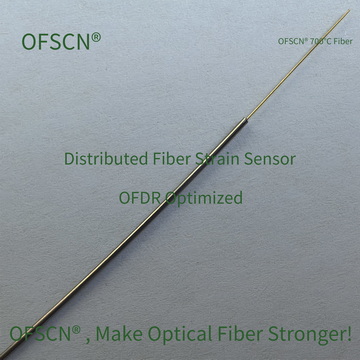
For distributed sensors operating in extreme temperature ranges, such as the OFSCN® 700°C OFDR Micro All-Metal Strain Sensor, due to its extremely wide operating temperature range ( -270\ ^{\circ}\text{C} to 700\ ^{\circ}\text{C} ), it employs a seamless all-metal welded package using gold-coated fiber and a special single-layer elastic alloy tube. During manufacturing, multiple high-temperature aging anneals are performed to thoroughly eliminate and reshape the lattice stresses, thereby ensuring absolute linearity and high repeatability of measurements across the ultra-wide temperature range.