Can I see temperature change records from a month ago, or even a year ago?
Yes. As long as your fiber optic sensing system has enabled data storage functionality, and the storage medium (such as a computer hard drive, server database, or cloud storage) retains data for the corresponding time period, you can retrieve and view temperature change records from a month ago, a year ago, or even several years ago at any time.
I. What is “Historical Data Query”?
Historical Data Query refers to the technical process by which a Fiber Bragg Grating (FBG) sensing monitoring system, through host computer software or a database management platform, retrieves, calls, and reproduces historical measurement data from the underlying storage medium according to specific time ranges (year/month/day/hour/minute/second), channel numbers, sensor measurement point IDs, or event trigger conditions.
In a fiber optic grating temperature measurement system, historical data typically includes two core categories:
- Raw physical quantity data: The central reflection wavelength data collected by the fiber optic grating demodulator (unit: \text{nm} or \text{pm}).
- Calibrated engineering data: The temperature value (unit: ^\circ\text{C}) obtained by the system software converting the wavelength in real-time, based on the sensor’s temperature calibration formula (usually a linear or quadratic equation, unit: ^\circ\text{C}/\text{pm}).
II. Implementation Mechanisms and Engineering Considerations for Long-Term Historical Data Recording
The key mechanisms that enable fiber optic grating sensing systems to achieve long-term data traceability for months or even years include:
- Timestamping:
Each set of spectral wavelength and temperature data collected by the demodulator is accompanied by a high-precision timestamp (microseconds/milliseconds), structured and written sequentially into a relational database (e.g., MySQL, SQL Server) or a time-series database (e.g., InfluxDB, TDengine), as well as log files. - Sampling Frequency and Storage Capacity Management:
- High-frequency acquisition (e.g., 10\ \text{Hz}, 50\ \text{Hz}, or 100\ \text{Hz}) generates a large amount of real-time data streams, typically used for short-term dynamic characteristic analysis.
- Long-term environmental or structural temperature monitoring usually adopts down-sampling storage (e.g., setting the recording frequency to 1\ \text{Hz}, one record per minute, or triggering storage only when the temperature change exceeds a threshold). This way, even with continuous operation for several years, the occupied storage space is extremely limited, facilitating millisecond-level rapid retrieval of historical curves.
- Data Presentation and Export:
The historical data query module typically provides functions for displaying temperature trend graphs over time, extreme value statistics (maximum temperature, minimum temperature, average temperature), historical over-temperature alarms, and exporting data into standard engineering reports like CSV/Excel.
III. Related Products and System Support
In the OFSCN® (Beijing Dacheng Yongsheng Technology Co., Ltd.) fiber optic grating sensing system, the interrogator and temperature sensors work together to support long-term temperature monitoring and historical data management:
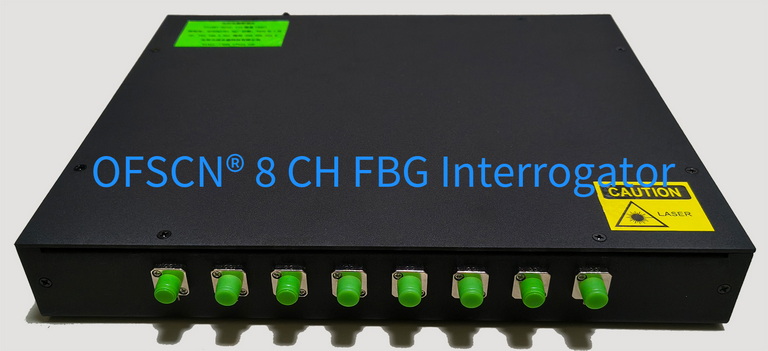
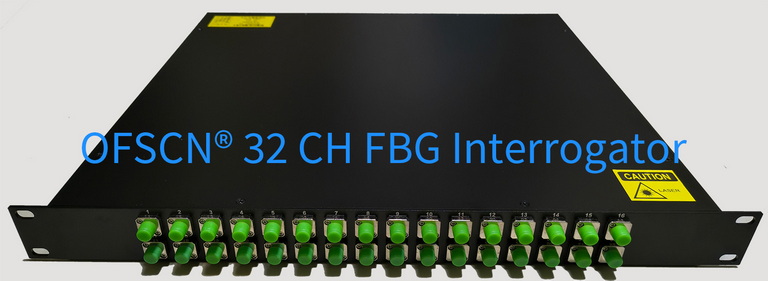
- OFSCN® Fiber Bragg Grating Interrogator:
The interrogator supports customized 4-channel, 8-channel, 16-channel, and 32-channel configurations. Sampling frequencies support 10\ \text{Hz}, 50\ \text{Hz}, and 100\ \text{Hz} (which can be reduced to a minimum of 1\ \text{Hz} via the supporting software for low-power and low-data-volume long-term recording). The system defaults to B/S or C/S architecture software, supporting seamless integration of real-time and historical data into third-party databases or management platforms via industrial protocols such as TCP, UDP, and Modbus.
- OFSCN® FBG Temperature Sensor Products Aggregation Link:
Provides seamless steel-pipe encapsulated temperature sensors covering -200\ ^\circ\text{C} to 800\ ^\circ\text{C}, featuring extremely high long-term wavelength stability and anti-drift capabilities, ensuring that historical data over a year or longer possesses reliable metrological comparability value.