Why are indoor optical cables generally softer? Do they have fire resistance requirements? OFSCN®
From the perspective of fiber engineering and physical structure design, the core of indoor optical cable design lies in meeting the wiring needs of complex and narrow spaces within buildings, while ensuring the safety of the building and personnel.
Here are the detailed technical answers to your two questions:
1. Why are indoor optical cables usually soft?
The softness (high flexibility) of indoor optical cables is determined by their application environment, structural design, and material selection:
-
Bending & Routing Requirements
During indoor cabling, optical cables frequently need to pass through right-angle corners, wall penetrations, narrow cable trays, or conduits. To enable the optical cable to adapt to extremely small bending radii without incurring significant bending loss or fiber breakage, its overall structure must remain highly flexible.
For instance, by using bend-insensitive fibers (such as fibers compliant with the G.657 standard), the minimum bending radius can be as small as r = 7.5\ \text{mm} or even smaller, whereas conventional G.652D single-mode fibers require a radius of r = 30\ \text{mm} or more. -
Differences in Strength Member Materials
- Outdoor Optical Cables: To withstand outdoor spans, hanging, tension, crushing, and harsh weather, they typically use extremely rigid strength members like thick steel wires, metallic armor layers, or thicker FRP (Fiber Reinforced Plastic), making outdoor cables very stiff.
- Indoor Optical Cables: Their tensile load is relatively small. They primarily use high tensile strength, low bending stiffness Aramid fibers (e.g., Kevlar) or glass yarns as core strength members. Aramid fibers possess extremely high tensile strength but are physically very soft, thus not restricting cable bending.
-
Outer Sheath Material Selection
Indoor optical cable outer sheaths do not require UV resistance or prolonged immersion in water. Therefore, they do not need to use high-hardness High-Density Polyethylene (HDPE) or similar materials commonly used outdoors. Instead, they utilize lower-hardness, highly elastic materials like Polyvinyl Chloride (PVC), Polyurethane (PU), or Low Smoke Zero Halogen (LSZH) polyolefins. -
Simplified Structure
Indoor optical cables omit the heavy protective structures commonly found in outdoor cables, such as water-blocking tapes, water-blocking gel, double-layer metallic armor, and moisture barriers. This results in a smaller size, lighter weight, and physically softer texture.
2. Do indoor optical cables have fire performance requirements?
Yes, indoor optical cables have extremely stringent fire performance and flame retardancy requirements.
Due to the enclosed spaces within buildings, if a fire occurs, optical cables laid along ventilation ducts and cable risers can easily become conduits for fire propagation. More critically, the dense smoke and toxic gases (such as acidic gases like hydrogen chloride and hydrogen fluoride) produced when traditional plastic materials burn are the primary causes of personnel suffocation and corrosive damage to sensitive electronic equipment.
Therefore, international and national standards impose strict classifications and definitions for the fire performance of indoor optical cables:
-
Low Smoke Zero Halogen (LSZH) Standard
LSZH sheath materials emit very little smoke when heated or burned and contain no toxic halogen elements. In the event of a fire, LSZH cables effectively maintain visibility in escape routes and prevent the generation of deadly acidic toxic gases. This is one of the most recommended fire safety standards for commercial and residential buildings. -
NEC (National Electrical Code) Fire Ratings
In the United States and some regions with similar standards, indoor optical cables are classified into different flame retardancy levels based on the safety level of the installation area:- OFNP (Plenum): The highest fire rating. Made from materials with high flame retardancy and minimal smoke generation when heated (e.g., fluoropolymers), suitable for use in plenum spaces (pressurized spaces above a suspended ceiling used for air circulation).
- OFNR (Riser): Suitable for vertical runs or risers between floors, effectively preventing the vertical spread of fire between floors. Its flame retardancy is slightly lower than OFNP.
- OFN / OFNG (General Purpose): Suitable for general horizontal cabling, providing basic flame retardancy.
-
Chinese National Standards (GB Standards)
China has strict classification and testing standards for the flame retardancy of cables and optical cables (e.g., GB/T 18380 specifies vertical burn test methods for single and bundled cables). Optical cables must pass the corresponding Class A, B, C, or D flame retardancy tests. In specific public buildings, the use of LSZH or higher flame-retardant class optical cables is mandated.
3. Related OFSCN® (Beijing Dacheng Yongsheng Technology Co., Ltd.) Products
OFSCN® (Beijing Dacheng Yongsheng Technology Co., Ltd.) manufactures various fiber optic cables and patch cords that meet standard indoor flexible cabling requirements and feature special protective designs for complex indoor environments:
1. Typical Indoor Flexible Cabling Structure
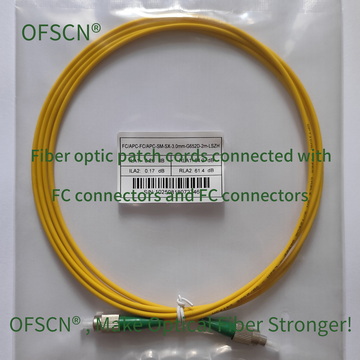
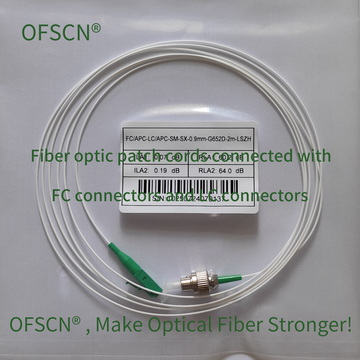
OFSCN® Standard Fiber Patch Cord is a typical indoor fiber optic patch cord. It consists of a PVC jacket, Kevlar® aramid fiber strength members, and a single-mode fiber, providing excellent tensile strength and superior flexibility, making it ideal for standard indoor connections and patch panel terminations.
2. Indoor Bend-Resistant Cabling Applications
For indoor cabling scenarios with more confined spaces and tighter corners, it is recommended to use OFSCN® G.657 Optical Fiber equipped with bend-insensitive fiber. This fiber maintains extremely low additional loss even under microbending conditions, ensuring the stability of high-speed signal transmission.

3. Applications Balancing Flexibility and Physical Protection
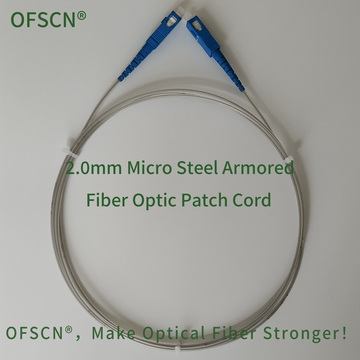
If the indoor cabling environment is prone to rodent damage or external crushing forces (e.g., under floors or exposed runs), the OFSCN® 2.0mm Micro Steel Armored Fiber Optic Patch Cord can be used. Beneath the PVC outer jacket, this product features a thin (0.6\ \text{mm}) seamless stainless steel tube (steel armor), which retains high flexibility and ease of bending while providing extremely strong resistance to side pressure and physical damage.