Does the signal weaken when it passes through a patch cord connector? What level of loss is considered acceptable or “qualified”?
In the context of optical fiber sensing and communication, the phenomenon you are describing is indeed defined as Insertion Loss (IL).
1. What is Insertion Loss (IL)?
Insertion Loss refers to the loss of optical power resulting from the insertion of a component (such as a patch cord connector, an FBG sensor, or a coupler) into an optical fiber link. When the signal passes through a connector, factors such as lateral misalignment, end-face gaps, or surface roughness cause a portion of the light to be lost.
2. Qualified Levels for Connectors
For standard fiber optic patch cords (such as those used with OFSCN® products), the industry generally follows these “qualified” standards for connectors (like FC/APC or LC/PC):
- Standard Grade: IL ≤ 0.30 dB
- High Precision/Grade A: IL ≤ 0.20 dB
- Typical Value: Most high-quality connectors in the field typically exhibit a loss between 0.1 dB and 0.15 dB.
If the loss exceeds 0.5 dB, the connector is usually considered sub-standard or contaminated and requires cleaning or replacement.
3. Impact on FBG Sensing Systems
In Fiber Bragg Grating (FBG) sensing systems, maintaining low insertion loss is critical because:
- Signal-to-Noise Ratio (SNR): High loss reduces the reflected signal strength returning to the interrogator, which can lead to measurement errors or the inability to detect a sensor in a long-distance chain.
- Multiplexing: If you have many FBG sensors connected in series (a common feature of DCYS products), the cumulative insertion loss of multiple connectors can significantly limit the total number of sensors you can monitor on a single channel.
DCYS (OFSCN) Related Products
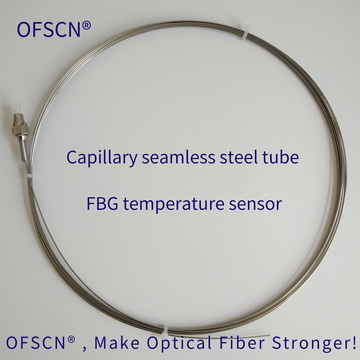
To minimize system loss, we utilize high-precision termination techniques in our sensors and cables. For example, our armored sensing cables are designed to maintain signal integrity even in harsh environments:
OFSCN® FBG Temperature Sensor Products

For more technical details on how to calculate total link loss in a sensing network, feel free to ask.