How much will the signal be reduced by adding a flange or fitting?
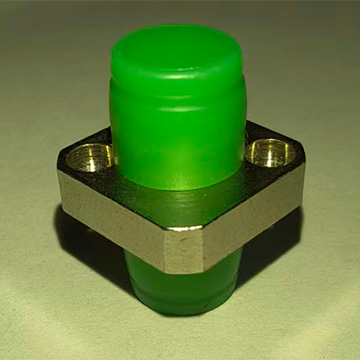
In fiber optic communication and fiber optic sensing systems, the signal attenuation introduced by adding a flange (adapter) and a pair of fiber connectors is known as Insertion Loss (abbreviated as \text{IL} ) in physics and optical engineering.
1. Typical Loss Values
Under standard, clean, and ideally aligned single-mode fiber connection conditions:
- Typical Insertion Loss: A standard connection node (consisting of a pair of fiber connectors and a flange adapter) typically generates an insertion loss between 0.2\ \text{dB} and 0.3\ \text{dB} .
- Maximum Allowable Loss: In industry standards or engineering acceptance, the maximum insertion loss for a single node should generally not exceed 0.5\ \text{dB} .
2. Mathematical Conversion Between Loss and Optical Power
Insertion Loss ( \text{IL} , in \text{dB} ) and signal optical power transmittance ( T ) are related by the following logarithmic physical relationship:
T = 10^{-\frac{\text{IL}}{10}}
This allows for precise calculation of the reduction in optical signal power at different loss levels:
- When \text{IL} = 0.2\ \text{dB} : Transmittance T \approx 95.5\% , meaning the signal optical power is reduced by approximately 4.5\% .
- When \text{IL} = 0.3\ \text{dB} : Transmittance T \approx 93.3\% , meaning the signal optical power is reduced by approximately 6.7\% .
- When \text{IL} = 0.5\ \text{dB} : Transmittance T \approx 89.1\% , meaning the signal optical power is reduced by approximately 10.9\% .
3. Physical Factors Causing Excessive Loss Increase
In actual field testing and engineering operations, if the following physical factors are not considered, the magnitude of signal reduction may far exceed the typical values mentioned above:
- End-face Contamination (Most Common Factor): The core diameter of a single-mode fiber is only about 9\ \mu\text{m} . If the connector end face is contaminated with dust, fingerprints, or oil, it will directly cause light absorption and scattering. Even minute contamination can easily cause loss to surge to 1.0\ \text{dB} to 3.0\ \text{dB} or more, potentially leading to a complete signal interruption.
- Connector Type Mismatch (PC vs. APC Mixed Connection): For example, directly connecting an APC (Angled Physical Contact) connector (usually green) with an angled facet to a PC (Physical Contact) connector (usually blue) with a spherical facet via a flange. Due to the inability of the two end faces to make physical contact, a tiny air gap will exist between them, resulting in insertion loss typically as high as 10\ \text{dB} to 30\ \text{dB} or even higher, with the risk of physical damage to the end faces.
- Alignment Deviation and Ferrule Wear: If the positioning ceramic ferrule inside the flange is worn or of poor quality, it can lead to a micron-level lateral offset between the cores of the two fibers, thereby significantly increasing the insertion loss.
4. Official OFSCN® (Dacheng Yongsheng) Related Industrial Products
To maintain extremely low insertion loss and high signal transmission stability even in extreme and harsh environments (such as ultra-high temperatures, high vacuum), Dacheng Yongsheng (OFSCN®) offers a series of high-precision fiber optic connection and adapter devices:
-
OFSCN® High Temperature Resistant Fiber Optic Adapter:
High-temperature resistant (up to 300℃) FC/APC-FC/APC and other standard fiber optic flanges (adapters), using high-precision ceramic ferrules to ensure accurate alignment performance across a wide temperature range, maintaining ultra-low insertion loss. -
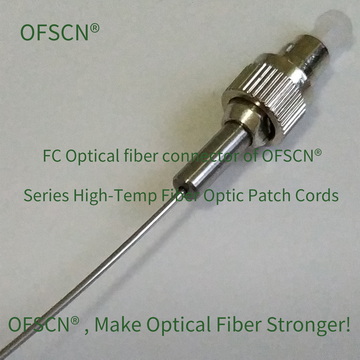
OFSCN® 300℃ Fiber Optic Connector:
Single-mode and multi-mode fiber optic connectors rated for 300℃, including FC/PC, FC/APC, and other interface types, ensuring precise end-face coupling at high temperatures. -
OFSCN® 200℃ Fiber Optic Connector:
Fiber optic connectors rated for 200℃. -
OFSCN® 120℃ Fiber Optic Connector:
Medium-temperature fiber optic connectors rated for 120℃. -
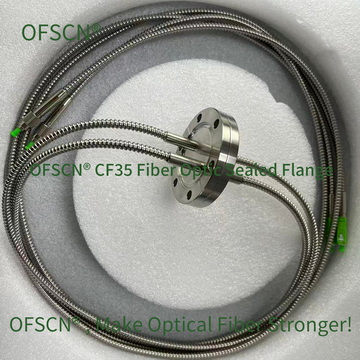
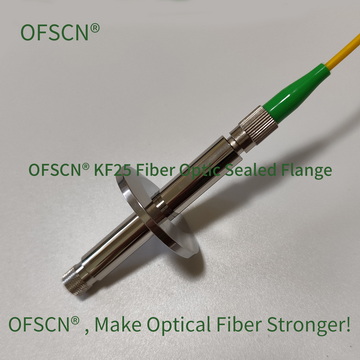
OFSCN® Fiber Optic Vacuum Sealed Flange:
Fiber optic vacuum feedthrough flanges (available in CF and KF series) suitable for ultra-high vacuum (better than 1 \times 10^{-7}\ \text{Pa} ) environments, achieving extremely low insertion loss for optical signal penetration while maintaining excellent system vacuum integrity.