Why is the accuracy of jumper length critical to the optical power budget in a sensing system?
In fiber optic sensing systems, the Length Precision of fiber optic patch cords holds crucial physical significance for the system’s Optical Power Budget and overall signal integrity.
Below is an analysis from an optical engineering and physical perspective, explaining why precise patch cord length is vital for the optical power budget:
1. Non-linear Control of Bending Loss
In practical engineering deployments, if patch cord length is not precisely customized and has excessive slack, the excess fiber must be coiled or bundled during installation. This introduces two types of severe non-linear loss:
- Macrobending Loss: If the coiling radius is smaller than the fiber’s critical bending radius, the fundamental mode (LP_{01}) energy leaks significantly into the cladding, causing a sharp decrease in optical power.
- Microbending Loss: When redundant fiber is subjected to local squeezing, mechanical vibration, or alternating environmental temperatures (causing protective jacket contraction), micron-level axis bends occur, leading to continuous and unpredictable microbending losses.
Through length customization, patch cords can be routed along the most rational and direct path, completely avoiding abnormal optical power loss due to the coiling of excess fiber and disordered bending, thereby ensuring the designed power budget is not eroded.
2. Precise Lock-in of Cumulative Attenuation
Optical fibers inherently possess intrinsic absorption and scattering losses (for instance, conventional single-mode fibers have an attenuation of approximately 0.2\,\text{dB/km} at the 1550\,\text{nm} wavelength, while special fibers or those in harsh environments may have higher attenuation coefficients).
- In multi-channel, cascaded sensing systems, or long-distance transmissions, if the actual length of each patch cord exceeds the designed expectation, the accumulated additional transmission loss will directly consume the marginal safety margin of the optical power budget.
- Precise length determination allows designers, at the outset of system establishment, to accurately simulate the intrinsic losses of the entire link, preventing the received optical power from falling below the demodulator’s sensitivity threshold due to cumulative length deviations.
3. Reflection Localization and Signal-to-Noise Ratio (SNR) Optimization in Time/Frequency Domain Sensing Systems
In distributed fiber optic sensing systems (such as OTDR, OFDR) or interferometric fiber optic sensing systems, the phase and time delay of the optical signal are closely related to the optical power budget:
- Time Delay Deviation and Crosstalk: Light propagates through silica fiber at a delay of approximately 5\,\text{ns/m}. If the patch cord length is imprecise, it will cause the time window of the sensing channel to drift in time-domain reflection localization, or even cause the reflected light pulses of adjacent channels to overlap in time.
- Equivalent Power Budget Degradation: The signal crosstalk and multipath interference resulting from this overlap significantly reduce the system’s signal-to-noise ratio (SNR). At the signal processing level, a reduction in SNR is equivalent to a substantial loss in the optical power budget.
4. Thermal Stress and Bending Control in Extreme Temperature Environments
In high or extremely low-temperature sensing environments, there are significant differences in the coefficients of thermal expansion (CTE) between the optical fiber and its protective jacket (such as stainless steel seamless tubes, armor layers, or coatings).
- If the patch cord length is excessive, during drastic temperature changes, redundant fiber will accumulate uneven mechanical stress inside or outside the protective tube, causing severe thermo-induced microbending losses.
- Precise length customization ensures the fiber is in a designed zero-stress or slightly tensile state within the specific packaging structure, maintaining constant optical transmittance across a wide temperature range.
OFSCN® Precise Length Customization Solution
Addressing the stringent requirements of fiber optic sensing systems for optical power budgets, OFSCN® offers ultra-high precision length-customized fiber optic patch cords covering conventional, high-strength, and extreme temperature environments. The length customization range extends from 10\,\text{cm} to hundreds of meters, effectively avoiding the risk of bending loss caused by excess length in the system:
-
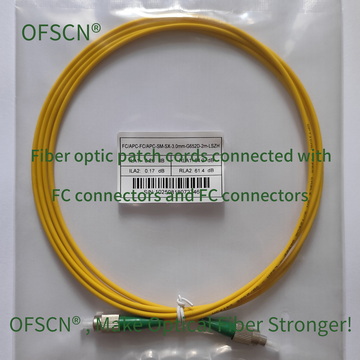
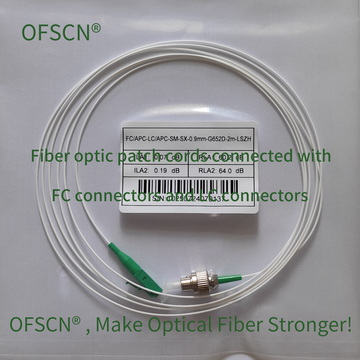
OFSCN® Standard Fiber Patch Cord
- Default length is 2 meters, supporting custom lengths from 10\,\text{cm} to hundreds of meters. It defaults to OFSCN® G.652D fiber, meeting the high-precision interconnect needs of conventional environments.
-
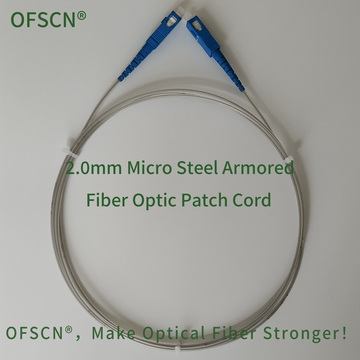
OFSCN® 2.0mm Micro Steel Armored Fiber Optic Patch Cord
- Features a built-in 0.6\,\text{mm} stainless steel seamless tube. Length can be precisely customized from 1\,\text{m} to hundreds of meters, providing high tensile strength while eliminating microbending risks caused by uncertain excess length.
-
High-Temperature Special Fiber Optic Patch Cord Series (High-Precision Length Customization)
- OFSCN® 120℃ Fiber Optic Patch Cord: Suitable for medium-temperature sensing environments.
- OFSCN® 200℃ Fiber Optic Patch Cord: Uses polyimide fiber, providing extremely stable optical power transmission from -200^\circ\text{C} to 200^\circ\text{C}.
- OFSCN® 300℃ Fiber Optic Patch Cord: Handles demanding environments from -270^\circ\text{C} to 300^\circ\text{C}.
- OFSCN® 700℃ Fiber Optic Patch Cord: Based on gold-plated fiber and stainless steel seamless tube encapsulation, ensuring extremely low attenuation at ultra-high temperatures.

By selecting custom patch cord lengths that perfectly match the physical spatial layout of the sensing system, designers can minimize unstable attenuation factors in the link, thereby allocating precious optical power budget to core sensing elements (such as FBG sensors or scattered light collection), significantly enhancing the system’s measurement accuracy and long-term reliability.