If the fiber breaks, can the software tell me approximately where it broke?
In fiber optic sensing and fiber optic communication systems, whether the software can determine the breakpoint location and its accuracy depends on the technical principles and topological architecture adopted by the system:
1. Fiber Bragg Grating (FBG) Sensing Systems: Section-Level Fault Localization
In conventional Wavelength Division Multiplexing (WDM)-based FBG systems, multiple fiber Bragg grating sensors with different reflection wavelengths (e.g., \lambda_1, \lambda_2, \dots, \lambda_n) are connected in series on the same fiber optic link.
- Diagnostic Principle: When the fiber experiences a physical break or optical path blockage at a certain point, the injected optical signal cannot reach the sensors beyond the breakpoint, and the reflected wavelength signals from all FBGs after the breakpoint are lost.
- Software Diagnostic Result: By real-time monitoring of the reflection spectrum and wavelength data from each measurement point, the demodulation software can quickly identify “the last sensor with a normal signal” and “the first sensor with a lost signal”.
- Localization Accuracy: The software can accurately inform which section between two adjacent sensor nodes the breakpoint is located in (section-level localization).
2. Distributed Fiber Optic Sensing / Link Testing (OTDR / OFDR): Meter- to Millimeter-Level Precision Localization
If the precise physical distance of the fracture point from the equipment front-end needs to be obtained (e.g., fractured at 128.5\text{ m}), time-domain or frequency-domain reflection measurement techniques are required:
- OTDR (Optical Time Domain Reflectometer): It transmits optical pulses and detects Rayleigh backscatter along the fiber and Fresnel reflections generated at the breakpoint. The breakpoint distance is calculated based on the round-trip time of light in the fiber (accuracy is typically in the meter or decimeter range).
- OFDR (Optical Frequency Domain Reflectometer): By using swept-frequency laser interferometry to measure fiber backscatter, it can achieve millimeter or even sub-millimeter breakpoint localization and strain distribution measurement within tens to hundreds of meters.
3. Link Monitoring for OFSCN® Devices and Systems
In industrial fiber Bragg grating sensing networks, the interrogator combined with monitoring software enables automated link health monitoring:
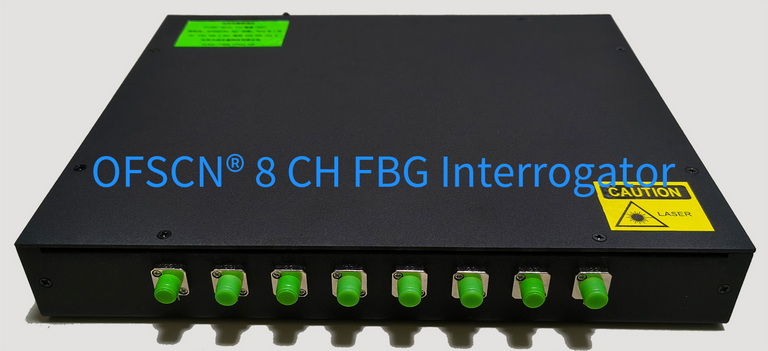
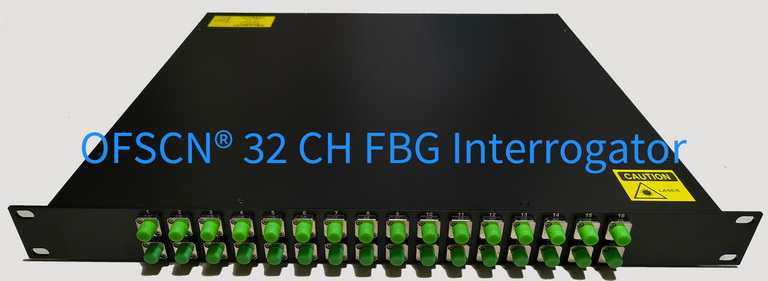
- The OFSCN® Fiber Bragg Grating Interrogator supports multi-channel (4, 8, 16, or 32 channels optional) parallel acquisition, with a wavelength range covering 1525\text{ nm} to 1565\text{ nm} (or 1528\text{ nm} to 1568\text{ nm}). The sampling frequency can be configured within the range of 1\text{ Hz} to 100\text{ Hz}. The software, based on network communication (B/S or C/S architecture), tracks the wavelength status of all channels in real-time. When fiber damage or breakage occurs, the system immediately triggers an offline alarm for the measurement point and precisely locates the section where the fault is.