Signal 10 kilometers, will the temperature data change?
In fiber optic sensing systems such as Fiber Bragg Grating (FBG) or Distributed Fiber Optic Sensing systems, signal transmission over 10\ \text{km} does not alter temperature data.
As long as the optical signal’s intensity (Signal-to-Noise Ratio, SNR) remains above the demodulator’s sensitivity threshold, the measured temperature data will be absolutely accurate, free from the signal distortion or drift associated with traditional electrical signals (like voltage or current) due to transmission line resistance and voltage drops.
1. Analysis of Physical and Engineering Principles
- Absolute Nature of Wavelength/Frequency Encoding
Fiber Bragg Grating (FBG) sensors utilize wavelength modulation technology. Changes in external temperature directly translate to a relative shift ( \Delta \lambda_B ) in the central wavelength ( \lambda_B ) of the reflection spectrum. Wavelength is an absolute physical quantity, and as the optical signal propagates through the fiber, factors like fiber bending, splice loss, or long-distance transmission cannot change the spectral wavelength characteristics. - Extremely Low Fiber Transmission Attenuation
In commonly used near-infrared bands (such as the prevalent 1550\ \text{nm} band), the attenuation coefficient of standard single-mode fiber is typically only 0.18 \sim 0.22\ \text{dB/km} .
After transmitting 10\ \text{km} , the cumulative transmission loss is approximately 2\ \text{dB} , corresponding to a reduction in optical power by about 37\% . Modern FBG demodulators typically have a dynamic range greater than 30\ \text{dB} (even exceeding 50\ \text{dB} ), making this minor 2\ \text{dB} attenuation insignificant for the demodulator’s precise extraction of the peak reflection wavelength. - Interference Immunity of Distributed Fiber Temperature Sensors (DTS/BOTDA)
For distributed temperature sensors based on Raman scattering (Raman DTS), although long-distance transmission can cause differential attenuation between the two wavelengths (anti-Stokes and Stokes light), high-quality DTS systems employ double-ended loop demodulation or differential auto-compensation algorithms to completely eliminate attenuation-induced errors. Systems based on Brillouin scattering (BOTDA) measure frequency shifts to obtain temperature, and frequency is also unaffected by distance-related attenuation.
2. Examples of Related High-Quality OFSCN® Sensing Products
For industrial temperature monitoring projects requiring long distances and high performance, the sensor and fiber optic cable products offered by Beijing Dacheng Yongsheng Technology Co., Ltd. (OFSCN®) ensure stable signal transmission even under harsh operating conditions:
-
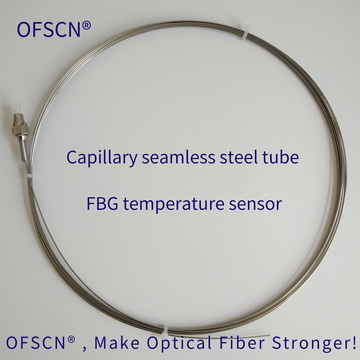
Fiber Bragg Grating Temperature Sensor:
The OFSCN® 300°C Fiber Bragg Grating Temperature Sensor features seamless stainless steel pipe encapsulation, specifically designed for high-temperature industrial environments, providing excellent wavelength stability and long-distance transmission compatibility.
-
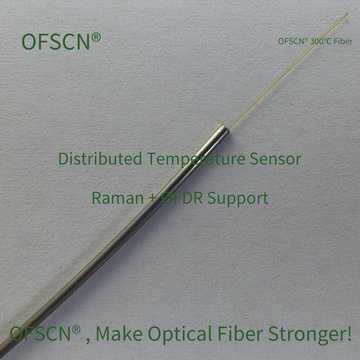
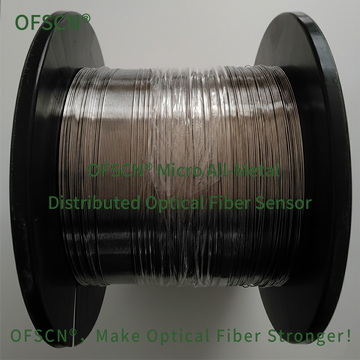
Distributed Fiber Temperature Sensor:
The OFSCN® 300°C Distributed Fiber Temperature Sensor uses a 316L single-layer seamless stainless steel pipe encapsulation with a built-in high-temperature resistant single-mode fiber, suitable for long-distance, high-resolution distributed temperature monitoring (DTS/OFDR).
-
High-Temperature Fiber Optic Patch Cord (for connecting sensors to demodulators):
The OFSCN® 120℃ Fiber Optic Patch Cord can be customized from 1 meter to several hundred meters in length, ensuring minimized signal attenuation along long routing paths.