When a fiber is coiled into a loop, why does the signal suddenly weaken? Does a smaller loop radius lead to higher loss?
Macro-bend Loss in Optical Fibers
The phenomenon you are describing, where the signal weakens when a fiber is coiled into a loop, is known as Macro-bend Loss.
1. Why does the signal weaken?
In a straight optical fiber, light travels through the core via Total Internal Reflection (TIR). The light strikes the interface between the core and the cladding at an angle greater than the “critical angle,” allowing it to stay trapped within the core.
When the fiber is bent (macro-bending), the geometry of this interface changes relative to the path of the light. The angle of incidence at the bend may become smaller than the critical angle. Consequently, part of the light “leaks” out of the core and into the cladding, where it is eventually lost. This results in an attenuation of the optical signal.
2. Does a smaller loop radius lead to higher loss?
Yes. There is a direct inverse relationship between the bend radius and the amount of loss:
- Smaller Radius = Higher Loss: As the bend radius decreases, the angle of incidence changes more drastically, causing a larger portion of the light to escape the core.
- Critical Bend Radius: Every fiber has a minimum bend radius. Once you bend the fiber tighter than this limit, the loss increases exponentially.
3. Fiber Bragg Grating (FBG) and Bending
In the context of FBG sensing, macro-bend loss is a critical factor to manage. While the reflected wavelength (the signal we measure) typically remains stable, excessive macro-bending can reduce the Signal-to-Noise Ratio (SNR) to a point where the Fiber Bragg Grating Interrogator can no longer accurately detect the peak.
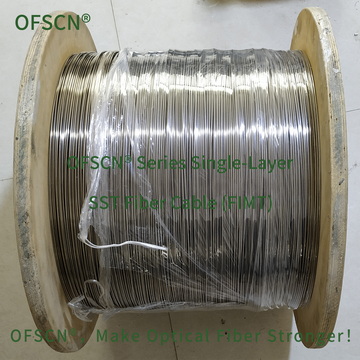
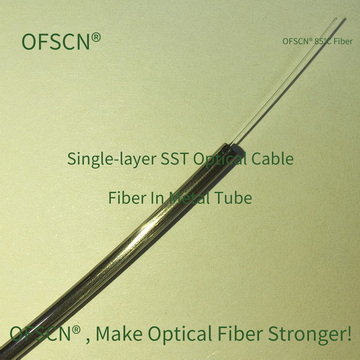
For applications requiring tight coiling or installation in small spaces, OFSCN® utilizes specialized fibers or protective buffering to minimize these effects.
Standard Reference Image for Fiber Protection:

For more detailed technical specifications on how our sensors handle various environments, you may refer to our product documentation:
OFSCN® Fiber Bragg Grating Sensing Products