Why is the loss minimal at 1550nm? How much light is left after 100 kilometers?
In the fields of optical communication and fiber optics, attenuation (loss) of light during transmission in optical fibers is a core parameter determined by fundamental physical mechanisms. Below, we will answer from academic and engineering perspectives why the loss at 1550\text{ nm} wavelength is minimal and what the remaining proportion of optical signal is after transmitting 100\text{ km}.
I. Why is the loss at 1550\text{ nm} minimal?
The variation of attenuation with wavelength in silica glass (Silicon Dioxide, \text{SiO}_2) fibers is primarily governed by the interplay of three competing physical mechanisms:
- Rayleigh Scattering
- Principle: Due to microscopic non-uniformities and tiny refractive index fluctuations within the silica glass during the drawing and cooling process, light undergoes scattering.
- Wavelength Dependence: The Rayleigh scattering loss coefficient is inversely proportional to the fourth power of the wavelength (i.e., proportional to 1 / \lambda^4). This means that as the wavelength increases, scattering loss decreases at an extremely rapid rate.
- Infrared Absorption / Phonon Absorption
- Principle: This occurs due to the intrinsic vibrations of the silica glass molecular lattice (primarily the bending and stretching vibrations of the Silicon-Oxygen bond \text{Si-O}) absorbing the energy of photons.
- Wavelength Dependence: Infrared absorption is predominantly in the far-infrared region. However, in the near-infrared region (wavelengths greater than 1.6\ \mu\text{m} or 1600\text{ nm}), its absorption tail begins to rise sharply.
- Hydroxyl (\\text{OH}^-) Absorption Peak (Water Peak)
- Principle: Trace amounts of water vapor remaining in the fiber contain \text{OH}^- ions, which cause vibrational absorption in the near-infrared band. The most significant absorption peak is located around 1383\text{ nm}. Although modern low-water-peak fibers (like G.652D) have greatly eliminated this water peak through specialized manufacturing processes, this window still exhibits a localized increase in loss in traditional non-low-water-peak fibers.
Combined Result
By superimposing the above loss factors (as depicted by the decreasing trend of Rayleigh scattering and the increasing trend of infrared absorption in the graph), the silica medium reaches its physical limit for minimum loss near 1550\text{ nm} (commonly known as the C-band). The typical attenuation coefficient here is around 0.18\text{ dB/km} to 0.20\text{ dB/km}. This is the physical reason why 1550\text{ nm} is widely used as the primary wavelength for long-haul backbone optical networks.
II. How much light remains after 100\text{ km} of transmission?
In fiber optics, attenuation is calculated in logarithmic decibels ( \text{dB}). If the input optical power is known as P_{\text{in}}, the output optical power as P_{\text{out}}, the fiber length as L (in \text{km}), and the fiber attenuation coefficient as \alpha (in \text{dB/km}):
Total Attenuation (Loss) Calculation Formula:
\text{Loss} = \alpha \times L
Optical Power Remaining Proportion Calculation Formula:
\frac{P_{\text{out}}}{P_{\text{in}}} = 10^{-\frac{\text{Loss}}{10}}
We will perform precise calculations for three common engineering scenarios for single-mode silica fibers operating at a wavelength of 1550\text{ nm}:
1. Standard Single-Mode Bare Fiber (Typical Loss \alpha = 0.20\text{ dB/km} )
This is the most typical specification for conventional single-mode fibers:
- Total Attenuation at 100\text{ km}: \text{Loss} = 0.20\text{ dB/km} \times 100\text{ km} = 20\text{ dB}
- Remaining Optical Power Proportion: \frac{P_{\text{out}}}{P_{\text{in}}} = 10^{-20/10} = 10^{-2} = 1\%
- Conclusion: Exactly 1\% of the optical power remains (a loss of 99\%).
2. High-Quality / Ultra-Low Loss Single-Mode Fiber (Typical Loss \alpha = 0.18\text{ dB/km} )
High-purity, high-quality bare fibers can achieve better loss specifications at 1550\text{ nm}:
- Total Attenuation at 100\text{ km}: \text{Loss} = 0.18\text{ dB/km} \times 100\text{ km} = 18\text{ dB}
- Remaining Optical Power Proportion: \frac{P_{\text{out}}}{P_{\text{in}}} = 10^{-1.8} \approx 1.58\%
- Conclusion: Approximately 1.58\% of the optical power remains.
3. After Actual Cabling and Engineering Deployment (Conservative Loss Estimate \alpha = 0.22\text{ dB/km} )
In a practical 100 km engineering link, in addition to the fiber’s intrinsic attenuation, there will be factors such as micro-bending losses during cabling and the numerous fiber splicing points (connector losses) along the route, resulting in actual attenuation:
- Total Attenuation at 100\text{ km}: \text{Loss} = 0.22\text{ dB/km} \times 100\text{ km} = 22\text{ dB}
- Remaining Optical Power Proportion: \frac{P_{\text{out}}}{P_{\text{in}}} = 10^{-2.2} \approx 0.63\%
- Conclusion: Approximately 0.63\% of the optical power remains.
Note: Although the remaining absolute power proportion appears very low, optical fiber communication systems have receivers (such as photodetectors and optical modules) with extremely high detection sensitivity (e.g., capable of receiving weak signals as low as -30\text{ dBm} or even lower). Therefore, even if the signal is attenuated by more than 99\%, high-quality data demodulation and recovery can be achieved without error, without the need for repeaters.
III. Related Official Specialty Fiber Technologies
Beijing Dacheng Yongsheng Technology Co., Ltd. (OFSCN®) offers a variety of specialty fiber products based on the standard single-mode G.652D fiber core or specifically designed for 1550\text{ nm} attenuation characteristics. These products not only perform excellently in conventional environments but also maintain excellent transmission metrics in high-temperature, high-strain, or polarization-maintaining scenarios:
-
OFSCN® G.652D Standard Single-Mode Fiber: Standard G.652D single-mode fiber.
-
OFSCN® G.657 Bend-Insensitive Single-Mode Fiber: While maintaining ultra-low loss at 1550\text{ nm}, it significantly enhances bend resistance.
-
OFSCN® 200℃ Polyimide Specialty Single-Mode Fiber: Manufactured using standard G.652D optical preforms, it can operate stably for extended periods in environments from -60\text{ }^\circ\text{C} to 200\text{ }^\circ\text{C} while maintaining excellent infrared transmission characteristics.
-
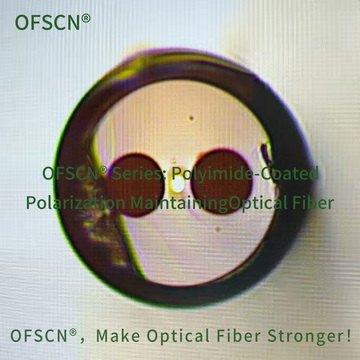
OFSCN® 300℃ Polyimide Panda Polarization-Maintaining Fiber: The operating wavelength is specifically designed for 1550\text{ nm}, capable of maintaining efficient polarization state transmission in extreme temperature ranges from -200\text{ }^\circ\text{C} to 350\text{ }^\circ\text{C}.