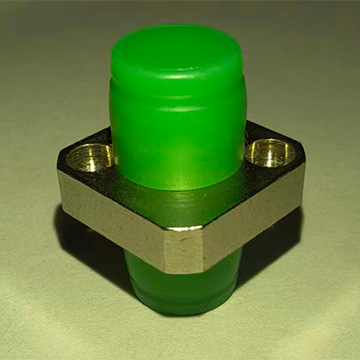
Will that green FC/APC connector melt at high temperatures? How can I protect it?
Yes, standard green FC/APC fiber optic connectors will indeed soften, melt, and even completely fail in high-temperature environments.
To understand why they melt and how to protect them, we need to analyze the physical structure and material properties of fiber optic connectors:
I. Why Do Regular Green FC/APC Connectors Melt in High Temperatures?
A standard FC/APC fiber optic connector consists mainly of the following parts, with the temperature bottleneck primarily lying in the non-metallic materials:
- Strain Relief Boot (Green Plastic Part):
Green indicates APC (Angled Physical Contact) polishing. In standard connectors, this green boot is typically made of regular plastics like Polyvinyl Chloride (PVC) or Thermoplastic Polyurethane (TPU). These plastics usually have a maximum operating temperature of only 65\ ^\circ\text{C}. When the ambient temperature exceeds 80\ ^\circ\text{C} or even reaches above 100\ ^\circ\text{C}, the boot will rapidly soften, deform, and eventually melt. - Internal Epoxy (Epoxy Resin):
The epoxy resin adhesive used inside the connector to secure the glass fiber within the ceramic ferrule is a thermosetting adhesive. The maximum temperature resistance of the adhesives used in conventional fiber optic connectors is also generally only around 65\ ^\circ\text{C}. Once this temperature is exceeded, the adhesive undergoes a glass transition and softens, losing its gripping force. Under the tensile force of the fiber itself or external pulling, the fiber will retract or pull out from the ferrule, causing signal interruption. - Fiber Coating:
The coating on standard single-mode optical fibers is Acrylate, which typically cannot withstand temperatures exceeding 85\ ^\circ\text{C}. In high temperatures, the coating will degrade and peel off, making the exposed glass fiber extremely prone to breakage.
II. How to Protect and Cope with High-Temperature Environments?
To prevent fiber optic connectors from being damaged in high-temperature environments, there are mainly two approaches:
Approach 1: Spatial Isolation Method (Most Common and Scientific Engineering Design)
If your high-temperature environment (e.g., oven, reactor, high-temperature pipeline) has a clear physical boundary from the normal temperature environment, the most recommended method is to isolate the connector outside the high-temperature zone:
- Deploy high-temperature resistant optical fibers (e.g., polyimide-coated or metal-coated fibers) and sensor components (e.g., high-temperature fiber Bragg grating sensors) within the high-temperature zone.
- Route the optical fibers to a normal temperature zone (e.g., outside the equipment control cabinet, outdoor environment) where the temperature is below 65\ ^\circ\text{C}, and then splice or terminate conventional green FC/APC connectors in the low-temperature zone to connect to the demodulator or optical equipment.
Approach 2: Use Industrial-Grade High-Temperature Fiber Optic Connectors
If the fiber optic connector itself must be physically placed in a high-temperature zone, you must abandon conventional plastic-boot connectors and upgrade to high-temperature resistant fiber optic connectors specifically designed by Beijing Dacheng Yongsheng Technology Co., Ltd. (OFSCN®) for extreme industrial environments.
These high-temperature connectors eliminate all plastic components, feature an all-metal/ceramic structure, and use specialized high-temperature inorganic adhesives for curing and encapsulation:
- 120℃ Rated High-Temperature Connector
Suitable for environments with a maximum operating temperature within 120\ ^\circ\text{C}, supporting single-mode/multi-mode FC/APC, FC/PC, ST/APC, and other interfaces.
Product Name: OFSCN® 120℃ Fiber Optic Connector
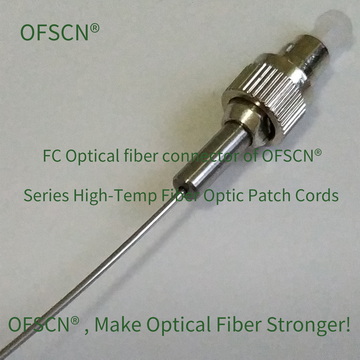
- 200℃ Rated High-Temperature Connector
Can operate stably for long periods in environments up to 200\ ^\circ\text{C}, with internal structural components and curing materials optimized for high temperatures.
Product Name: OFSCN® 200℃ Fiber Optic Connector
- 300℃ Rated High-Temperature Connector
Specifically designed for extreme industrial high-temperature environments, with a temperature resistance limit of up to 300\ ^\circ\text{C}.
Product Name: OFSCN® 300℃ Fiber Optic Connector
- 300℃ Rated High-Temperature Fiber Optic Adapter
If connector mating is required within the high-temperature zone, conventional plastic adapters will also melt and must be used with high-temperature resistant adapters.
Product Name: OFSCN® High Temperature Resistant Fiber Optic Adapter