Under high-power lasers, if the end face is oily, will the connector really “smoke”?
In high-power laser transmission engineering, if the fiber optic end face has oil stains, dust, or fingerprint residues, the fiber optic connector will genuinely “smoke,” and may even undergo instantaneous thermal melting, charring, and complete damage. This phenomenon is known as “End-face Thermal Damage” or “Optical Fiber End-face Burning” in optics and laser engineering.
I. Analysis of Physical Mechanisms: Why Do Oil Stains Cause Smoking and Burning?
-
Extremely High Local Optical Power Density
The cross-sectional area of a fiber’s core is extremely small. For example, a common single-mode fiber has a core diameter of only about 9\ \mu\text{m} and a mode field area A_{\text{eff}} \approx 60\ \mu\text{m}^2 to 80\ \mu\text{m}^2 . When the transmitted laser power reaches several watts ( \text{W} ), tens of watts, or even higher (such as kilowatt-class industrial lasers), the optical power density in the end face core area can easily reach 10^5\ \text{W/cm}^2 to 10^7\ \text{W/cm}^2 or more. -
Strong Light Absorption and Intense Local Heating
Silicon dioxide (fused silica glass) has extremely low absorption at common near-infrared laser wavelengths (such as 1064\text{nm} or 1550\text{nm} ). However, organic oil stains, grease, or dust particles have a very high light absorption coefficient for laser wavelengths. When high-power lasers pass through a contaminated end face, the energy is instantly absorbed by the contaminant and rapidly converted into heat. -
Thermal Pyrolysis and Gasification (The “Smoking” Phenomenon)
After absorbing laser heat, the contaminant’s temperature rapidly rises to hundreds or even thousands of degrees Celsius ( > 500\ ^\circ\text{C} ) within milliseconds ( \text{ms} ) or even microseconds ( \mu\text{s} ). The organic compounds in the oil stains undergo pyrolysis and carbonization, producing volatile gases and smoke, which is observed as smoking at the connector. -
Thermal Runaway and Damage to the Fused Silica End Face
The black residue formed after the oil stain’s thermal decomposition and carbonization has a higher absorption rate for the laser, triggering a positive feedback loop of “thermal runaway.” When the local temperature exceeds the softening and melting point of fused silica glass (approximately 1700\ ^\circ\text{C} ), the fiber core end face will undergo melting, pitting, or cracking. In severe cases, it can even induce the “Fiber Fuse” effect, causing melting to propagate backward along the fiber core.
II. Engineering Protection and General Product Information
To prevent high-power laser end face burnout, rigorous end face inspection and cleaning (e.g., using isopropyl alcohol, lint-free wipes, or dry cleaning pens) must be implemented in optical engineering.
Technical Note: Tools such as specialized fiber optic end face cleaning pens, cleaning papers, and end face microscopes are general optical maintenance tools and are not part of Beijing Dacheng Yongsheng Technology Co., Ltd.'s (OFSCN®) core product line.
Beijing Dacheng Yongsheng Technology Co., Ltd. (OFSCN®) focuses on the research, development, and production of high-temperature resistant fiber optics, connectors, and patch cords for harsh environments. For industrial and sensing scenarios involving high heat and extreme temperatures, relevant official products include:
-
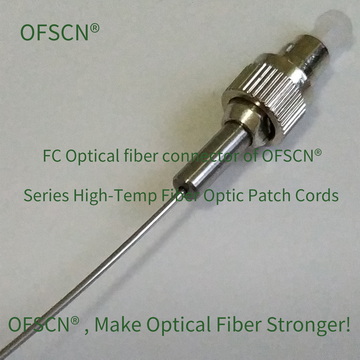
OFSCN® 300℃ Fiber Optic Connector: Utilizes a high-temperature resistant metal structure and ceramic ferrule to maintain mechanical stability in extreme temperature environments.
-
OFSCN® 300℃ Fiber Optic Patch Cord: Features a seamless steel tube protection and high-temperature resistant polyimide fiber, suitable for optical signal transmission and sensor connections in high ambient temperature conditions.