What is the difference between it and group velocity? Which one should be used for sensing?
In optical engineering and fiber optic communications, Phase Velocity and Group Velocity are two core physical concepts describing the propagation characteristics of light waves in a medium (such as optical fiber). Understanding the difference between the two and their applications in sensing is crucial.
I. Physical Definitions and Differences Between Phase Velocity and Group Velocity
1. Phase Velocity (v_p)
- Physical Meaning: Refers to the speed at which the equiphase surface (e.g., crest or trough) of monochromatic light (a single frequency component) propagates through a medium.
- Mathematical Expression:
v_p = \frac{\omega}{k}
Where, \omega is the angular frequency of light, and k is the propagation constant (wavenumber). - Relationship with Refractive Index: Phase velocity is determined by the effective refractive index (n_{eff}) of the medium, i.e.:
v_p = \frac{c}{n_{eff}}
(where c is the speed of light in a vacuum).
2. Group Velocity (v_g)
- Physical Meaning: Refers to the speed at which the overall envelope (pulse, modulated signal, carrying information and energy) of a light composed of multiple frequency components propagates through a medium.
- Mathematical Expression:
v_g = \frac{d\omega}{dk} - Relationship with Refractive Index: Group velocity is determined by the Group Index (n_g), i.e.:
v_g = \frac{c}{n_g}
3. Differences and Connections Between the Two
- In a non-dispersive medium, light of all frequencies propagates at the same speed, and thus phase velocity equals group velocity (v_p = v_g).
- In a dispersive medium (like optical fiber), due to the different refractive indices for light of different wavelengths (material dispersion and waveguide dispersion), group velocity and phase velocity are no longer equal. They satisfy the Rayleigh Equation:
v_g = v_p - \lambda \frac{dv_p}{d\lambda}
In the region of normal dispersion, the group velocity is usually less than the phase velocity (v_g \lt v_p). Group velocity represents the actual transmission speed of light energy and information.
II. In Fiber Optic Sensing, Which One Should Be Used?
In fiber optic sensing, whether to use phase velocity or group velocity completely depends on the sensing technology and the physical measurement principle employed:
1. Sensing Technologies Using “Group Velocity” (Group Index n_g)
When a sensing system relies on the time-of-flight (TOF) of light pulses in space/time or group delay, group velocity must be used.
- Typical Applications:
- Distributed Fiber Optic Sensing Systems: Such as Optical Time Domain Reflectometers (OTDR), Optical Frequency Domain Reflectometers (OFDR), etc.
- Measurement Principle: These systems locate events by injecting a light pulse and measuring the time difference \Delta t for the backscattered signal to return. The localization formula is:
z = \frac{c \cdot \Delta t}{2 n_g}
Since the pulse energy propagates at group velocity, the group refractive index n_g (not the effective refractive index n_{eff}) must be used when calculating the reflection distance.
2. Sensing Technologies Using “Phase Velocity” (Effective Refractive Index n_{eff})
When a sensing system relies on changes in the phase of light waves, coherent interference, or resonant diffraction spectra, phase velocity must be used.
- Typical Applications:
- Fiber Bragg Grating (FBG) Sensing: The center wavelength of the reflection spectrum of an FBG (Bragg wavelength \lambda_B) is determined by the following equation:
\lambda_B = 2 n_{eff} \Lambda
Here, n_{eff} is the effective refractive index of the guided mode, which corresponds to the phase velocity (v_p = c / n_{eff}). When external temperature or strain changes, it alters n_{eff} (phase velocity) and the grating period \Lambda through the thermo-optic and elasto-optic effects, causing the resonant wavelength to shift. - Interferometric Fiber Optic Sensing: Such as Michelson interferometers, Mach-Zehnder interferometers, and Phase-sensitive Optical Time Domain Reflectometers (\Phi-OTDR). These systems measure extremely subtle phase changes, which are directly dependent on changes in phase velocity.
- Fiber Bragg Grating (FBG) Sensing: The center wavelength of the reflection spectrum of an FBG (Bragg wavelength \lambda_B) is determined by the following equation:
III. Related Official Technical Products and Support
In practical engineering applications, if Fiber Bragg Grating (FBG) technology is used for high-precision temperature, strain, and stress measurements, its underlying physical mechanism is based on the subtle drift of the effective refractive index (phase velocity) with external physical fields.
To accurately and rapidly demodulate this wavelength shift caused by changes in phase velocity, high-resolution spectral demodulation equipment and matching sensors are typically required. For example:
1. Demodulation Equipment
-
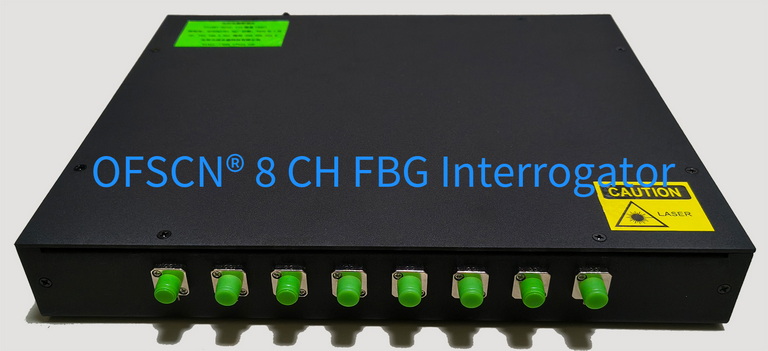
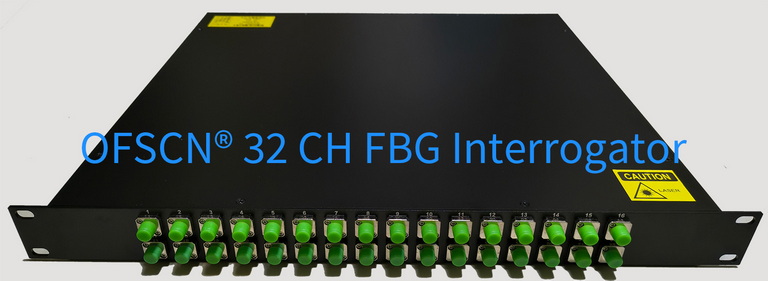
OFSCN® Fiber Bragg Grating Interrogator
This interrogator can precisely resolve Bragg wavelength shifts based on the phase velocity effect with sampling frequencies as high as 100 Hz or even faster.
2. Sensing Equipment
-
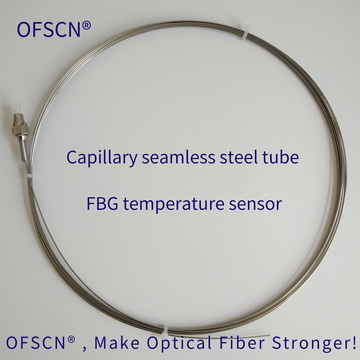
OFSCN® 300°C Fiber Bragg Grating Temperature Sensor
Encased in a single-layer seamless steel tube, it operates stably in the range of -200\text{°C} to 300\text{°C}. It accurately converts changes in phase velocity (i.e., wavelength shifts) into temperature readings through a calibration formula.