When shaking the jumper, does the signal experience jitter?
When the fiber optic jumper is shaken, signal jitter in both transmitted and reflected signals does indeed occur. The degree of jitter and its specific manifestation depend on the physical dimension being measured by the system (optical power dimension or wavelength dimension) and the system’s polarization sensitivity.
From the perspective of optical engineering and physical mechanisms, the phenomenon primarily involves the following key mechanisms:
I. Core Physical Mechanisms: Why Does Jiggling a Jumper Cause Signal Jitter?
1. The Photoelastic Effect and Random Drift of Polarization State (SOP)
Standard single-mode fibers (e.g., G.652D or G.657) are ideally isotropic. However, due to minute geometric ellipticity and residual stress from the manufacturing process, a subtle intrinsic birefringence always exists within the fiber core.
When the jumper is subjected to bending, shaking, or twisting, the fiber experiences mechanical strain. Through the Photoelastic Effect, this strain alters the refractive index distribution along different directions within the fiber, leading to rapid changes in the magnitude and orientation of the local birefringence. This causes the State of Polarization (SOP) of the light wave to drift randomly and rapidly on the Poincaré Sphere during transmission.
2. Polarization-Dependent Loss (PDL) Converted into “Optical Intensity Jitter”
Optical fiber links and instruments inevitably contain passive optical components that exhibit Polarization-Dependent Loss (PDL) or polarization sensitivity (such as fiber connectors, circulators, couplers, splitters, detectors, etc.).
As the SOP of the incident light changes drastically due to shaking, the insertion loss varies differently for each polarization state at these components. This directly translates the drift in polarization state into jitter in optical power/amplitude. On an oscilloscope or in optical power monitoring, noticeable fluctuations in intensity amplitude are typically observed.
3. Impact on Wavelength Demodulation of Fiber Bragg Gratings (FBGs)
In FBG sensing systems based on wavelength encoding, signals are inherently immune to intensity fluctuations. The impact of jumper shaking on wavelength stability is generally minor, but slight perturbations may still be observed in high-precision measurements:
- Polarization-Dependent Wavelength (PDW) and Spectral Shape Micro-variation: If the Fiber Bragg Grating region itself has slight birefringence, there is an extremely small separation between the Bragg reflection wavelengths along the fast and slow axes (i.e., \Delta \lambda_B = 2 \Delta n_{\text{eff}} \Lambda). When jumper shaking causes changes in the proportion of polarization components input to the grating region, the energy weighting of the two orthogonal components of the reflection spectrum shifts, potentially causing a slight change in the symmetry of the reflection peak. For high-resolution demodulators (e.g., with 0.1\ \text{pm} resolution), this might manifest as a minor center wavelength fitting jitter within a few picometers (\text{pm}).
- Signal-to-Noise Ratio Degradation and Peak Loss: If the shaking causes instantaneous extreme bending radii (below the critical bending radius of the fiber), it can trigger transient macro-bending loss, causing the reflected optical power to drop below the demodulator’s detection threshold, leading to short-term signal loss or wavelength jumps.
4. Speckle Noise in Multimode Jumpers (If Multimode Jumpers Are Used)
If the system employs multimode fiber jumpers, due to the presence of hundreds or thousands of propagation modes, micro-bending in the jumper can cause drastic phase drifts between different modes. Interference at the fiber end face generates a randomly flickering speckle pattern, resulting in significant modal noise.
II. Engineering Suppression Solutions
To eliminate or reduce signal jitter caused by jumper disturbances, engineering solutions typically include the following technical measures:
- Utilize Polarization-Maintaining (PM) Fiber Systems:
In polarization-sensitive systems (such as optical interferometers, fiber optic gyroscopes, or PM sensing systems), high-birefringent PM fibers (e.g., Panda-type PM fibers) are used. These fibers suppress external minor mechanical disturbances from modulating the SOP through built-in stress. - Mechanical Reinforcement and Armored Protection of Structure:
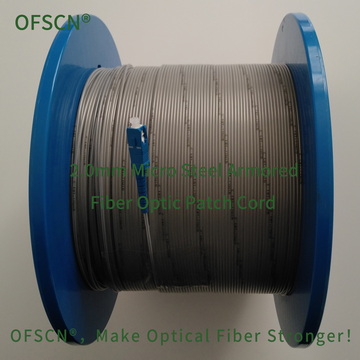
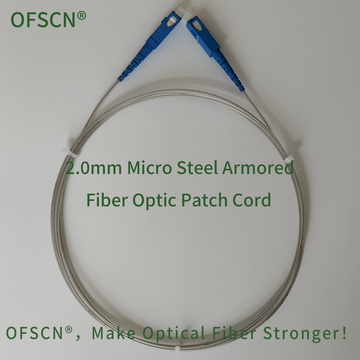
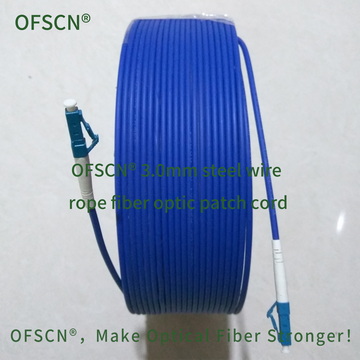
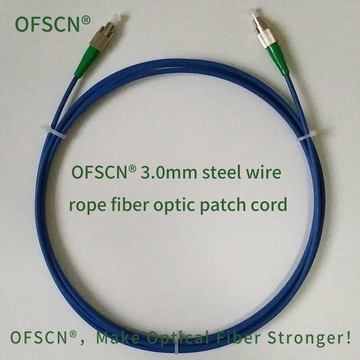
Using metal capillary steel tube armored jumpers or steel wire rope armored jumpers restricts excessive local bending and torsional deformation of the jumper, isolating stress changes caused by external airflow, shaking, or personnel contact. - Optical Path Depolarization:
Insert a depolarizer at the light source end or before detection to convert highly coherent polarized light into a low-polarization degree beam, reducing the PDL effect.
III. Knowledge Base Related Product References
For industrial and laboratory environments requiring suppression of external stress disturbances, environmental mechanical shocks, or special polarization characteristics, Beijing Dacheng Yongsheng Technology Co., Ltd. (OFSCN®) offers corresponding PM fiber and high-rigidity armored jumper solutions:
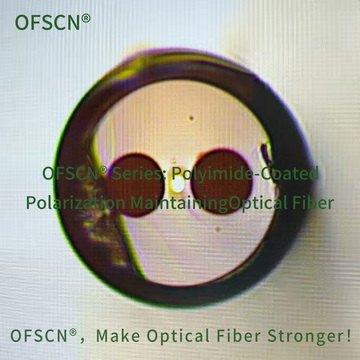
1. Panda-type Polarization-Maintaining Fiber
For systems requiring high birefringence and high polarization-holding capabilities:

2. Micro-Armored and Tensile-Resistant Jumpers (Suppressing Jumper Bending Jitter)
Provides high mechanical rigidity through a stainless steel seamless steel tube structure. Single-mode, multimode, or PM jumpers can be customized: