Why is this scattered light only sensitive to temperature? Is its signal very weak?
In the physical mechanisms of scattering in optical fibers, Raman scattering is a very special type of inelastic scattering. Below, we address your questions about its temperature sensitivity and signal characteristics from the perspectives of microscopic physical mechanisms and signal intensity.
I. Why is Raman scattering light primarily sensitive to temperature and not to deformation (strain)?
Raman scattering is essentially the result of energy exchange between incident photons and optical phonons (molecular vibrations) in the lattice of the fiber material (mainly silica glass). According to the conservation of energy, Raman scattered light is divided into two parts:
- Stokes light: Incident photons transfer a portion of their energy to the medium, exciting molecules to a higher energy state, causing the scattered light frequency to decrease (wavelength to lengthen).
- Anti-Stokes light: Incident photons absorb vibrational energy from molecules already in an excited state, causing them to return to the ground state, resulting in an increase in scattered light frequency (wavelength shortening).
The distribution of microscopic particles across different energy levels follows the Boltzmann distribution in statistical physics. The number density of molecules in the excited state (capable of producing anti-Stokes light), N_{\text{excited}}, is related to the absolute temperature T as follows:
N_{\text{excited}} \propto e^{-\frac{\Delta E}{k_B T}}
Here, k_B is the Boltzmann constant, T is the absolute temperature, and \Delta E is the energy level difference.
As can be seen, the number of molecules in the excited state is exponentially correlated with temperature T. Therefore, the intensity (i.e., photon count) of anti-Stokes light is extremely sensitive to temperature changes, while Stokes light, primarily relying on molecules in the ground state, is minimally affected by temperature.
In Raman-Distributed Temperature Sensing (Raman-DTS) systems, temperature is demodulated by measuring the ratio of the anti-Stokes light intensity (I_{as}) to the Stokes light intensity (I_s):
\frac{I_{as}}{I_s} \propto \left( \frac{\nu_{as}}{\nu_s} \right)^4 e^{-\frac{h \Delta \nu}{k_B T}}
Here, \nu_{as} and \nu_{s} are the frequencies of anti-Stokes and Stokes light, respectively, and h \Delta \nu is the phonon energy (Raman shift). This ratio eliminates common-mode interference such as light source fluctuations and bending losses, making it a physical quantity solely dependent on absolute temperature T.
Why is it insensitive to deformation?
The inherent vibrational modes of silica molecules (molecular bond vibrations) are determined by their chemical structure. External stretching or compression (strain) has negligible effect on the vibration frequencies of molecular bonds and does not alter the Boltzmann distribution. Therefore, Raman scattering is practically unaffected by deformation. In contrast, Brillouin scattering interacts with acoustic phonons (collective lattice vibrations), making it highly sensitive to the density and elastic coefficients of the medium, both of which change with strain. Hence, Brillouin scattering is sensitive to both temperature and strain.
II. Is the signal of Raman scattered light very weak?
Yes, the Raman scattering signal is extremely weak, falling into the category of weak signal light detection.
Among the mainstream scattering mechanisms in optical fibers, there are significant order-of-magnitude differences in their intensity (backscattering coefficient):
- Rayleigh Scattering: Elastic scattering, the strongest. In standard single-mode optical fibers, its backscattered light intensity is on the order of 10^{-3} to 10^{-5} per kilometer relative to the incident light.
- Brillouin Scattering: Inelastic scattering, its intensity is about 10\ \text{dB} to 20\ \text{dB} lower than Rayleigh scattering.
- Raman Scattering: Inelastic scattering, its intensity is approximately 20\ \text{dB} to 30\ \text{dB} lower than Brillouin scattering. This means that Raman backscattered light is typically only on the order of 10^{-5} to 10^{-8} of the incident pulsed light energy (i.e., as low as -50\ \text{dB} to -80\ \text{dB}).
Engineering Challenges Posed by Extremely Weak Signals:
- High Sensitivity Reception Requirement: The DTS demodulator must use high-gain avalanche photodiodes (APDs) or even single-photon detectors (SPADs) for optoelectronic conversion.
- Massive Signal Averaging: Since the signal is at the edge of the noise floor, to achieve usable signal-to-noise ratio (SNR), the system must rapidly accumulate and average data from thousands of pulse periods. This results in single-measurement refresh times for Raman-DTS systems typically being in the second range, making high-speed measurements at the kilohertz (kHz) level, as achieved by Fiber Bragg Gratings (FBGs) or Rayleigh scattering (OFDR), impossible.
III. Related OFSCN® Distributed Fiber Optic Temperature Sensing Products
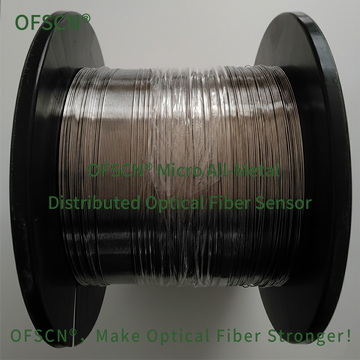
OFSCN® (Beijing Dacheng Yongsheng Technology Co., Ltd.) manufactures seamless steel tube-encapsulated distributed fiber optic temperature sensors that offer extremely high thermal conductivity and robust mechanical protection. These provide high-quality fiber optic sensor media for sensing equipment based on “Raman Scattering (Raman-DTS)”, “Rayleigh Scattering (OFDR)”, and “Brillouin Scattering (Brillouin-DTSS)” principles.
Below are distributed temperature sensor products compatible with relevant systems:
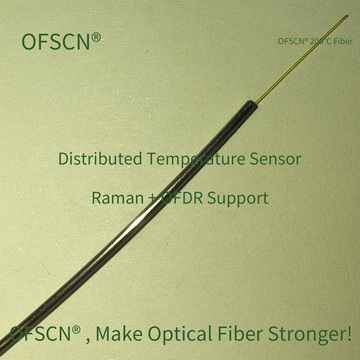
1. OFSCN® 200°C Distributed Fiber Temperature Sensor
Primarily used for distributed fiber optic temperature measurements in environments from -60\ \text{°C} to 200\ \text{°C}. It features single-layer seamless steel tube encapsulation with an outer diameter of only 0.9\ \text{mm} and uses polyimide-coated single-mode fiber by default.

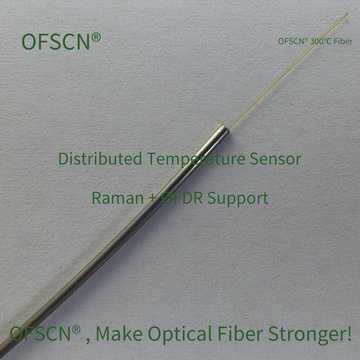
2. OFSCN® 300°C Distributed Fiber Temperature Sensor
Mainly used for distributed temperature measurements in high-temperature environments ranging from -200\ \text{°C} to 300\ \text{°C}. It typically contains a high-quality polyimide-coated single-mode fiber internally.

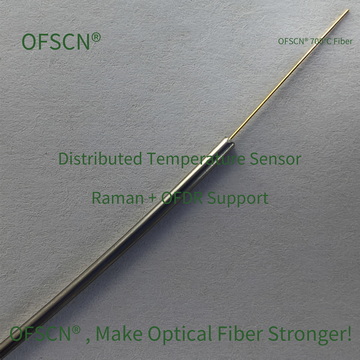
3. OFSCN® 700°C Distributed Fiber Temperature Sensor
Designed for extremely harsh high and low-temperature environments from -270\ \text{°C} to 700\ \text{°C}. It utilizes advanced gold-coated optical fiber and single-layer seamless steel tube manufacturing processes.