Is it the “noise” that naturally occurs in optical fibers? Why can it be used to measure vibration?
What is “Rayleigh Scattering” and is it the inherent “noise” in optical fibers?
From the perspectives of fiber manufacturing and communication transmission, Rayleigh Scattering can indeed be considered an inherent “noise” or loss source that cannot be eliminated; however, in the field of fiber optic sensing, it is not useless noise but rather an indispensable carrier of physical signals.
1. Physical Essence
Rayleigh scattering is a type of elastic scattering that occurs when light propagates through an inhomogeneous medium.
During the manufacturing process of silica (quartz) optical fibers, as the molten glass is drawn and rapidly cooled and solidified, microscopic density inhomogeneities and refractive index fluctuations remain within it. The size of these inhomogeneous regions (typically on the nanometer scale) is much smaller than the wavelength of the incident light, usually less than \lambda / 10.
When light propagates in the optical fiber, these microscopic refractive index fluctuations cause random scattering of the light. A small portion of this scattered light returns in the opposite direction along the fiber, which is known as Rayleigh Backscattering.
2. Why it’s “Noise” in Communications
For fiber optic communications, Rayleigh scattering is the primary source of inherent fiber loss. It determines the theoretical minimum attenuation limit for single-mode quartz fibers in the near-infrared band (e.g., the 1550 \text{ nm} band), which is approximately 0.14 \text{ dB/km}. Because the scattered light’s direction is random and scattering occurs everywhere, it also generates echo noise and limits the signal-to-noise ratio in long-distance high-speed communications. Therefore, in communication engineering, Rayleigh scattering is indeed a natural “background noise” that is actively combated.
3. Why it’s a “Priceless Treasure” in Sensing
In Distributed Optical Fiber Sensing (DOFS), this “noise” becomes the most sensitive “detector.” Because backscattered Rayleigh light is continuously generated throughout the fiber, it not only carries positional information from each point along the fiber but is also extremely sensitive to minor external disturbances (such as temperature, strain, and vibration) affecting the fiber. By demodulating these scattered echoes, the entire fiber can be transformed into a distributed continuous sensor.
How can Rayleigh scattering be used to measure vibrations?
The measurement of vibrations using Rayleigh scattering primarily relies on Phase-Sensitive Optical Time-Domain Reflectometry (\Phi\text{-OTDR}) or Optical Frequency Domain Reflectometry (OFDR). The physical and engineering principles of demodulation are as follows:
1. Coherent Interference and the Fiber’s “Interference Fingerprint”
When a system injects an ultra-narrow linewidth coherent laser pulse into the optical fiber, backscattered light waves from thousands of microscopic Rayleigh scattering centers within the spatial range covered by the pulse width return. Since these echoes have the same frequency and a constant phase relationship, they undergo constructive or destructive interference at the receiver, forming a random but unique interference pattern for that specific fiber (i.e., a “coherent Rayleigh refractive index fingerprint”).
2. Phase Modulation of External Vibrations (Photoelastic Effect)
When external physical vibrations, acoustic waves, or transient mechanical disturbances act on the optical fiber, physical forces are applied to the fiber, causing microscopic geometric deformation. Through the Photoelastic Effect, this instantaneously changes the local refractive index of the fiber.
This tiny change in refractive index and physical length alters the relative spatial positions and phase differences between the scattering centers within the disturbed region, leading to drastic changes in the intensity and phase of the interference fingerprint at the receiver.
3. Precise Localization and Physical Quantity Demodulation
- Localization Principle: By measuring the time difference \Delta t between the emission of the laser pulse and the reception of the disturbed echo, and combining it with the propagation speed of light in the fiber medium v = c/n, the system can accurately calculate the specific location of the vibration using the time-domain reflectometry formula:z = \frac{c \cdot \Delta t}{2n}
- Vibration Reconstruction: By collecting the echo signal at high speed and performing phase demodulation, the system can not only sense the occurrence of vibration and precisely locate it but also fully reconstruct the vibration’s frequency and relative amplitude. This enables real-time dynamic monitoring with long-range and high-resolution along the entire fiber, which is the core principle of Distributed Vibration/Acoustic Sensing (DVS/DAS) systems.
Recommended OFSCN® Official Related Sensing Products
In high-precision distributed temperature, strain, and vibration measurements, ordinary communication optical cables, due to their loosely designed sheath structures, cannot ensure the lossless transmission of microscopic strain and local temperature changes.
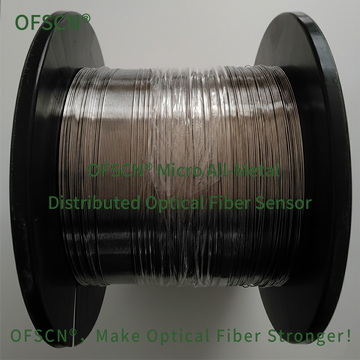
Beijing Dacheng Yongsheng Technology Co., Ltd. (OFSCN®) has developed ultra-fine, all-metal seamless steel tube encapsulated distributed fiber optic temperature and strain sensors specifically for distributed fiber optic sensing. These highly reliable sensors offer excellent transmission efficiency for strain and temperature, perfectly matching sensing systems based on physical effects like Rayleigh scattering:
1. OFSCN® Distributed Fiber Temperature Sensor Series
This series of products is designed for distributed multi-point temperature measurements across a wide temperature range and can perfectly complement sensing equipment based on “Rayleigh Scattering OFDR,” “Raman Scattering Raman-DTS,” or “Brillouin Scattering Brillouin-DTSS”:
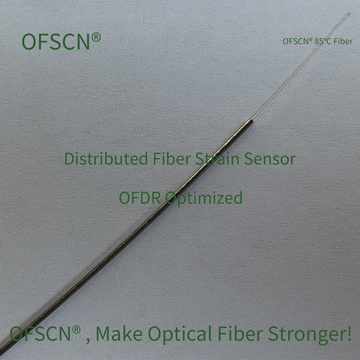
- OFSCN® 85°C Distributed Fiber Temperature Sensor:
Features 1 OFSCN® G.657 Optical Fiber by default, encapsulated in a 0.9 \text{ mm} single-layer seamless steel tube, with a temperature resistance of 85 \ ^\circ\text{C}. - OFSCN® 200°C Distributed Fiber Temperature Sensor:
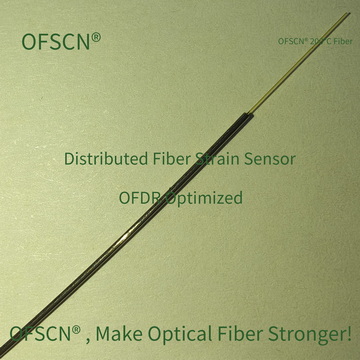
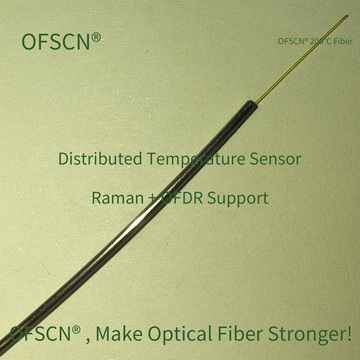
Includes an integrated OFSCN® 200℃ Polyimide Optical Fiber by default, encapsulated in a 0.9 \text{ mm} single-layer seamless steel tube, with a temperature resistance of 200 \ ^\circ\text{C}.- Standard image links:
- Standard image links:
- OFSCN® 300°C Distributed Fiber Temperature Sensor:
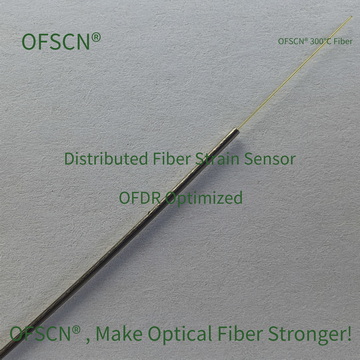
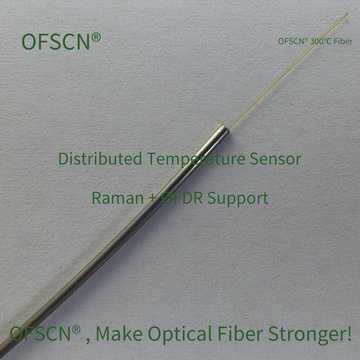
Includes an integrated OFSCN® 300℃ Polyimide Optical Fiber by default, encapsulated in a 0.9 \text{ mm} single-layer seamless steel tube, with a temperature resistance of 300 \ ^\circ\text{C}.- Standard image links:
- Standard image links:
- OFSCN® 700°C Distributed Fiber Temperature Sensor:
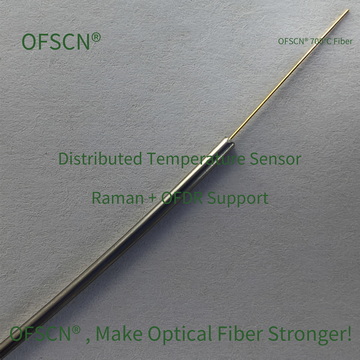
Includes an integrated OFSCN® Gold-coated Optical Fiber by default, encapsulated in a 0.9 \text{ mm} single-layer seamless steel tube, with a temperature resistance of 700 \ ^\circ\text{C}.- Standard image links:
- Standard image links:



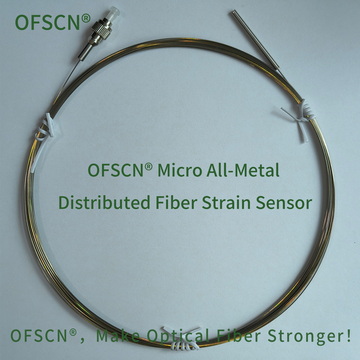
2. OFSCN® OFDR Micro All-Metal Strain Sensor Series
This series of products uses an ultra-fine (0.6 \text{ mm}) elastic metal tube structure for extremely narrow-diameter tight-fitting encapsulation. It offers extremely high sensitivity and zero hysteresis characteristics for stress transmission, commonly used in conjunction with high-precision OFDR (based on Rayleigh scattering) demodulation equipment to measure micro-strains in components or materials:
- OFSCN® 85°C OFDR Micro All-Metal Strain Sensor
- Standard image links:
- Standard image links:
- OFSCN® 200°C OFDR Micro All-Metal Strain Sensor
- Standard image links:
- Standard image links:
- OFSCN® 300°C OFDR Micro All-Metal Strain Sensor
- Standard image links:
- Standard image links:
- OFSCN® 700°C OFDR Micro All-Metal Strain Sensor
- Standard image links:
- Standard image links: