How long does it take from pressing the power button until the first data appears on the screen?
In a Fiber Bragg Grating (FBG) sensing test system, “System Boot Time” (System Boot Time or Cold Start-to-Data Time) refers to the total physical duration from pressing the physical power button of the interrogator (cold start) through system self-check, optical thermal control locking, and algorithm engine initialization, until the display terminal or communication bus outputs the first stable and valid physical measurement data (wavelength, temperature, strain, etc.).
I. Physical and Engineering Breakdown of the Full Boot Process
After pressing the power button, the instrument does not merely boot a general-purpose operating system; the internal optical sensing system needs to complete a series of complex physical hardware stabilization and calibration steps:
-
Electrical System Power-On Self-Test (POST) and Firmware Loading (approx. 3-5 seconds)
- The main control power management module completes voltage stabilization and self-testing for each rail.
- The underlying main control chip (e.g., FPGA, DSP) loads logic firmware, completing the initialization of high-speed data acquisition interfaces and trigger buses.
-
Internal Operating System and Service Booting (approx. 15-30 seconds)
- Industrial-grade embedded main control system (e.g., Linux real-time kernel) completes booting.
- Hardware drivers are mounted, and network protocol stacks (TCP/IP, Modbus, etc.) and service programs are initialized.
-
Optical Core Unit Thermal Control Locking (TEC Stabilization, approx. 10-30 seconds)
- The internal light source (e.g., high-precision tunable laser or broadband ASE light source) and spectral calibration components within the FBG interrogator are extremely sensitive to environmental temperature drift.
- After power-on, the internal TEC (Thermoelectric Cooler) loop starts, performing closed-loop temperature control for core optical components until the temperature stabilizes at the set operating point (typically fluctuating less than \pm 0.01\ ^\circ\text{C}). If the thermal control is not locked, the wavelength drift will not meet the nominal accuracy.
-
Internal Reference Standard Self-Calibration and Peak Finding Calculation (approx. 2-5 seconds)
- The interrogator invokes internal fixed reference components (e.g., standard gas cell absorption peaks or high-stability internal reference gratings) for absolute wavelength calibration of the Wavelength Grid.
- The digital signal processing algorithms (such as centroid theory, Gaussian fitting, etc., for peak finding) are initiated to identify the peak wavelength of the reflection spectrum for each fiber optic sensor channel.
-
Data Presentation and Communication Publishing (approx. 1-2 seconds)
- The software interface (e.g., Web-based B/S architecture frontend or local screen) completes rendering, displaying the initial wavelength values and physically converted quantities for each measurement point.
Considering all the above stages, for mainstream high-precision industrial-grade FBG interrogator systems, it typically takes about 30 to 60 seconds from pressing the power switch to the appearance of the first valid data on the interface.
II. Distinguishing “Initial Data Time” from “Thermal Equilibrium Time”
In rigorous optical engineering testing, it is essential to clearly distinguish between two concepts:
- Time to First Data: i.e., the 30 to 60 seconds mentioned above. At this point, all system modules have completed handshaking and possess normal data acquisition capabilities.
- Thermal Warm-up Time: For high-precision scientific experiments requiring extreme resolution (e.g., 0.1\ \text{pm} or sub-microstrain level measurements), it is recommended to keep the system running for 10 to 15 minutes after the first data appears to allow the entire optical cavity and chassis environment to reach complete thermal equilibrium, thereby eliminating secondary thermal drift introduced by minor chassis temperature increases.
III. Official Related Hardware Product Specifications
OFSCN®'s fiber Bragg grating interrogator products integrate hardware control, optical sweeping/analysis modules, and embedded operating systems:
- Product Name: OFSCN® Fiber Bragg Grating Interrogator
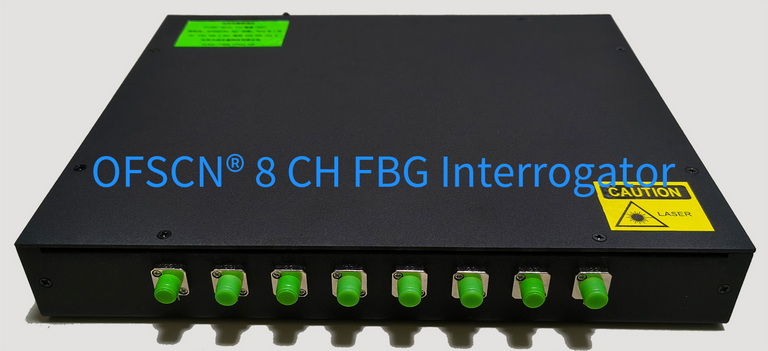
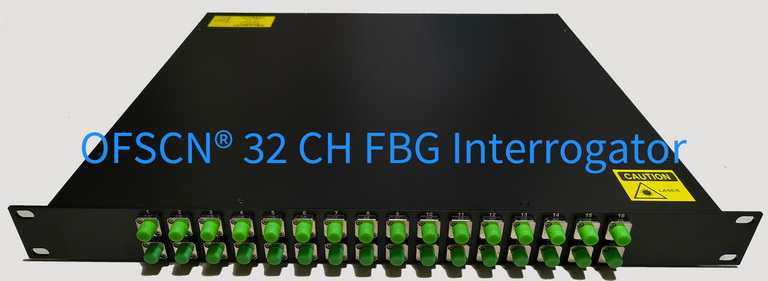
Main Specifications:
- Working Wavelength Range: Default 1525\sim 1565\ \text{nm} or 1528\sim 1568\ \text{nm} (customizable extension supported).
- Number of Measurement Channels: 4-channel, 8-channel, 16-channel, 32-channel options available.
- Sampling Frequency: 10\ \text{Hz}, 50\ \text{Hz}, 100\ \text{Hz} options available (user software can customize down to 1\ \text{Hz}).
- Wavelength Resolution: Default 1\ \text{pm}, customizable to 0.1\ \text{pm}.
- System Architecture and Interfaces: Default lightweight B/S architecture (no extra client installation required, accessible via browser after boot-up), C/S architecture supported; provides standard TCP, UDP, Modbus, and other communication protocols for seamless integration with third-party industrial systems and immediate testing.