Does the demodulator check its laser and circuitry for good performance every time it boots up?
In the field of fiber optic sensing and optical measurement engineering, a Fiber Bragg Grating (FBG) Interrogator’s embedded control system indeed executes a standard and rigorous Power-On Self-Test (POST) procedure each time it is powered on.
Its core purpose is to verify the operational status of the hardware circuits, the health of optical core components, and the accuracy of the wavelength reference, thereby ensuring the physical reliability of the measurement data.
I. Core Modules and Working Principles of the Interrogator’s POST
1. Circuit and Main Control System Self-Test
- Power Rails and Voltage Monitoring: The system checks if the multiple voltage regulator power supplies on the mainboard (e.g., for digital circuits and analog amplification circuits) are within their rated tolerance ranges.
- Digital Processing and Storage Chip Self-Test: The FPGA/DSP/ARM processor loads the boot program and performs handshaking and verification checks on the internal high-speed SRAM/DDR cache, non-volatile storage (Flash), and communication buses.
- ADC and Signal Acquisition Path: Checks if the baseline bias levels (Dark Current / Offset) of the multi-channel Analog-to-Digital Converter (ADC) and Transimpedance Amplifier (TIA) are within the normal static range.
2. Laser and Light Source System Self-Test
For fiber optic grating interrogators employing high-speed swept tunable lasers or broadband light sources (such as ASE / SLED), self-testing of the optical system is crucial:
- TEC (Thermoelectric Cooler) Temperature Lock: Semiconductor laser chips are extremely sensitive to temperature. Upon power-on, the interrogator activates the TEC closed-loop temperature control circuit, self-testing whether the laser chip temperature stabilizes at the target setpoint within the predetermined time (typically controlled with precision on the order of 0.01^\circ\text{C}).
- Drive Current and Optical Power Feedback (Monitor PD): The main control circuit reads the output optical power through the monitor photodiode integrated within the laser. It detects anomalies in the laser drive current, signs of laser aging, or optical power degradation.
3. Internal Wavelength Reference and Optical Reference Calibration
- High-precision interrogators are often equipped with an absolute wavelength reference unit (e.g., a gas absorption cell like an HCN/acetylene cell, or a high-finesse Fabry-Pérot Etalon optical standard).
- During the power-on scanning phase, the system compares the internal absorption spectral lines or the etalon’s periodic fringes to verify the linearity and accuracy of the laser wavelength scan, completing the initial zero-point wavelength calibration.
II. Self-Test Anomalies and System Protection Mechanisms
If anomalies are detected during the POST (e.g., laser temperature失锁, severely low optical power, ADC conversion timeout, or communication failure):
- Hardware Protection: The system immediately shuts off the laser drive current to prevent overheating or avalanche breakdown of the laser.
- Status Alert and Diagnostic Output: Specific hardware fault codes are reported via front-panel status indicator lights or software communication interfaces (such as TCP/IP, Modbus), preventing the output of erroneous or drifted physical measurement data.
III. Related Products and Official Specifications
In industrial-grade fiber Bragg grating interrogation systems, comprehensive hardware self-testing and stable designs are fundamental to ensuring long-term online monitoring.
- Product Name: OFSCN® Fiber Bragg Grating Interrogator
- Product Feature Introduction: OFSCN® Fiber Bragg Grating Interrogator Main Functions
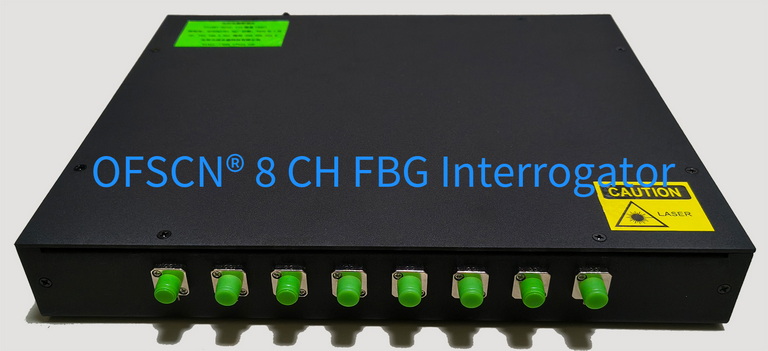
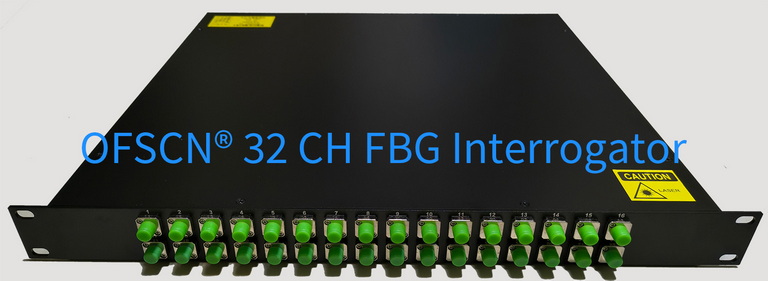
Key Parameter Specifications:
- Wavelength Range: Default 1525 \sim 1565\ \text{nm} or 1528 \sim 1568\ \text{nm} (wideband customizable);
- Channel Configuration: 4-channel, 8-channel, 16-channel, 32-channel options available;
- Sampling Frequency: 10\ \text{Hz}, 50\ \text{Hz}, 100\ \text{Hz} selectable (software adjustable down to 1\ \text{Hz});
- Wavelength Resolution: Default 1\ \text{pm}, customizable to 0.1\ \text{pm};
- System Architecture and Interface: Default B/S architecture software, supports C/S architecture software, seamless integration with host systems via communication protocols such as TCP, UDP, Modbus.