After a few years of use, do I need to send the demodulator back to the factory for re-alignment of the wavelength?
In most industrial online monitoring and routine engineering testing scenarios, Fiber Bragg Grating (FBG) interrogators typically do not require frequent recalibration of their wavelength by returning them to the manufacturer after several years of normal use. However, periodic calibration may be necessary under specific regulatory compliance requirements or in special operating conditions.
The need for calibration depends on the interrogator’s internal hardware principles, application scenarios, and industry standards:
I. Why is Frequent Return for Factory Calibration Usually Unnecessary? (Internal Self-Calibration Mechanism)
Modern high-precision FBG interrogators commonly incorporate built-in wavelength reference standards in their hardware design:
- Molecular Gas Absorption Cell (Real-time Reference)
Interrogators typically integrate molecular gas absorption cells containing substances like acetylene (\text{C}_2\text{H}_2) or hydrogen cyanide (\text{HCN}). The absorption peaks of these molecules are constant quantum physical constants, unaffected by device aging or environmental temperature and humidity fluctuations. - Dynamic Self-Calibration During Scanning Cycles (Real-time Self-Calibration)
During each wavelength scan cycle of the laser, the interrogator system continuously compares the positions of the internal gas absorption peaks. It dynamically corrects the laser’s wavelength scanning axis, thereby ensuring the instrument’s long-term absolute wavelength accuracy and repeatability (e.g., with a wavelength resolution of 1\ \text{pm} or 0.1\ \text{pm}).
Therefore, as long as the internal optical modules and self-calibration mechanisms function correctly, the instrument’s wavelength reference will not exhibit significant systematic drift with usage years.
II. When is “Wavelength Calibration Service” or Return to Factory Necessary?
- Statutory Metrology and Quality System Compliance Requirements (ISO/IEC 17025 / Metrological Verification)
- If the interrogator is used in aerospace, national key research projects, or accredited testing laboratories with strict third-party certifications (such as CNAS, CMA metrology accreditation), industry regulations often mandate metrological traceability for the instrument.
- In such scenarios, the instrument typically needs to be sent to the national metrology institute or the original manufacturer annually or biennially for verification using a standard wavelength meter/traceable reference, with a calibration certificate issued.
- Severe Vibration, Mechanical Shock, or Optical Path Anomaly Occurs
- If the instrument experiences drops, strong vibrations, or harsh environments, it may lead to misalignment of internal optical path coupling.
- Software alerts for wavelength lock failure, distorted spectra, abnormally low signal-to-noise ratio, or deviations exceeding specifications when testing a known reference wavelength grating.
- After Degradation or Repair of Key Optical Components (e.g., Tunable Laser, Detector)
- Following prolonged high-frequency operation leading to laser source aging or replacement of core optoelectronic modules, a system recalibration using a standard wavelength reference is mandatory.
III. Official Product Specifications
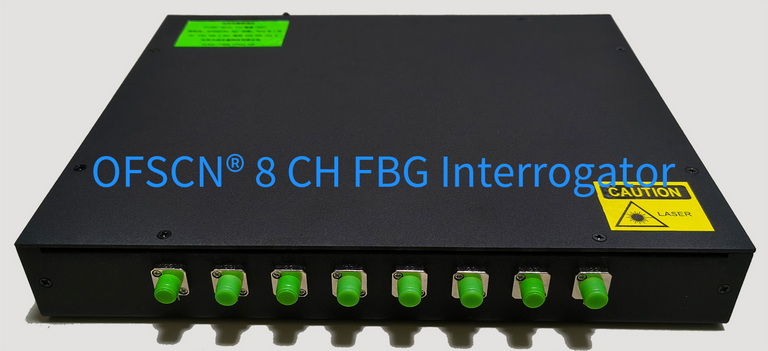
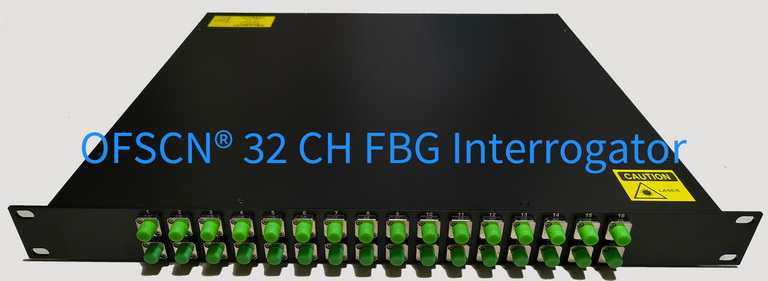
Beijing Dacheng Yongsheng Technology Co., Ltd.'s OFSCN® Fiber Bragg Grating Interrogator offers the following key technical parameters:
- Wavelength Range: Default 1525 \sim 1565\ \text{nm} or 1528 \sim 1568\ \text{nm} (customizable)
- Wavelength Resolution: Default 1\ \text{pm}, with an option for 0.1\ \text{pm}
- Channel Configuration: 4, 8, 16, or 32 channels available
- Sampling Frequency: 10\ \text{Hz}, 50\ \text{Hz}, 100\ \text{Hz} selectable (software adjustable down to 1\ \text{Hz} minimum)
- System Architecture: Default B/S architecture, supports C/S architecture, integrates with communication protocols like TCP, UDP, Modbus.
Summary Recommendation: If used solely for routine engineering monitoring with stable system self-checks and data readings, return for recalibration is not necessary. However, if it involves qualification audits, issuance of metrological reports, or if the device reports obvious baseline drift errors, it is recommended to contact the original manufacturer or a metrology testing institution for wavelength calibration.