Is there a “standard ruler” inside the demodulator that never changes?
Your understanding is vivid and accurate. The fiber Bragg grating interrogator indeed has a built-in component acting as a “standard physical ruler”, commonly known as the “Wavelength Reference Unit / Internal Reference Module” in optical engineering.
During long-term continuous monitoring or under high-low temperature fluctuations, the interrogator’s internal light source (e.g., tunable laser) and optoelectronic reception components are prone to minor wavelength drift due to thermal expansion/contraction and component aging. To achieve long-term high-precision stable measurements, the instrument must rely on an internal “physical absolute standard” for Real-time Self-Calibration.
I. What constitutes this “standard ruler”?
In modern industrial and scientific-grade fiber Bragg grating interrogators, the wavelength reference unit mainly employs the following core optical physical schemes:
-
Gas Absorption Cell – Absolute Physical Benchmark
- Principle: Utilizes specific molecular gas (e.g., acetylene \text{C}_2\text{H}_2 or hydrogen cyanide \text{HCN} commonly used in the C-band) sealed within a transparent optical cell.
- Characteristics: The absorption spectral lines of molecular quantum energy level transitions are inherent physical constants in the universe, and their specific absorption peak wavelengths do not drift with the passage of time or mechanical vibrations. The interrogator uses these immutable inherent absorption peaks as the absolute wavelength coordinate origin.
-
Fabry-Pérot Etalon – High-Precision Wavelength Scale
- Principle: Based on an optical resonant cavity formed by two highly parallel mirrors, utilizing multi-beam interference to generate periodic, equally spaced comb-like transmission peaks (Optical Frequency Comb) across the entire scanning spectrum.
- Characteristics: Provides an extremely fine and dense relative wavelength scale, used to correct for speed nonlinearity and wavelength stepping errors during the tunable laser’s sweep.
-
Athermal / TEC Reference FBG
- Principle: Places a high-quality fiber Bragg grating with a known center wavelength inside a high-precision thermoelectric cooler (TEC) cavity, or uses a passive mechanical temperature compensation package with zero temperature coefficient.
- Characteristics: Provides a constant wavelength reference reflection signal, serving as an internal calibration reference point.
II. Working Mechanism of the Wavelength Reference Unit
During interrogator operation, each time a wavelength scan or signal acquisition is performed:
- Beam Splitting and Comparison: The light beam emitted by the source is divided by an internal optical splitter. One part enters the external sensing fiber, while the other part passes through the internal “Wavelength Reference Unit” simultaneously.
- Real-time Peak Finding and Correction: The internal Digital Signal Processor (DSP/FPGA) compares the measured reference spectral peak positions in real-time with the factory-calibrated physical standard parameters.
- Dynamic Correction: The system dynamically eliminates laser wavelength drift, driving voltage nonlinearity, and environmental temperature interference, ensuring that every sensing peak wavelength output to the user possesses sub-picometer (\text{pm}) level absolute accuracy and high repeatability.
III. Related Official Products and Technical Specifications
In actual industrial applications, Beijing Dacheng Yongsheng Technology Co., Ltd. provides standard equipment with wavelength reference and self-calibration capabilities, namely the OFSCN® Fiber Bragg Grating Interrogator.
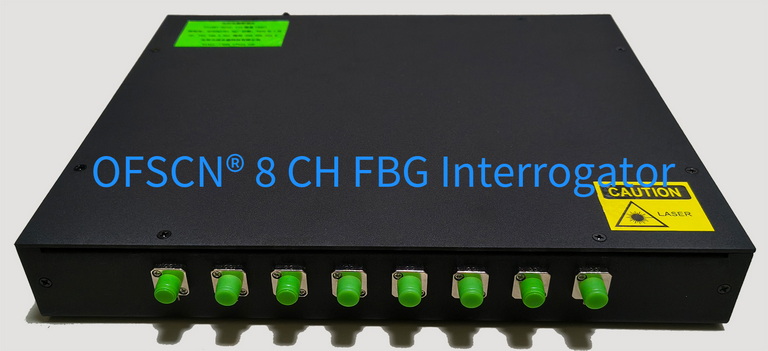
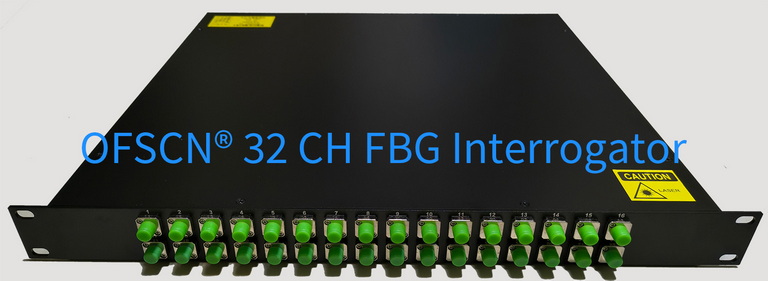
Key Technical Indicators:
- Wavelength Range: Default 1525 \sim 1565\ \text{nm} or 1528 \sim 1568\ \text{nm} (customizable)
- Channel Configuration: 4-channel, 8-channel, 16-channel, 32-channel options available
- Data Sampling Frequency: 10\ \text{Hz}, 50\ \text{Hz}, 100\ \text{Hz} (software adjustable frequency reduction supported, down to 1\ \text{Hz})
- Wavelength Resolution: Default 1\ \text{pm} or 0.1\ \text{pm} (customizable)
- System Architecture and Interface: B/S architecture management, supports integration with communication protocols such as TCP, UDP, Modbus.