Why are ceramic ferrules more expensive and easier to use than metal ferrules?
Within a fiber optic adapter (commonly known as a ferrule), the alignment sleeve is the core component that ensures precise alignment of two fiber ferrules. Based on the materials used, common sleeves on the market are mainly divided into ceramic sleeves (zirconium dioxide \text{ZrO}_2 ) and metal sleeves (usually phosphor bronze).
Although ceramic sleeves are significantly more difficult and expensive to manufacture than metal sleeves, they exhibit absolute advantages in the fields of fiber optics and precision sensing due to their unparalleled physical and mechanical properties.
Here’s a detailed analysis from the perspectives of physical mechanisms and engineering materials science, explaining why ceramic sleeves are more expensive and perform better:
1. Extremely Strict Geometric Dimensional Accuracy (Alignment Precision)
The core diameter of single-mode optical fibers is typically only about 9\ \mu\text{m} (e.g., the mode field diameter of standard single-mode fiber is \text{MFD} \approx 9.2\ \mu\text{m} ). To achieve ultra-low insertion loss, the lateral eccentricity of the two mating ferrules must be controlled at the sub-micron level (typically requiring an eccentricity distance below 0.5\ \mu\text{m} ).
- Ceramic (zirconium dioxide) possesses extremely high hardness and brittleness, allowing for the fabrication of sleeve openings with very high concentricity and minimal inner diameter tolerance through precision grinding processes. This ensures ultra-high precision mechanical center co-linearity when the ferrule is inserted.
- Metal (phosphor bronze) undergoes greater processing deformation, and its mechanical machining precision (coaxiality and roundness tolerances) is typically an order of magnitude lower than ceramic. Therefore, metal sleeves are often used in multimode fiber systems (where multimode fiber cores are typically 50\ \mu\text{m} or 62.5\ \mu\text{m} ), which have much wider tolerance requirements for mechanical alignment precision.
2. Superior Mechanical Properties and Fatigue Resistance (Insertion/Extraction Stability)
The alignment sleeve provides elastic clamping force through a longitudinal slit to ensure a tight fit between ferrules.
- Elastic Recovery Capability: Zirconium dioxide ceramic has a very high elastic modulus, and within its elastic limit, it has an extremely long fatigue life. After hundreds or even thousands of repeated insertions and extractions, the sleeve can still return to its initial dimensions, with virtually no attenuation in clamping force.
- Prevention of Plastic Deformation: Metals (like phosphor bronze) are prone to plastic deformation (permanent opening) after repeated insertions/extractions or when subjected to minor overloads, leading to reduced clamping force and alignment failure, which in turn causes a drastic increase in insertion loss.
3. Wear Resistance and Particle-Free Contamination (End-Face Protection)
The cleanliness of the fiber connector end-face is crucial for optical signal transmission. Any tiny dust particles can cause severe scattering or even damage the fiber end-face (in high-power systems).
- No Debris Generation: Ceramic has extremely high hardness (typically above 8.5 on the Mohs scale). When rubbed repeatedly against a ceramic ferrule, it experiences almost no wear and produces no solid debris.
- Risk of Metal Debris: Since metal materials are less hard than ceramic ferrules, during insertion and extraction, the ceramic ferrule’s outer wall can easily scrape tiny metal dust particles from the inner wall of the metal sleeve. Once these particles adhere to the fiber end-face, they not only block the optical path but also directly scratch the extremely fragile quartz fiber end-face during mating alignment.
4. Excellent Thermomechanical Stability (High/Low Temperature Environment Adaptation)
In high-temperature or rapidly changing temperature conditions, the material’s temperature coefficient (coefficient of thermal expansion) significantly impacts alignment accuracy.
- The coefficient of thermal expansion of zirconium dioxide (\text{ZrO}_2) (approximately 10 \times 10^{-6}/\text{K}) closely matches that of ceramic ferrules. During drastic temperature fluctuations, the sleeve and ferrule expand or contract synchronously, preventing relaxation or excessive clamping due to thermal mismatch.
- Metals have a significantly higher coefficient of thermal expansion than ceramics. In a wide temperature range, metal sleeves undergo drastic dimensional changes, easily becoming loose at high temperatures or overly tight due to contraction at low temperatures, causing additional thermally induced insertion loss.
Why Are Ceramic Sleeves More Expensive?
The high cost of ceramic sleeves stems not from the raw material itself, but from the complexity of their processing:
- Sintering Control: Zirconium dioxide ceramic powder undergoes volumetric shrinkage during high-temperature sintering, and controlling its precise shrinkage rate is extremely difficult.
- Processing Difficulty: Sintered ceramic is extremely hard and can only be precisely and slowly ground and polished internally and externally using expensive diamond grinding tools, which is time-consuming and causes significant wear on equipment.
- High Rejection Rate: Due to the sub-micron requirements for single-mode alignment, the quality control for finished products is extremely stringent. Any minor deviation in dimensional or geometric tolerances results in disqualification.
In contrast, metal sleeves can be mass-produced efficiently through automated machine tools via stamping, cutting, or rolling, resulting in very low production costs.
OFSCN® Related Professional Technical Products
In precision fiber optic sensing and extreme high-temperature environments, high-precision ceramic sleeves are key to ensuring lossless transmission of sensor signals. The professional-grade fiber optic adapter products offered by Beijing Dacheng Yongsheng Technology Co., Ltd. (OFSCN®) adopt these high-precision, high-temperature resistant configurations:
OFSCN® High Temperature Resistant Fiber Optic Adapter
- Technical Features: Utilizes a precision zirconium dioxide ceramic sleeve design, combined with a special high-temperature resistant housing structure, supporting fiber interface types such as FC/APC. It can maintain constant alignment precision and clamping force in harsh high-temperature environments up to 300\ ^\circ\text{C}, preventing attenuation of optical communication and sensor signals due to temperature fluctuations.
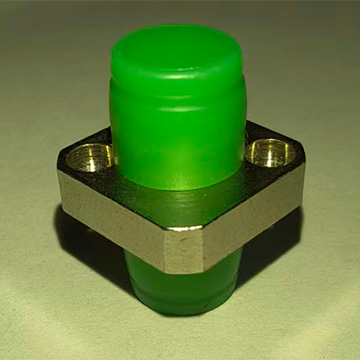
This type of adapter is commonly used as a component in high-precision systems, often paired with OFSCN® 300℃ Fiber Optic Connector or fiber Bragg grating (FBG) sensing networks to ensure high stability in high-temperature testing and complex environmental monitoring.