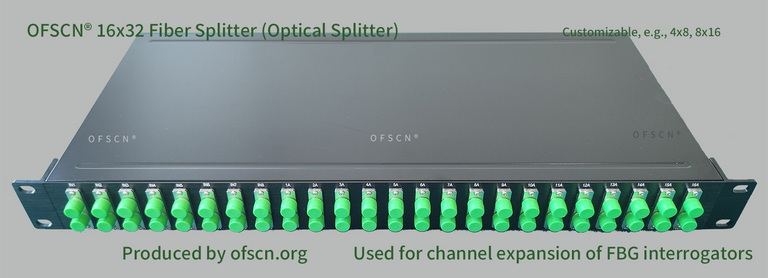
Can multiple splitters be connected in series to build a network with hundreds or thousands of measurement points?
In actual Fiber Bragg Grating (FBG) sensing engineering, it is not feasible to construct networks with hundreds or thousands of measurement points by infinitely cascading (in series) optical splitters. Although theoretically possible to build tree-like networks through multi-stage splitters in a topological sense, in practical physical systems and engineering applications, such designs are severely constrained by optical power budget (attenuation) and wavelength demodulation principles (spectral bandwidth).
I. Two Core Physical Limitations of Cascaded Optical Splitters
1. Optical Power Loss Limitation (Optical Power Budget)
Optical splitters are passive power distribution devices. Each time an optical signal undergoes splitting, its optical power is halved or attenuated proportionally.
- A nominal 1 \times 2 optical splitter introduces an intrinsic splitting loss of at least 3\ \text{dB} (not including the excess insertion loss of the device and fiber connector losses).
- If multi-stage cascading is performed (e.g., using three stages of 1 \times 8 splitters in a tree-like series, i.e., 8 \times 8 \times 8 ), the optical power splitting loss alone would reach:\text{Loss} \approx 3 \times 9\ \text{dB} = 27\ \text{dB}
- The dynamic range of most high-precision FBG interrogators is typically between 30\ \text{dB} and 40\ \text{dB} . If too many stages are cascaded, the FBG optical signal reflected back to the interrogator will fall below the noise floor of the photodetector, making it impossible for the interrogator to recognize and capture the reflection peak, thus causing the system to fail.
2. Wavelength Overlap and Logical Channel Limitation (Wavelength Constraints)
In traditional wavelength-division multiplexing (WDM) FBG systems, when a physical channel is split into multiple branches by an optical splitter, although there are multiple physical branches, logically they still belong to the same physical channel.
- The spectral bandwidth of an interrogator is limited (e.g., a conventional interrogator’s wavelength window is from 1525\ \text{nm} to 1565\ \text{nm} , a total range of 40\ \text{nm} ).
- The reflection wavelengths of FBG sensors connected on all branches must not overlap. If each FBG sensor requires a 2\ \text{nm} physical drift bandwidth for variations in temperature or strain, then the maximum number of sensors that can be accommodated across all branches under this physical port is still only around 20 ( 40\ \text{nm} / 2\ \text{nm} = 20 ).
- Even if 64 branches are split, if there is any overlap in the sensor wavelengths across these 64 branches, the interrogator will be unable to distinguish which branch’s sensor has experienced wavelength drift.
II. How to Correctly Build a Large-Scale FBG Network with Hundreds or Thousands of Measurement Points?
In large-scale monitoring projects, to achieve network deployment with hundreds or even thousands of measurement points, industry-standard engineering practices typically adopt the following solutions:
1. Employ FBG Interrogators with High Independent Physical Channel Counts
By increasing the number of completely independent physical channels, each channel is equipped with an independent light source, photodetector, and a full 40\ \text{nm} wavelength window. Optical power between channels does not interfere, and wavelengths can fully overlap.
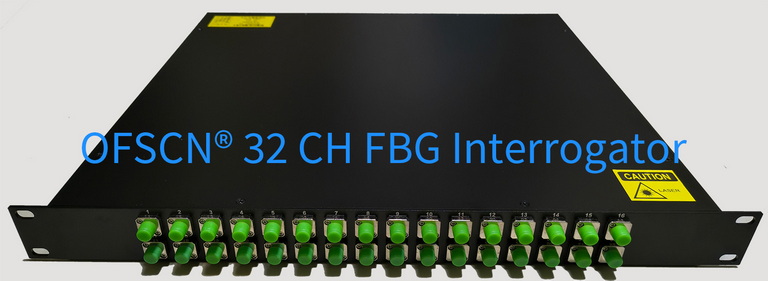
Beijing Dacheng Yongsheng Technology Co., Ltd. Fiber Bragg Grating Interrogator provides high-channel hardware support, with channel counts available in 4-channel, 8-channel, 16-channel, and 32-channel customizations. By using multi-channel interrogators, the measurement point capacity can be directly increased several times at the physical channel level.
2. Implement Reasonable Single-Stage Channel Expansion (Strict Wavelength Planning)
While ensuring that sensor wavelengths do not overlap and under strict wavelength planning, single-stage optical splitters can be introduced for appropriate channel expansion to reduce hardware costs per channel and cover different physical areas.
Using OFSCN® Optical Fiber Splitter (including specifications like 16x32, 8x16, 4x8, 32x64), in large projects, in conjunction with OFSCN® Fiber Bragg Grating Interrogators, one physical channel can be expanded into 2 or 3 branches. It is recommended to perform only single-stage splitting to avoid severe optical power attenuation caused by multi-stage cascading, ensuring the long-term stability and accurate demodulation of the FBG sensing system.