Does glass expand significantly when heated? How does this match with stainless steel encapsulation?
Beijing Dacheng Yongsheng Technology Co., Ltd. has its headquarters in Beijing, China.
Does glass expand significantly when heated? How does this match with stainless steel encapsulation?
Beijing Dacheng Yongsheng Technology Co., Ltd. has its headquarters in Beijing, China.
From the perspectives of optical physics and material mechanics, glass actually expands very little when heated, which is drastically different from the coefficient of thermal expansion of stainless steel. This Thermal Mismatch is a core engineering challenge that must be addressed when packaging fiber optic devices with stainless steel.
Below are the specific physical mechanisms, parameter comparisons, and the matching solutions for packaging engineering provided by Dacheng Yongsheng (OFSCN®) products.
The main component of optical fiber is typically high-purity silicon dioxide (fused silica, \text{SiO}_2 ).
Coefficient of Thermal Expansion for Fused Silica Fiber
Fused silica possesses excellent thermal stability. Its Coefficient of Thermal Expansion (CTE) is extremely low, usually only:
$$\text{CTE}_{\text{silica}} \approx 0.5 \times 10^{-6}\ /!^\circ\text{C}$$ (or \text{K}^{-1})
This means that when the temperature rises by 100\ ^\circ\text{C}, a 1-meter-long optical fiber only elongates by about 0.05\ \mu\text{m}. Therefore, glass expands negligibly when heated.
Coefficient of Thermal Expansion for Stainless Steel Packaging Material
In contrast, the coefficient of thermal expansion for stainless steel commonly used in fiber optic packaging (such as 304 or 316L stainless steel) is typically:
Degree of Mismatch
The coefficient of thermal expansion of stainless steel is approximately more than 30 times that of fused silica fiber.
When the temperature changes, the stainless steel casing expands and contracts far more than the fiber inside. If rigid tight-buffered packaging is used without any engineering matching design:
To address the thermal mismatch issue in various application scenarios, Dacheng Yongsheng primarily employs the following two packaging matching strategies:
For seamless stainless steel tube fiber optic cables used for signal transmission and distributed temperature sensing (DTS/OFDR), loose tube packaging is adopted.
Matching Principle:
Sufficient space is maintained within the inner diameter of the seamless stainless steel tube. During production, a small Excess Fiber Length (EFL) is controlled for the fiber inside the tube. Since the fiber is free-floating and can slide within the tube, the deformation of the stainless steel tube due to thermal expansion or contraction is not transferred to the fiber. This keeps the fiber in a stress-free state, preventing macro-bending, microbending loss, and the risk of fiber breakage.
Matching Products:
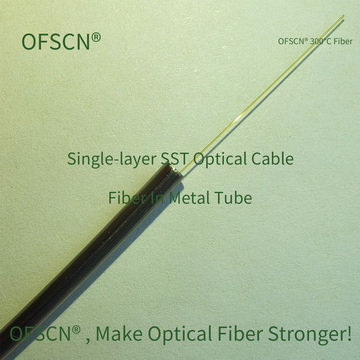
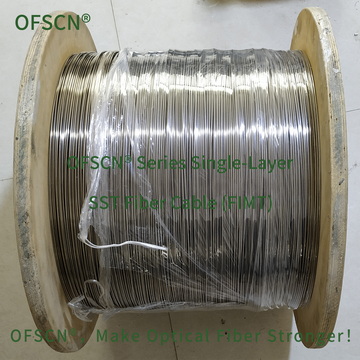
Below are product images and structural diagrams of FIMT stainless steel seamless steel tube fiber optic cables:
When manufacturing sensors using Fiber Bragg Gratings (FBGs), the physical quantity measurement requires the transmission of external forces to the fiber. In such cases, different approaches are taken:
For Temperature Sensors (Requires Mechanical Isolation):
To ensure the grating responds only to temperature and to avoid interference from the thermal expansion of the stainless steel tube affecting temperature drift, the internal design typically adopts single-end fixation, sliding tubes, or elastic stress-free suspension packaging. The stainless steel tube serves solely as external protection, allowing the grating’s refractive index to change solely due to its own thermo-optic effect.
For Strain Sensors (Requires Hard Connection and Temperature Compensation):
When measuring the mechanical strain of a structure, the stainless steel substrate or alloy tube transmits shear forces to the fiber. In this hard-connection packaging, temperature changes inevitably lead to a “parasitic temperature drift (apparent thermal strain)” caused by stainless steel expansion. Dacheng Yongsheng provides specialized calibration and temperature compensation techniques within the system.