Besides yellow and orange, what other colors represent special performance?
In fiber optics and communication cabling engineering (in accordance with international standards such as TIA-598-C/D and industry best practices), besides the most common yellow (single-mode fiber) and orange (OM1 / OM2 multimode fiber), different colors on the outer jacket, connector body, and special coatings represent specific physical specifications and transmission characteristics:
I. Fiber Optic Jacket Color Codes
| Jacket Color | Corresponding Fiber Type / Specification | Typical Core/Cladding Diameter | Transmission and Physical Performance Characteristics |
|---|---|---|---|
| Aqua | OM3 / OM4 Multimode Fiber | 50/125\ \mu\text{m} | Multimode fiber optimized for 850\text{nm} VCSEL lasers, supporting high-speed data transmission from 10\text{Gbps} to 100\text{Gbps}. |
| Erika Violet / Rose | OM4 Multimode Fiber (Common in European and some standard data centers) | 50/125\ \mu\text{m} | Used specifically to physically distinguish from aqua OM3, possessing higher modal bandwidth ( \ge 4700\ \text{MHz}\cdot\text{km} ). |
| Lime Green | OM5 Wideband Multimode Fiber (WBMMF) | 50/125\ \mu\text{m} | Designed for Short Wavelength Division Multiplexing (SWDM), covering a wavelength range of 850\text{nm}\sim 953\text{nm} , enabling high-speed signal transmission of multiple channels over a single fiber. |
| Blue | Polarization-Maintaining (PM) Fiber or Specialty Single-Mode | Common 8.5/125\ \mu\text{m} etc. | Often found on the outer jackets of polarization-maintaining (Panda/Bow-tie type) patch cords, used to maintain the polarization state of light waves; also used for non-standard identification in some regions. |
| Black | Outdoor Cable / UV-Resistant Jacket | Single-mode / Multimode applicable | Utilizes UV-resistant PE/LSZH jacket materials, offering weather resistance and moisture-proof properties, suitable for outdoor or heavy industrial environments. |
II. Connector Housing and Ferrule Color Codes
The color of the connectors at both ends of a patch cord directly indicates the polish type (Polish Type) and optical return loss (Return Loss) performance:
- Green — APC (Angled Physical Contact)
- Performance Characteristics: The end-face has an 8^\circ angle, causing reflected light to refract directly into the cladding, resulting in extremely low return loss (typical value \ge 60\text{dB}).
- Primary Applications: High-sensitivity Fiber Bragg Grating (FBG) sensing systems, WDM (Wavelength Division Multiplexing) systems, and long-haul communication networks.
- Blue — UPC (Ultra Physical Contact)
- Performance Characteristics: The end-face is vertically aligned with a micro-spherical polish, offering a typical return loss of \ge 50\text{dB}.
- Primary Applications: Standard digital communication network interfaces for single-mode equipment.
- Beige
- Performance Characteristics: General UPC polished connector for multimode fibers.
III. Industrial-Grade and Specialty Sensor Fiber Patch Cords
In harsh industrial and sensor measurement applications, the appearance color of a patch cord is often determined by its special protective sheath material and armored structure:
- Bare Metal (Bright Silver): Utilizes a fine stainless steel seamless steel tube or steel wire armor (e.g., OFSCN® 2.0mm Steel Wire Rope Fiber Optic Patch Cord), providing extremely high tensile strength and resistance to crushing forces.
- Amber / Yellowish-Brown Coating: Polyimide-coated fiber, designed for high-temperature and cryogenic environments ranging from -270^\circ\text{C}\sim 300^\circ\text{C}.
- Metallic Gold Coating: Gold-coated specialty fiber (e.g., OFSCN® 700℃ Fiber Optic Patch Cord), capable of operating in temperatures from -270^\circ\text{C}\sim 700^\circ\text{C}.
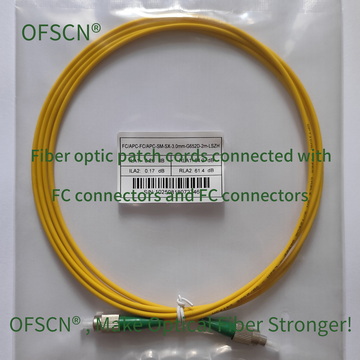
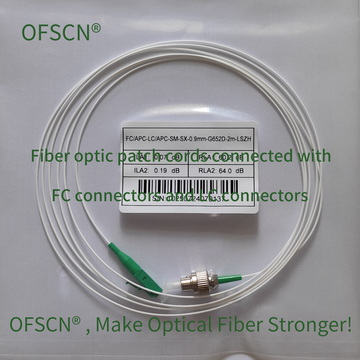
For more specifications on standard and specialty armored fiber patch cords, please refer to the OFSCN® Fiber Optic Patch Cord Product Series Official Page.