If the fiber core is not in the exact center of the ceramic tube, will the light not be able to pass through?
This is a classic problem in physics and optical fiber engineering.
Simply put: while light can still pass through a single fiber jumper cable itself, for the entire fiber connection system, if the concentricity is not up to standard, light will “fail to pass” during connection (resulting in extreme attenuation).
We need to consider the “transmission within a single fiber” and the “connection between two fibers” as separate physical processes:
1. Single Fiber Transmission Mechanism (Why Light Passes Through a Single Fiber)
Light transmission in an optical fiber is governed by the physical principle of Total Internal Reflection (TIR) at the interface between the Core and the Cladding.
As long as the glass’s geometric structure and refractive index distribution are not compromised, even if the core deviates from the geometric center of the external ceramic ferrule due to manufacturing errors (i.e., eccentricity exists), light will still undergo total internal reflection within the core and successfully transmit to the other end of the fiber.
2. Dual Fiber Connection Mechanism (Why Poor Concentricity Causes “Failure to Pass”)
The true purpose of fiber optic connectors (such as FC, SC, LC, etc.) is to precisely couple light from one fiber into another.
During physical connection, the ceramic ferrules of two fiber jumper cables are aligned by the outer diameter using a ceramic split sleeve within an adapter (flange).
If the Concentricity of the ceramic ferrules is not up to standard (meaning the core is not precisely at the center of the ferrule’s outer circle):
- When the two ferrules are physically connected, their outer circles are aligned. However, due to eccentricity, a Lateral Offset will occur between the cores of the two fibers.
- For standard single-mode fibers, the Mode Field Diameter (MFD) is typically only about 9.2 \ \mu\text{m}. Due to the extremely small core, even a tiny lateral offset can lead to catastrophic Insertion Loss (IL).
Quantitative Physical Relationship Between Lateral Offset and Insertion Loss:
According to Gaussian beam coupling theory, when two single-mode fibers are connected, the insertion loss \text{IL} (in decibels, \text{dB} ) caused by lateral offset can be approximately estimated by the following formula:
\text{IL (dB)} \approx 4.34 \times \left( \frac{d}{w_0} \right)^2
Where d is the lateral offset distance between the two fiber cores, and w_0 is the mode field radius of the fiber (for single-mode fiber, w_0 \approx 4.6\ \mu\text{m} ).
- Minor Offset ( d = 1\ \mu\text{m} ): Insertion loss is approximately 0.2\text{ dB} . This is considered an acceptable high-quality connection loss in optical communications.
- Moderate Offset ( d = 3\ \mu\text{m} ): Insertion loss increases sharply to about 1.8\text{ dB} (at this point, over 30\% of the light energy has leaked into the cladding and cannot enter the core of the next fiber section).
- Severe Offset ( d = 5\ \mu\text{m} ): Insertion loss will exceed 5\text{ dB} (equivalent to over 70\% of the light energy lost). If both connectors have severe eccentricity and are in opposite directions, the cumulative offset may exceed the core radius, at which point light coupling into the next core becomes almost impossible, leading to a complete interruption of the receiving link. In practical engineering, this manifests as “light failing to pass.”
3. Industry Control Standards for Concentricity
To ensure that fiber optic connectors maintain extremely low insertion loss (e.g., \le 0.3\text{ dB} ) even after repeated plugging and unplugging, the industry imposes extremely stringent controls on the geometric dimensions and concentricity of ferrules:
- Single-Mode Fiber Ceramic Ferrules: Due to the small core size of only 9\ \mu\text{m} , the concentricity (eccentricity) of the ferrule’s inner hole to its outer diameter is typically required to be controlled within < 1.4\ \mu\text{m} . High-precision Master Jumpers even require control within < 0.5\ \mu\text{m} .
- Multi-Mode Fiber Ceramic Ferrules: Due to the larger core size of multi-mode fibers (typically 50\ \mu\text{m} or 62.5\ \mu\text{m} ), the tolerance for lateral offset is higher, so the concentricity requirement for ferrules is relatively more relaxed, generally being < 3.0\ \mu\text{m} or < 4.0\ \mu\text{m} .
4. OFSCN® Fiber Optic Patch Cord Technology
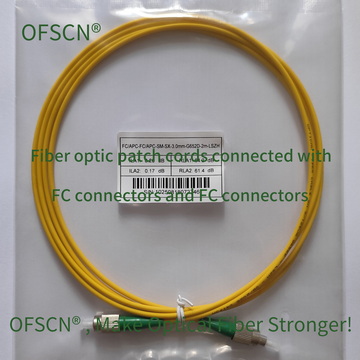
Beijing Dacheng Yongsheng Technology Co., Ltd. (OFSCN®) provides standard and special fiber optic patch cords. During production, they implement extremely strict testing for the concentricity of ceramic ferrules, the geometric tolerances of the inner hole, and the fiber centering process, to ensure extremely low insertion loss under various harsh and extreme physical and temperature conditions.
Here are related high-performance fiber optic patch cord products: