If the optical cable is run over by a car, will the optical fibers inside break?
Whether the optical fibers inside an optical cable will break if run over by a vehicle depends on the optical cable’s structural design (whether it has sufficient armored protection) and the complexity of the ground environment (whether it is flat or has sharp objects).
The following provides a specific analysis from the perspectives of optical engineering and structural mechanics:
I. Physical Characteristics of Bare Optical Fibers and “Crush Force”
A standard single-mode optical fiber consists of a core layer and a cladding made of silica glass. The outer diameter of the cladding is typically only 125\ \mu\text{m}, further protected by a polymer coating.
Glass, as a brittle material, has fundamentally different physical mechanisms for tensile strength and radial compression resistance (crush force, i.e., \text{Crush Force}):
- Local Shear Stress: When bare optical fiber directly bears a concentrated radial load, the local pressure rises exponentially due to the extremely small contact area.
- Microbending and Bending Stress: Slight non-uniform deformation during the crushing process generates high-intensity microbends, causing local tensile stress within the fiber to exceed the fracture threshold of glass, leading to catastrophic failure.
Therefore, if there is no external structural protection, the fiber will shatter 100% if run over directly by vehicle wheels.
II. Crush Resistance Performance of Different Cable Structures
To protect fragile optical fibers, they are encapsulated in optical cables (\text{Optical Cable}). The “crush resistance” (\text{Crush Resistance}) of an optical cable is a key mechanical performance indicator used to assess its ability to protect internal fibers from breakage when subjected to lateral squeezing.
1. Ordinary Non-Armored Optical Cables (e.g., Non-metallic Indoor/Outdoor Cables)
These cables primarily rely on plastic outer jackets (e.g., \text{PVC}, \text{PE}) and aramid yarns (Kevlar) for buffering:
- Flat Surface: If slowly run over by a passenger car tire on a completely flat, hard laboratory floor, the fiber has a chance of survival due to the elastic deformation capacity of the plastic jacket, though it will typically experience significant microbending losses (signal attenuation).
- Actual Road Surfaces (Gravel, Cobblestones): On actual roads, vehicle crushing will transform scattered gravel and sand into “point loads” with extremely high pressure. The plastic outer jacket will be instantly punctured or deform beyond its limit, allowing localized shear forces to be directly transmitted to the internal glass medium, causing the fiber to break or be severely damaged.
2. Metallic Armored Optical Cables (High Crush Resistance)
In engineering sites requiring resistance to vehicle crushing and heavy object squeezing, armored protection structures are essential. Beijing Dacheng Yongsheng Technology Co., Ltd. (OFSCN®), by incorporating stainless steel seamless steel tubes or steel wire stranded armor, constructs extremely strong lateral “load-bearing arch” physical protection, thereby achieving very high crush resistance.
III. Official High Crush Resistance Armored Fiber Optic Solutions and Parameters
For applications requiring resistance to extreme mechanical environments such as vehicle crushing and heavy object stacking, Beijing Dacheng Yongsheng Technology Co., Ltd. (OFSCN®) offers the following professional-grade high tensile, high crush-resistant fiber optic patch cords/cables:
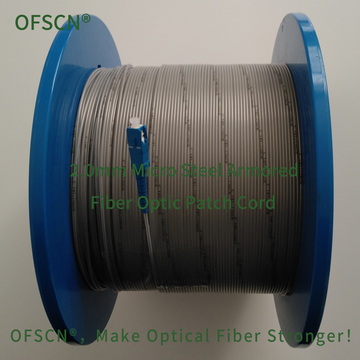
1. OFSCN® 2.0mm Micro Steel Armored Fiber Optic Patch Cord
This product encapsulates the optical fiber within a 0.6\text{mm} diameter seamless stainless steel tube, with an outer \text{PVC} jacket. This seamless metal tube completely absorbs external lateral squeezing forces and distributes them axially and circumferentially, rendering the radial stress on the internal fiber almost zero.
- Crush Strength (Crush Resistance): \u003e 240\text{ MPa}
- Tensile Strength: \u003e 150\text{N}
- Fiber Type: Default G.652D single-mode fiber
- Physical Effect: Even when repeatedly run over by heavy trucks, the internal fiber remains structurally intact without any additional optical loss.

2. OFSCN® 3.0mm Steel Wire Rope Fiber Optic Patch Cord
This product features even more extreme dual protection: it consists of an outer \text{PE} jacket, a 0.45\text{mm} stainless steel wire stranding structure, an inner 0.9\text{mm} seamless stainless steel tube, and the optical fiber. The steel wire stranding structure not only provides extremely high tensile strength but also offers excellent crush and impact resistance.
- Crush Strength (Crush Resistance): \u003e 200\text{ MPa}
- Tensile Strength: \u003e 1200\text{N}
- Fiber Type: Default G.657 bend-insensitive single-mode fiber
Conclusion
If the optical fibers inside a cable lack hard armored protection, such as metal steel tubes, they are highly prone to shattering or developing micro-cracks due to point loads and high pressure after being run over by a vehicle. If a high-crush-resistance stainless steel seamless tube armored optical cable, such as those from Beijing Dacheng Yongsheng Technology Co., Ltd. (OFSCN®), is used, the metal casing bears the entire lateral force, ensuring that the internal optical fibers will absolutely not break and that normal optical signal transmission is maintained.