During construction, if workers pull the optical cable hard, will the optical fibers inside break? How many Newtons can it generally withstand?
When pulling optical cables during construction and laying, whether the optical fibers inside will break depends on the cable’s tensile design, the strength of the reinforcement used, and whether the specific pulling force applied exceeds the cable’s design limits.
To understand this issue in depth, we need to scientifically analyze it from two dimensions: the “physical tensile limit of bare optical fibers” and the “engineering tensile limit of the overall optical cable.”
I. Physical Tensile Limit of Bare Optical Fibers
The core material of single-mode or multi-mode optical fibers is high-purity silicon dioxide (quartz glass). Although silicon dioxide has a theoretically very high intrinsic tensile strength (exceeding 5 \ \text{GPa}), microscopic cracks inevitably exist on the surface of the glass during the actual drawing and manufacturing process, which significantly reduces its actual tensile strength.
-
Proof Test Standards:
Standard communication optical fibers undergo rigorous tension screening tests for the entire reel before leaving the factory. The standard screening stress is typically 100 \ \text{kpsi} (approximately equivalent to 700 \ \text{MPa}), with a corresponding tensile strain of about 1\%. -
Tension Calculation:
For standard silicon dioxide optical fibers with a glass cladding outer diameter of 125 \ \mu\text{m}, the cross-sectional area is approximately:A = \frac{\pi \times d^2}{4} \approx 1.227 \times 10^{-8}\ \text{m}^2Under the screening stress, the short-term tension that this bare optical fiber can safely withstand is:
F = \sigma \times A \approx 700\ \text{MPa} \times 1.227 \times 10^{-8}\ \text{m}^2 \approx 8.6\ \text{N} -
Actual Breaking Limit:
On short segments of bare optical fiber without severe microscopic defects, the actual breaking force may range between 30 \ \text{N} and 50 \ \text{N}. However, under long-term static load or complex environments, to ensure no breakage for decades, the safe working tension for bare optical fibers is usually strictly limited to within 10 \ \text{N} (equivalent to a force of about 1\ \text{kg}).
Conclusion:** If bare optical fibers are pulled directly, an adult can easily apply tens to hundreds of Newtons of force with a single hand, and the bare optical fibers will break immediately.
II. Tensile Protection Principles and Newton Force Bearing During Optical Cable Construction
In actual engineering construction, workers pull the optical cable (Cable), not the bare optical fibers inside. Optical cables are designed with various “reinforcements” to bear all the tensile force, keeping the optical fibers inside in a “safely slack” state (under minimal or no stress).
Different optical cable structures have vastly different tensile forces they can withstand during construction:
-
Indoor Drop Cables / Standard Patch Cords:
These cables typically use aramid yarn (Kevlar) or two FRP (Fiber Reinforced Plastic) rods as reinforcements inside.- Allowable Short-Term Tension:** Generally between 200 \ \text{N} and 400 \ \text{N} (approximately 20\ \text{kg} to 40\ \text{kg} of force).
- Risk of Breakage:** If workers pull excessively hard, especially with multiple people pulling together or using mechanical dragging, it is very easy to exceed the 400 \ \text{N} limit. Once the outer jacket and reinforcements undergo plastic deformation or fracture, the tensile force will directly act on the glass optical fibers, causing them to break instantly.
-
Outdoor Duct/Aerial/Direct Buried Cables:
These cables usually have robust central metallic strength members (steel wires), steel tape, or aluminum tape armoring.- Allowable Construction Tension:** Generally short-term tensile strength is between 1500 \ \text{N} and 3000 \ \text{N} (approximately 150\ \text{kg} to 300\ \text{kg}).
- Risk of Breakage:** In this specification, if workers pull using a pulling net or reinforcement core in accordance with standards, the optical fibers are absolutely safe. However, if the pulling angle is incorrect, or the bending radius is too small, causing excessive compression or bending shear on the optical fibers inside, the optical fibers may be damaged even if the cable itself is not broken.
III. Beijing Dacheng Yongsheng Technology Co., Ltd. (OFSCN®)'s Ultra-Strong Tensile Special Armored Solution
In harsh industrial, monitoring, and high-load construction environments, ordinary aramid or loose-tube cables often cannot withstand harsh field pulling. Beijing Dacheng Yongsheng Technology Co., Ltd. has developed special armored fiber optic patch cords and cables with extremely high tensile strength, based on seamless stainless steel pipes and stranded steel wire structures, effectively preventing fiber breakage due to rough pulling during construction.
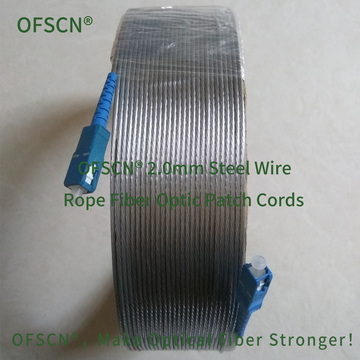
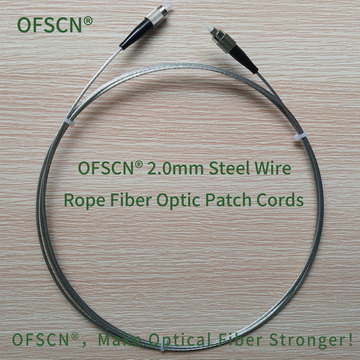
1. OFSCN® 2.0mm Steel Wire Rope Fiber Optic Patch Cord
This product uses a 0.6\ \text{mm} galvanized steel wire stranded structure encapsulated with a 1.0\ \text{mm} seamless stainless steel pipe, achieving full metal heavy-duty protection.
- Tensile Strength:** Greater than 1500 \ \text{N} (can withstand tensile forces up to 150\ \text{kg} or more; manual pulling is almost incapable of damaging its internal optical fibers).
- Compressive Strength:** Greater than 150 \ \text{MPa}.
- Applicable Scenarios:** High-risk construction areas, environments with multiple sharp corners, dynamic load sensing.

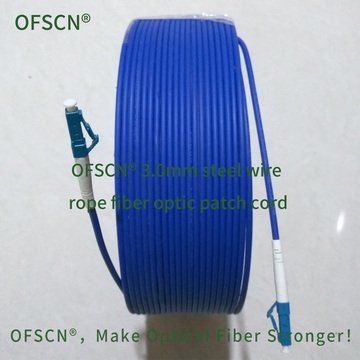
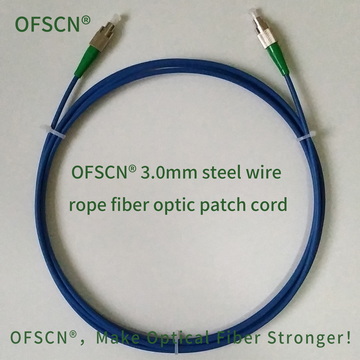
2. OFSCN® 3.0mm Steel Wire Rope Fiber Optic Patch Cord
This product features a 0.45\ \text{mm} stainless steel wire stranded structure layered over a 0.9\ \text{mm} seamless stainless steel pipe, and is covered with a high-strength PE sheath.
- Tensile Strength:** Greater than 1200 \ \text{N} (allows for extremely high-strength dragging).
- Compressive Strength:** Greater than 200 \ \text{MPa}.

Summary
During construction, if ordinary non-armored civil optical cables are used, and workers pull excessively hard (exceeding 200 \ \text{N} to 400 \ \text{N}), the optical fibers inside are very likely to break. In engineering sites or industrial monitoring, the pulling force should be strictly limited within the cable’s allowable short-term tension specifications. If strong pulling is predicted during construction, special armored optical cables with structures like the stainless steel stranded wire mentioned above must be used to ensure the absolute safety of the physical link.