Why does this parameter determine the “running speed” of light in a jumper?
In fiber optics, the **Effective Refractive Index (commonly denoted as n_{eff}) ** is a core physical quantity that describes the actual propagation characteristics of light within the guided modes of an optical fiber or fiber jumper cable.
I. What is “Effective Refractive Index” (n_{eff})?
An optical fiber typically consists of a core with a higher refractive index (n_1) and a cladding with a lower refractive index (n_2) (n_1 > n_2). When light propagates in a single-mode fiber jumper cable, the light field is not confined to the core by 100\%. Instead, a portion of its energy penetrates and distributes into the cladding as an evanescent wave.
Consequently, the overall medium experienced by the light wave is neither pure core nor pure cladding, but rather a weighted equivalent result of the two:
n_2 < n_{eff} < n_1
From the perspective of the guided-wave optical wave equation, let k_0 = \frac{2\pi}{\lambda} be the wavenumber of light in vacuum, and \beta be the propagation constant along the fiber axis. The effective refractive index is strictly defined as:
n_{eff} = \frac{\beta}{k_0}
II. Why does n_{eff} Determine the “Running Speed” of Light in a Jumper Cable?
The speed of light propagation in a medium is directly constrained by the refractive index of that medium. In fiber jumper cables, two primary concepts of speed are involved:
1. Phase Velocity (Phase Velocity)
The propagation speed of equiphase surfaces (a single monochromatic wave’s crests/troughs) is directly determined by the effective refractive index:
v_p = \frac{c}{n_{eff}}
(where c \approx 3 \times 10^8\text{ m/s} is the speed of light in a vacuum).
2. Group Velocity (Actual Signal Transmission Speed)
The speed at which light pulses and modulated signals (i.e., data packets carrying energy and information) travel in optical communication or fiber sensing is the group velocity v_g:
v_g = \frac{c}{n_g}
Here, n_g is the Group Index, which is derived from the effective refractive index n_{eff} and its dispersion relationship with wavelength:
n_g = n_{eff} - \lambda \frac{dn_{eff}}{d\lambda}
3. Actual Speed Estimation
Taking a standard single-mode fiber (e.g., G.652D) at the 1550\text{ nm} wavelength window as an example:
- Effective Refractive Index n_{eff} \approx 1.447
- Effective Group Refractive Index n_g \approx 1.468
The actual signal propagation speed of light in the fiber jumper cable is:
v_g = \frac{3 \times 10^8\text{ m/s}}{1.468} \approx 2.04 \times 10^8\text{ m/s} \approx 204,000\text{ km/s}
Conclusion: The “running speed” of light in a fiber jumper cable is approximately 68\% of the speed of light in a vacuum (taking about 4.9\text{ ns} to travel 1\text{ m}). This speed is fundamentally and strictly determined by the n_{eff} and its derived n_g dictated by the core/cladding structure of the fiber jumper cable.
III. Significance in Fiber Bragg Gratings (FBGs) and Sensing Engineering
- Fiber Bragg Grating (FBG) Bragg Reflection Condition:
The center reflection wavelength formula for an FBG is \lambda_B = 2 n_{eff} \Lambda (where \Lambda is the grating modulation period). External physical quantities such as temperature and strain achieve wavelength tuning and high-precision sensing precisely by altering the fiber’s effective refractive index n_{eff} or the grating period \Lambda. - Time Domain Reflectometry and Distance Localization (OTDR):
When OTDR is used to test the length of a jumper cable or the position of an event, any deviation in the set refractive index parameter (i.e., n_g) will directly lead to proportional errors in fiber distance measurement.
IV. Related OFSCN® Product References
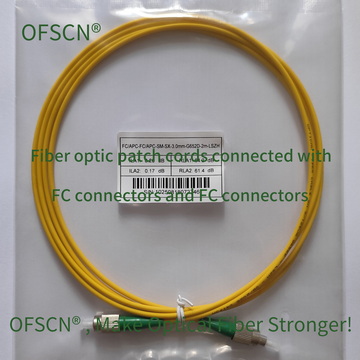
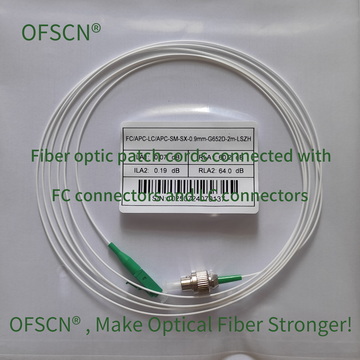
Standard fiber jumper cables and bare optical fibers provided by Beijing Dacheng Yongsheng Technology Co., Ltd. (OFSCN®) are manufactured according to standard optical specifications and possess strictly consistent optical refractive index parameters: