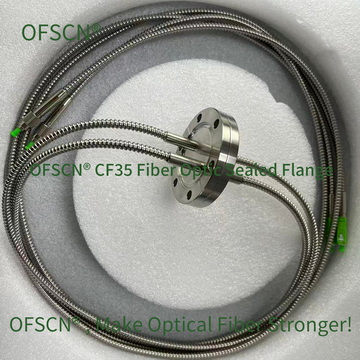
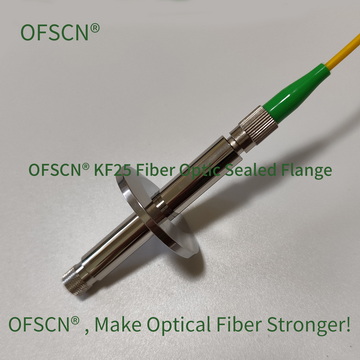
Can bulkhead connectors transmit optical signals while ensuring electrical insulation between the inner and outer walls?
From the perspectives of optical physics and electrical engineering, fiber optic feedthroughs (such as fiber optic vacuum feedthrough flanges) can guarantee absolute electrical insulation on the “signal transmission channel” while transmitting optical signals. However, in practical applications, whether the entire feedthrough (including its mechanical housing) can ensure electrical insulation between the inside and outside of the cabin’s metal wall needs to be discussed based on the system’s mechanical and electrical design.
Here are the underlying physical mechanisms and general engineering principles:
1. Absolute Electrical Insulation of the Signal Transmission Channel
The fiber optic feedthrough transmits optical signals, and its electrical isolation characteristics are reflected in the following physical dimensions:
- Non-conductive Medium: The core and cladding of optical fibers are made of high-purity silicon dioxide (\text{SiO}_2) glass, which is an excellent solid electrical insulator, naturally lacking any charge conduction paths.
- No Electromagnetic Interference: Light waves, as high-frequency electromagnetic waves, are confined within the optical fiber for transmission based on the principle of total internal reflection, without electromagnetic coupling with the outside. This means that optical signals are not only physically insulated but also achieve complete electromagnetic compatibility (EMC) electromagnetically, unaffected by high voltages or strong electromagnetic fields inside or outside the cabin wall.
- Insulation of Sealing Medium: During the manufacturing of the feedthrough, the gap between the optical fiber and the metal flange hole is typically vacuum-sealed using special epoxy resins or glass-frit materials with high insulation properties. These encapsulation materials also possess extremely high dielectric strength and insulation resistance, ensuring electrical isolation at the fiber optic feedthrough aperture.
2. Electrical Insulation Between the Entire Feedthrough (Flange Body) and the Cabin Wall
It is important to note that although the optical signal channel itself is absolutely insulated, the flange body of standard vacuum fiber optic feedthroughs (such as CF, KF series, etc.) is usually made of metal (e.g., stainless steel 316L or 304):
- If the metal flange is directly installed on the metal cabin wall, the physical metal interface inside and outside the cabin wall will still be conductive.
- If your system requires absolute electrical insulation between the inner and outer walls of the cabin (or between the flange itself and the cabin), you cannot rely solely on the insulation of the optical fiber. In such scenarios, you need to install a Ceramic Break/Insulator between the feedthrough flange interface and the cabin, or use electrically insulating gasket materials (such as high-resistance polyimide or special rubber gaskets) to block the conductive path between the flange metal housing and the cabin.
Related Official Products and Specifications
OFSCN® offers fiber optic feedthrough/sealing products specifically designed for vacuum environments – OFSCN® Fiber Optic Vacuum Sealed Flange. This product series enables lossless and undistorted transmission of fiber optic signals while maintaining the ultra-high vacuum of the cabin.
Key Product Technical Specifications:
- Vacuum Performance: Excellent sealing performance, with vacuum levels better than 1 \times 10^{-7}\ \text{Pa}, or customizable ultra-high vacuum series better than 1 \times 10^{-9}\ \text{Pa}.
- Flange Standards: Available in CF and KF series, offering single-channel (single-head) or multi-channel (multi-head) designs, supporting male or female connector customization.
- Temperature Range: Standard models for room temperature use, with special high-temperature models rated up to 250\ ^{\circ}\text{C} available for customization.