If the container pressure rises abnormally, will the flange become a weak point in safety?
In physics and pressure vessel engineering design, if the internal pressure (positive pressure) within a vessel abnormally rises, fiber optic vacuum feedthrough flanges can indeed become the physical and safety weak points in the system.
To ensure the safety of experimental and industrial systems, it is essential to analyze the behavior of flanges under overpressure conditions from the perspective of mechanical structure and connection mechanisms.
I. Stress Analysis During Abnormal Pressure Rise
When the internal pressure of a sealed vessel abnormally increases, the flange, sealing ring, and the penetrating optical fiber itself will bear a pressure difference directed outward from the vessel, resulting in a net outward force F = \Delta P \times A (where \Delta P is the pressure difference between the inside and outside of the vessel, and A is the effective force-bearing area).
The weak points of fiber optic vacuum flanges are primarily reflected in two aspects: the connection strength of the flange itself and the shear strength of the sealing medium at the fiber penetration point (Feedthrough). Depending on the flange standard (e.g., KF and CF series), their overpressure failure mechanisms differ significantly:
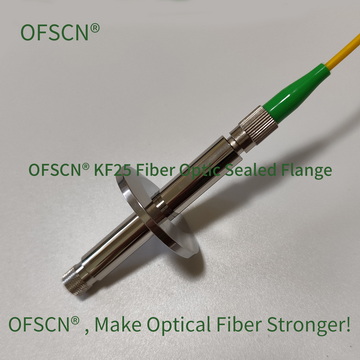
1. KF Series Fiber Optic Vacuum Flanges (e.g., KF25, KF40, etc.)
- Connection Mechanism: KF flanges typically use a rubber O-ring (e.g., Viton fluoroelastomer) for central positioning and are clamped externally using hinged quick-release clamps. This design relies mainly on external atmospheric pressure to press the flanges together under vacuum conditions.
- Overpressure Behavior: The KF series has extremely weak resistance to positive overpressure. If the internal pressure of the vessel abnormally rises, even a very small positive pressure (typically exceeding 0.1\ \text{MPa} to 0.2\ \text{MPa} overpressure) can cause mechanical deformation of the clamp and O-ring.
- Failure Result: The sealing ring may be extruded, or the clamp itself may physically detach. This leads to an “uncontrolled, sudden pressure release.” While in a sense it prevents the vessel itself from exploding by leaking or detaching, this release is extremely dangerous. The detached flange or ejected high-pressure medium can cause severe personal injury or equipment damage. It must never be considered a “safety barrier” within the design.
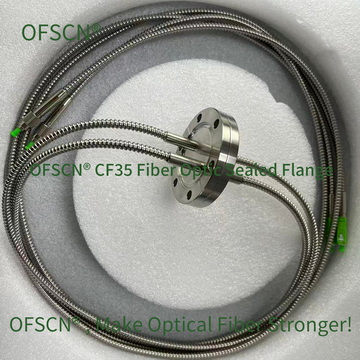
2. CF Series Fiber Optic Vacuum Flanges (e.g., CF35, etc.)
- Connection Mechanism: CF flanges use a metal copper gasket for hard sealing, relying on a set of high-strength bolts for rigid pre-tightening.
- Overpressure Behavior: The mechanical connection strength of CF flanges is extremely high, typically able to withstand several \text{MPa} of positive pressure without flange displacement. However, at this point, the safety weak point shifts to the fiber penetration point (Feedthrough).
- Failure Result: The aperture through which the fiber passes through the metal body of the flange is extremely small, usually sealed with high-vacuum specialty epoxy resin or glass/metal sintering. If the internal pressure becomes excessively high, exceeding the shear bonding limit between the sealing medium and the metal hole wall or the fiber surface, a “blow-out” effect will occur. The fiber and sealing block will be ejected like a bullet under high pressure, leading to instantaneous explosive leakage.
II. Industrial and Experimental Safety Principles: Non-substitutable Pressure Relief Protection Devices
In standard vacuum and pressure engineering, “fiber optic vacuum flanges” must never be designed as a substitute for pressure relief channels like safety valves.
- Install Dedicated Pressure Relief Equipment: Pressure vessel systems must be equipped with dedicated rupture disks or safety valves.
- Pressure Rating Matching: The rated positive pressure tolerance of the fiber optic vacuum sealed flange must be higher than the set action pressure of the dedicated safety valve. This ensures that the fiber optic flange does not suffer catastrophic physical damage before the pressure relief device safely activates and smoothly releases the excess pressure.
III. Official Related Fiber Optic Vacuum Sealed Flange Products
Beijing Dacheng Yongsheng Technology Co., Ltd. (OFSCN®) produces OFSCN® Fiber Optic Vacuum Sealed Flange that can provide extremely high vacuum and airtight fiber optic feedthrough for vacuum chambers. The main product parameters include:
- Series Specifications: Available in CF and KF series, as male and female types, supporting single-head and multi-head customization;
- Operating Temperature: Standard temperature use, with customizable high-temperature products resistant to 250\ ^{\circ}\text{C} ;
- High Vacuum Performance: Vacuum better than 1 \times 10^{-7}\ \text{Pa} (KF series) and 1 \times 10^{-9}\ \text{Pa} (CF series), ensuring extremely low leak rates in ultra-high vacuum environments.