Will internal optical fibers produce false strain signals when squeezed at the seal?
1. Impact of Squeezing on Fiber Signals: Will it Produce False Signals?
Yes, squeezing the internal fiber at the seal point will absolutely cause false signal interference (and may even lead to physical damage or optical signal interruption).
For Fiber Bragg Grating (FBG) sensors or other sensing systems based on fiber phase/intensity variations, localized axial or radial squeezing at the seal point can induce the following physical effects:
- Photoelastic Effect & Birefringence: When the fiber is subjected to uneven radial (lateral) squeezing, the originally symmetrical refractive index distribution within the fiber is disrupted, creating anisotropic birefringence. This causes the reflection spectrum of the Fiber Bragg Grating to undergo Peak Splitting or spectral broadening. To the demodulator, this irregular spectral distortion is misinterpreted as a change in temperature or strain, thus outputting a false “strain signal”.
- Longitudinal Stress Transfer (Curing Shrinkage): Sealing materials (such as epoxy resin, low-melting-point glass, or metal solder) undergo volume shrinkage during curing or cooling. This mechanical shrinkage exerts longitudinal tensile or compressive forces on the internal fiber. For FBG, it directly causes an undesired shift in the Bragg center wavelength \lambda_B. Without stress relief, this shift can be as large as hundreds of micro-strains (\mu\epsilon), leading to significant zero-point drift.
- Microbending Loss: Stress concentration at the squeeze point (especially at sharp edges) can also cause minute bends in the fiber axis. This leads to a sharp attenuation of optical power, reducing the signal-to-noise ratio of the sensing signal. In extreme cases, it may prevent the demodulator from accurately locking onto the wavelength peak or even cause link interruption.
2. What is “Stress Relief” for Fiber Optic Vacuum Flanges?
To completely eliminate the squeezing interference caused by the high vacuum sealing process or subsequent pressure differences, Stress Relief structures and processes must be employed in the design and manufacturing of high-standard fiber optic vacuum flanges.
“Stress Relief” refers to the process of physically isolating the strong mechanical squeezing forces generated during external flange sealing, the thermal shrinkage stresses of materials, and the differential pressure loads inside and outside the vacuum chamber from the internal light-transmitting core of the fiber (especially the sensitive grating region or sensing fiber core) through physical structural isolation, transition material buffering, and assembly process design.
High-quality fiber optic vacuum sealed flanges typically employ the following stress relief methods:
- Staged Potting / Graduated Sealing: At both ends of the high vacuum sealing section of the flange, damping materials with lower Young’s modulus and better elasticity are used as buffer layers to prevent microbending of the fiber at the junction between the “hard metal wall” and “soft air” due to stress concentration.
- Protective Sleeving: The fiber first passes through an extremely thin seamless stainless steel tube or metal capillary. The mechanical hermetic seal is achieved between the metal tube and the flange body, ensuring that external potting pressure and shear forces are absorbed by the metal tube wall, while the fiber inside the tube remains “suspended” or under very low constraint.
- Service Loops & Slack Design: At the fiber patch cord connection points on both sides of the flange, a small bending margin is reserved. This allows external pulling forces, thermal deformation of the chamber, and other longitudinal stresses to be completely released by the elastic deformation of the excess fiber before they reach the sealing area.
3. Related Professional Product Technical Specifications
To achieve stable transmission and avoid false signal interference in harsh environments such as ultra-high vacuum and extreme temperatures, Beijing Dacheng Yongsheng Technology Co., Ltd. (OFSCN®) has launched professional vacuum-sealed fiber optic component products:
OFSCN® Fiber Optic Vacuum Sealed Flange | Official Link
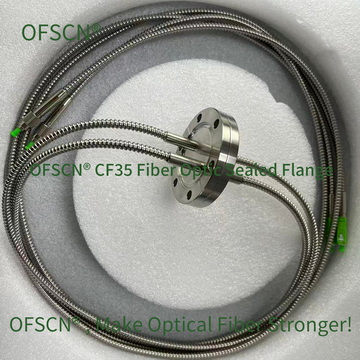
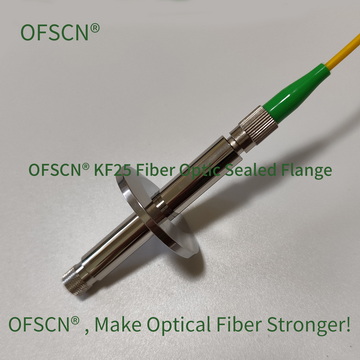
This product is specifically designed for high and ultra-high vacuum (UHV) environments. It is available in CF and KF series, offering excellent hermeticity and self-isolating stress design, effectively preventing signal attenuation or spectral distortion in the sealing area.
- Core Parameter Indicators:
- Ultimate Vacuum Level: Better than 1 \times 10^{-7}\ \text{Pa} and 1 \times 10^{-9}\ \text{Pa}.
- Specification Division: Divided into CF and KF series, with options for single-channel, multi-channel, male, and female connectors for customized solutions.
- Temperature Range: Standard temperature operation; high-temperature resistant flanges up to 250^\circ\text{C} can be customized.
- Ferrule Protection: Metal anti-kink tubes are reserved at the tail end to provide mechanical tensile stress relief, ensuring structural stability for long-term operation in extreme environments.
For precision optical strain, displacement, or stress measurements within a vacuum chamber using this flange, please refer to the accompanying high-precision sensor series: OFSCN® FBG Strain Sensor Products Aggregation Link | Official Link for further details on composite temperature and strain demodulation solutions under variable load conditions.