In a strong magnetic field vacuum environment (such as nuclear fusion experiments), will the flange material be disturbed by magnetic force?
In strong magnetic field vacuum environments (such as nuclear fusion experiments, superconducting magnets, space environment simulations, or high-energy physics experiments), the magnetic permeability of flange materials is an extremely critical technical indicator. The answer is: If the flange material is not chosen properly, it will indeed be subject to significant magnetic interference in a strong magnetic field.
The following provides a rigorous academic explanation from three aspects: physical mechanisms, material selection, and solutions:
1. Physical Mechanism of Strong Magnetic Fields Acting on Flange Materials
In a strong magnetic field environment, if the vacuum flange itself is magnetic (i.e., has high magnetic permeability), it will cause the following three main types of interference and hazards at the physical level:
- Electromagnetic Forces and Mechanical Stress (Maxwell Stress):
Magnetic flanges in strong magnetic fields (especially in regions with magnetic field gradients) are subjected to strong attractive or repulsive torques. These electromagnetic torques act on the flange body, causing additional mechanical stress in the fastening structure, and may even cause slight deformation of the sealing gasket, thereby compromising the integrity of ultra-high vacuum sealing. - Local Magnetic Field Distortion:
Nuclear fusion devices (like tokamaks) require extremely precise magnetic field configurations to confine high-temperature plasmas. If the relative permeability (\mu_r) of the flange is high, it will be magnetized in a strong magnetic field, causing magnetic field lines to bend and distort locally, thereby disrupting the original magnetic field symmetry and affecting the stable confinement of the plasma. - Eddy Current Heating under Transient Magnetic Fields:
If the magnetic field in the environment is pulsed or rapidly changing, very large eddy currents will be induced within conductive and magnetic metal flanges. Eddy currents not only generate opposing secondary magnetic fields but also produce significant Joule heat within the metal flange, causing a temperature rise and affecting the performance of vacuum sealing compounds or metal sealing rings (such as copper gaskets).
2. Magnetic Permeability and Cold Work Hardening of Vacuum Flange Materials
Standard vacuum flanges (including KF and CF series) are typically made of austenitic stainless steel (e.g., 304, 316L).
- Theoretical State:
Fully solution-annealed austenitic stainless steel is a weakly paramagnetic material with a relative permeability \mu_r very close to 1 (typically between 1.003 and 1.01), and is almost unaffected by conventional magnetic fields. - Actual State (Critical Risk):
During the machining (lathing, drilling, cutting) and welding (e.g., welding of fiber optic feedthroughs to flange disks) of flanges, austenitic stainless steel undergoes a phase transformation induced by severe plastic deformation or thermal effects, causing the originally non-magnetic austenite to locally transform into ferromagnetic martensite. This leads to a significant increase in local magnetic permeability \mu_r (potentially exceeding 1.1 or higher), exhibiting noticeable magnetic interference in strong magnetic fields.
Low Magnetic Permeability Material Solutions:
To ensure complete immunity to magnetic interference in strong magnetic fields, strict control of the material’s relative magnetic permeability is essential.
- 316LN Stainless Steel:
Stabilizes the austenite phase by increasing nitrogen (N) content. Even after severe cold working and welding, 316LN can maintain extremely low magnetic permeability (typical value \mu_r < 1.005), making it the standard preferred material for vacuum flanges in nuclear fusion (e.g., the ITER project). - Titanium Alloys (e.g., Gr2, Gr5) or Aluminum Alloys:
These non-ferrous metals are absolutely non-ferromagnetic materials with extremely low magnetic permeability, achieving “zero interference” with magnetic fields.
3. Technical Advantages of Fiber Optic Vacuum Flanges and OFSCN® Products
The material of optical fibers itself is silicon dioxide (\text{SiO}_2), which is electrically insulating and completely non-magnetic, naturally immune to electromagnetic interference (EMI) and strong magnetic fields. This makes optical fibers the ideal means for optoelectronic detection, temperature, and strain sensing (e.g., using FBG fiber Bragg grating sensors) within vacuum chambers.
To introduce non-magnetic optical fibers into ultra-high vacuum strong magnetic field chambers, Beijing Dacheng Yongsheng Technology Co., Ltd. offers the official OFSCN® Fiber Optic Vacuum Sealed Flange.
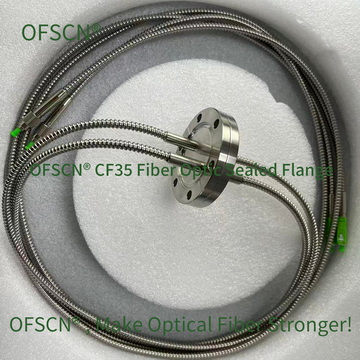
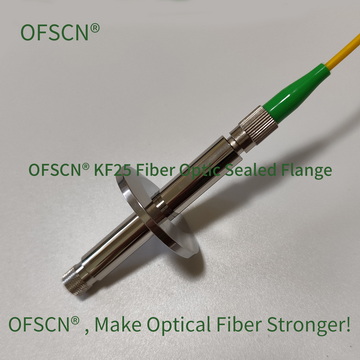
Key Specifications and Customization Capabilities of this Product:
- Series:
Available in CF and KF series, supporting single and multi-channel fiber feedthroughs, customizable with single or multiple heads based on the test system scale. - Excellent Vacuum Sealing Performance:
KF series achieves a vacuum better than 1 \times 10^{-7}\ \text{Pa}, and CF series achieves an ultra-high vacuum better than 1 \times 10^{-9}\ \text{Pa}, meeting the stringent requirements of physical experiment chambers. - Temperature Resistance Range:
Standard models are for ambient temperature use, with customizable options for high-temperature applications up to 250\ \text{°C}. - Low Magnetic Permeability Special Customization:
For strong magnetic field environments such as nuclear fusion, the flange body, fiber optic metal protective tube, and internal sealing components can be fully customized using extremely low magnetic permeability materials like 316LN stainless steel, titanium alloy, or high-purity oxygen-free copper. This minimizes the material’s relative magnetic permeability in strong magnetic fields (controlled below \mu_r < 1.005), ensuring the flange and feedthrough structure are completely unaffected by electromagnetic forces and magnetic field distortion.