Why are flanges typically made of 304 or 316L stainless steel?
In vacuum systems, including those with fiber optic feedthroughs within vacuum fiber optic flanges, the preferred flange materials are typically 304 or 316L austenitic stainless steel. This choice is primarily dictated by their physical hardness, mechanical properties, chemical stability, and magnetic characteristics, for the following reasons:
1. Hardness Matching and High-Pressure Sealing Mechanism (CF Metal Seal)
Especially in CF (ConFlat) series flanges, commonly used in ultra-high vacuum (UHV) environments, sealing is achieved by the “knife-edge” on the flange cutting into a softer metal gasket (usually an oxygen-free copper gasket, OFHC):
- Hardness Contrast: The Brinell hardness (HB) of oxygen-free copper gaskets typically ranges from 35\ \text{to}\ 45. In contrast, 304 or 316L stainless steel in the annealed state usually has a hardness of around \text{HB}\ 170\ \text{to}\ 200 (or Rockwell hardness \text{HRB}\ 80\ \text{to}\ 90).
- Seal Knife-Edge Protection: The flange material must possess a significantly higher hardness and yield strength than the gasket. This ensures that when the bolts are tightened, the knife-edge causes the copper gasket to plastically deform and fill the microscopic gaps on the stainless steel surface, while the knife-edge itself remains undamaged or undeformed. If the flange’s hardness is insufficient, the knife-edge will become dull or chip after repeated compression and use, leading to flange seal failure and rendering the flange unusable.
2. Extremely Low Outgassing Rate
In high vacuum (HV) and ultra-high vacuum (UHV) environments, gas adsorption on material surfaces and the diffusion of internal gases outward (outgassing) are critical factors determining the system’s ultimate vacuum level:
- 304 and 316L stainless steels have a dense lattice structure with very low solubility and diffusion coefficients for common gases like hydrogen and water vapor.
- After precision machining and electrochemical polishing, their nominal surface area for adsorption is significantly reduced. During high-temperature bake-out degassing (e.g., baking at 250\ ^{\circ}\text{C} to 450\ ^{\circ}\text{C}), their outgassing rate can be reduced to extremely low levels, allowing for the maintenance of ultra-high vacuum levels better than 1 \times 10^{-7}\ \text{Pa}, or even 1 \times 10^{-9}\ \text{Pa}.
3. Temperature Resistance and Weldability
- Ultra-low Carbon Content (“L” denotes Low Carbon): 316L has a lower carbon content than 304 (\le 0.03\% ), which greatly reduces the precipitation of chromium carbides at grain boundaries during flange welding (such as welding of fiber optic transition sleeves) or high-temperature bake-outs, thereby decreasing the susceptibility to intergranular corrosion.
- Thermal Stability: 304 and 316L exhibit excellent high-temperature strength and oxidation resistance. During repeated thermal cycling (e.g., from cryogenic environments to bake-out temperatures of several hundred degrees Celsius), they maintain structural dimensional stability without undergoing ferritic phase transformation, thus avoiding leaks caused by mismatched coefficients of thermal expansion.
4. Weakly Magnetic or Non-magnetic Properties
304 and 316L are austenitic stainless steels. In the solution-annealed state, they exhibit paramagnetic properties (non-magnetic or very weakly magnetic). In many vacuum environments involving electron beams, ion beams (such as in Scanning Electron Microscopes (SEM), mass spectrometers, or superconducting applications), or precision optical physics experiments, weakly magnetic flanges effectively prevent electromagnetic interference with the trajectories of charged particles or the signals of precision sensors.
Beijing Dacheng Yongsheng Technology Co., Ltd. (OFSCN®) Related Products
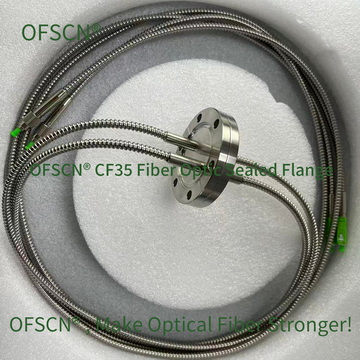
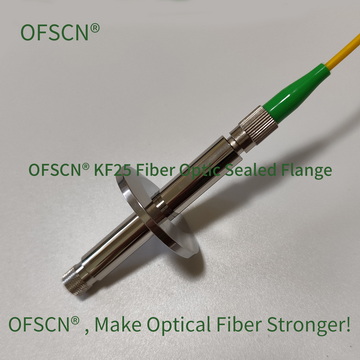
The OFSCN® Fiber Optic Vacuum Sealed Flange developed by Beijing Dacheng Yongsheng Technology Co., Ltd. is designed based on the rigorous material science specifications mentioned above. This product series is available in both KF and CF series, specifically developed for introducing optical fibers (such as FBG sensors, specialty fibers, etc.) into high and ultra-high vacuum environments:
- Structural Forms: Supports single and multi-channel configurations, available in male and female connector types.
- Vacuum Performance: Ultimate vacuum levels better than 1 \times 10^{-7}\ \text{Pa} and 1 \times 10^{-9}\ \text{Pa}.
- Temperature Resistance: Standard models are for room temperature use, with special customizable models capable of withstanding high temperatures up to 250\ ^{\circ}\text{C}, perfectly matching vacuum bake-out processes.