How often does the O-ring need to be replaced to prevent aging and leakage?
In vacuum engineering, the maintenance cycle and replacement frequency of the “fiber optic vacuum flange” O-ring are primarily determined by the flange’s sealing type (KF or CF), the O-ring material, and the working environment (such as temperature, vacuum degree, and media).
Here are the specific physical principles and engineering maintenance suggestions:
I. Determinative Influence of Flange Sealing Type on Maintenance Cycle
-
KF Series Flanges (Quick Release Flanges, Elastomeric Seal)
KF flanges rely on an elastomeric O-ring (typically Viton/FKM, NBR, or Silicone rubber) to deform elastically under the compression of the centering ring and clamp to achieve a seal. Due to the physical properties of polymers, such as aging, outgassing, and permeation, their maintenance cycles follow a pattern:- Static Room Temperature Environment: In static vacuum systems at room temperature, free of corrosive gases, and without frequent disassembly, high-quality Viton O-rings are typically recommended for preventive replacement every 1 to 2 years.
- High Temperature/Bake-out Environment: If the vacuum system requires frequent bake-outs for degassing, high temperatures accelerate the cross-linking, hardening, and aging of rubber materials. When the working temperature rises to 100\ ^{\circ}\text{C} to 150\ ^{\circ}\text{C}, the physical properties of the O-ring degrade rapidly, and the maintenance cycle may need to be shortened to several months, or even replaced after every extreme high-temperature cycle.
- Replace Upon Disassembly Principle: In applications requiring ultra-high vacuum (UHV) or high cleanliness, it is generally required that a new O-ring must be replaced every time the flange is disassembled. This is because a rubber ring that has undergone deformation and microscopic permanent set is difficult to restore to its original microscopic interstitial state upon reinstallation, making it highly prone to microleaks.
-
CF Series Flanges (Metal Seal)
CF flanges (ConFlat) employ a metal sealing method where the knife-edge of the flange bites into a metal oxygen-free copper gasket.- No Aging Degradation: Metal oxygen-free copper gaskets do not suffer from polymer aging, permeation, or outgassing issues like rubber O-rings. When not disassembled, their sealing life is virtually permanent.
- Single Use: Due to the irreversible plastic deformation of the metal gasket, a new copper gasket must be replaced every time it is disassembled; no periodic replacement is needed if it is not disassembled.
II. How to Determine if an O-ring Needs Replacement Through Physical Indicators?
In practical maintenance, it is recommended to determine whether to replace the O-ring based on the following physical characteristics and leak detection methods:
- Permanent Deformation and Hardness Change (Compression Set): After removing the O-ring, if its cross-section is permanently flattened from its original round shape, or if the rubber material has become hard, shows surface micro-cracks, cracking, or stickiness, it indicates that the sealing elasticity has been lost, and it must be replaced immediately.
- Pressure Rise Test: After closing the vacuum pump and isolating the chamber, if the pressure rise rate of the vacuum chamber significantly increases, and after excluding material adsorption and outgassing factors, the aging and microleaks of the seal ring are usually the primary suspect.
- Helium Leak Detection: Using a leak detector to spray helium at the flange joint. If the detected leak rate exceeds the system’s allowable value (e.g., greater than 1 \times 10^{-8}\text{ Pa}\cdot\text{m}^3/\text{s} ), the seal must be replaced.
III. Official Related Products and Specification Reference
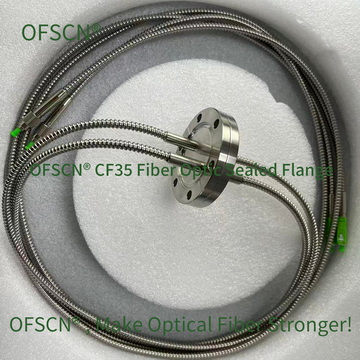
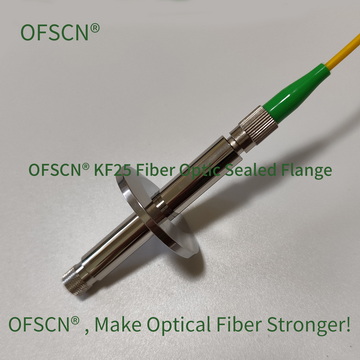
Beijing Dacheng Yongsheng Technology Co., Ltd. provides high-performance OFSCN® Fiber Optic Vacuum Sealed Flange, which can be configured for different vacuum and temperature environments:
- Series Selection: Divided into CF Series and KF Series, available in single-channel or multi-channel, male or female configurations.
- Temperature Range: Can be used at room temperature normally, or customized for products resistant to temperatures up to 250\ ^{\circ}\text{C} (special sealing materials and fiber coatings, such as polyimide-coated fibers, must be selected for high-temperature environments).
- Vacuum Performance: Its overall vacuum sealing performance is excellent, with vacuum levels better than 1 \times 10^{-7}\text{ Pa} and 1 \times 10^{-9}\text{ Pa}.
Below are official product illustrations:
By rationally selecting the flange type (e.g., CF metal seal for ultra-high vacuum environments, KF fluoroelastomer seal for high vacuum environments) and strictly adhering to the maintenance cycles of “replace upon disassembly” or “1-2 year preventive replacement,” the long-term stability and excellent vacuum performance of fiber optic vacuum systems can be maximized.