Purchasing 100 splitters in bulk, how much variation can there be between their parameters?
In optical communications and fiber optic sensing (such as Fiber Bragg Grating sensing systems), the manufacturing consistency of Optical Splitters is a key metric for assessing batch quality, system stability, and loss budgets. If you purchase 100 splitters in bulk, the variation in their parameters largely depends on the splitter manufacturing process (PLC vs. FBT) and the manufacturer’s production quality control level.
I. The Decisive Impact of Splitter Manufacturing Process on Production Consistency
-
PLC (Planar Lightwave Circuit) Splitters: Extremely High Consistency
- Manufacturing Principle: PLC splitters utilize semiconductor microelectronic lithography technology to fabricate optical waveguides on a quartz substrate. The geometric structure and physical parameters of the splitting channels are determined by high-precision optical reticle processes.
- Batch Consistency: Due to chip-level mass production, the parameter variations among 100 PLC splitters are extremely minimal.
- Channel Uniformity: The uniformity among different output channels within a single device is excellent. For instance, in a 1 \times 16 PLC splitter, the maximum insertion loss difference between channels typically falls within 1.2\ \text{dB} to 1.4\ \text{dB}.
- Inter-device Variation: For a batch of 100 devices of the same specifications, the fluctuation in nominal Insertion Loss (IL) is usually less than \pm 0.3\ \text{dB} .
-
FBT (Fused Biconical Taper) Splitters: Relatively Lower Consistency
- Manufacturing Principle: FBT splitters are made by fusing and stretching two or more optical fibers and coupling them through heating. For splitters with 1 \times 8 or higher port counts, multi-stage 1 \times 2 tapered devices are typically cascaded and welded.
- Batch Consistency: Due to multiple mechanical stretching and cascading fusion processes, cumulative process errors are significant.
- Channel Uniformity: As the port count increases, the uniformity across output channels deteriorates significantly.
- Inter-device Variation: In a batch of 100 devices, the fluctuations in insertion loss and the splitting ratio of each channel are relatively large. The parameter variation between devices can reach \pm 0.5\ \text{dB} to \pm 1.0\ \text{dB} . Furthermore, when operating over a wide wavelength range, the consistency of Wavelength Dependent Loss (WDL) is more challenging to control.
II. Standard Metrics for Parameter Variation in 100 High-Quality PLC Splitters
For a bulk purchase of 100 mainstream, high-quality PLC splitters, the consistency of their core technical parameters (using 1 \times 8 and 1 \times 16 as examples) typically conforms to the following specifications:
| Key Technical Parameter | Maximum Difference Between Channels in a Single Device | Maximum Deviation Between 100 Devices (Inter-device Consistency) |
|---|---|---|
| Operating Wavelength Range | Full band 1260\ \text{nm} \sim 1650\ \text{nm} | Batch spectral width consistency, no spectral drift |
| Insertion Loss (IL) | 1 \times 8 \le 10.5\ \text{dB} | |
| 1 \times 16 \le 13.8\ \text{dB} | Average deviation between devices \le \pm 0.3\ \text{dB} | |
| Uniformity | 1 \times 8 \le 0.8\ \text{dB} | |
| 1 \times 16 \le 1.2\ \text{dB} | Fluctuation within batch \le 0.3\ \text{dB} | |
| Polarization Dependent Loss (PDL) | \le 0.2\ \text{dB} | Maximum difference between devices \le 0.1\ \text{dB} |
| Return Loss (RL) | APC Connector \ge 55\ \text{dB} | |
| UPC Connector \ge 50\ \text{dB} | 100% compliant with standards, minimal deviation | |
| Directivity | \ge 55\ \text{dB} | High consistency within the batch |
III. OFSCN® Professional-Grade Solutions in Fiber Splitters
Beijing Dacheng Yongsheng Technology Co., Ltd.'s high-quality OFSCN® Optical Fiber Splitter series products strictly control batch consistency in both R&D and production.
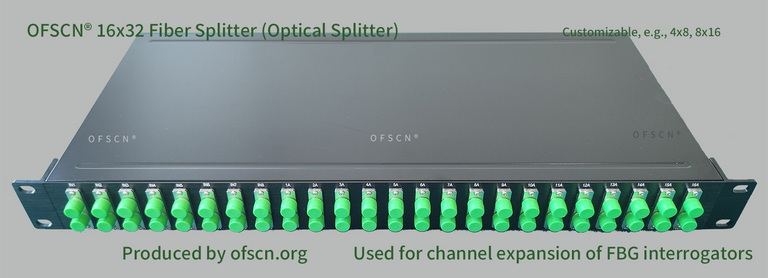
Technical Parameters and System-Level Application Features of OFSCN® Splitters:
- Specification Support: Standard specifications include 16 \times 32 splitters, 8 \times 16 splitters, 4 \times 8 splitters, and 32 \times 64 splitters. Standard products are for normal temperature environments, and high-temperature resistant products up to 250^{\circ}\text{C} can be customized for special industrial environments.
- Physical Expansion Application: In large-scale fiber optic sensing projects, these splitters are often used in conjunction with OFSCN® Fiber Bragg Grating Analyzers. They can physically expand one channel of the demodulator into two or three channels (while logically remaining one channel in the demodulator), thereby reducing the per-channel cost of the entire system by a factor of two or three.
- Wavelength Control Red Line: Since Fiber Bragg Grating (FBG) sensors are wavelength-modulated devices, extremely strict wavelength design is necessary when using splitters to expand channels. OFSCN® provides extremely high port consistency and low Polarization Dependent Loss, ensuring that the spectral signals on each expanded branch maintain balanced intensity when combined, thus avoiding the loss of weak signals due to excessive energy differences between channels.
In summary, if you are using splitters in bulk for system integration (especially in precision fiber optic sensing and demodulation systems), it is imperative to choose splitters based on the PLC manufacturing process to ensure high consistency in the loss budget for multiple signal paths.