Will frequent plugging and unplugging of connectors cause increasing losses?
Yes, frequently plugging and unplugging fiber optic connectors can indeed lead to a gradual increase in insertion loss (IL) and even a severe degradation of return loss (RL).
However, this phenomenon is not directly caused by the act of “plugging and unplugging” itself, but rather by the combined effects of mechanical wear, end-face contamination, and physical damage. Below are the underlying optical engineering and physics mechanisms:
I. Analysis of Physical and Engineering Principles
1. Mechanical Wear and Mating Cycles (Mating Durability)
- Ferrule and Sleeve Materials: The ferrules of modern high-quality fiber optic connectors (such as FC, SC, LC, etc.) and the alignment sleeves within adapters/flanges are typically made of high-hardness zirconia (Zirconia) ceramic. Ceramics possess extremely high wear resistance.
- Lifetime Rating: Under absolutely ideal conditions (dust-free, standardized operation) in a laboratory setting, the mating cycle life of standard connectors is usually defined as 500 to 1000 cycles. Within this range, due to the consistent precision of ceramic alignment, the change in insertion loss is minimal (typically a variation of \le 0.1\text{ dB} or 0.2\text{ dB}).
- Structural Wear: As the number of mating cycles increases, the metal or plastic positioning structures of the connector housing (such as the key of FC connectors, the plastic spring clip of LC connectors) and the flange locking mechanism will undergo slight physical wear. This wear can lead to lateral offset or angular misalignment, resulting in reduced alignment accuracy of the fiber cores and an increase in loss.
2. End-Face Contamination and Irreversible Mechanical Damage (Most Critical Cause)
In practical engineering applications, the primary reason for increased loss due to frequent plugging and unplugging is not the exhaustion of connector lifespan, but rather cross-contamination from airborne particulates.
- Localized High Pressure: During mating of Physical Contact (PC/APC) fiber optic connectors, pressure is applied to the ferrule end-face by a spring within the flange. Although the total pressure is not high, the local pressure per unit area is very significant due to the extremely small contact area of the fiber end-face.
- Destructive Power of Dust Particles: When connectors are exposed to air or used in unfiltered environments, the end-face can easily adsorb tiny, hard dust particles (such as silica or metal debris). If plugged without professional cleaning, these dust particles will be directly crushed and embedded into the silica glass surface of the fiber under the extremely high mating pressure.
- Cumulative Physical Damage: This crushing action will cause irreversible scratches, pits, or chipping on the surface of the fiber core (Core) and cladding (Cladding). As mating cycles accumulate, this physical damage worsens, leading to severe scattering and reflection of light as it passes through the end-face, thus causing loss to increase exponentially or in steps.
3. Standardized Operation to Mitigate Loss Increase
According to international standards (such as IEC 61300-3-35), before each plug-in and connection, the steps of “Inspect – Clean – Re-inspect – Connect” must be followed. Fiber end-face inspection scopes and dedicated fiber cleaning tools (such as wipes, isopropyl alcohol, or cleaning pens) are used to remove particulates. As long as stringent cleaning is maintained, connectors can sustain very low and stable loss within their rated mating cycles.
II. Related High-Quality OFSCN® Products
To maintain high-precision alignment and excellent mating durability even under frequent plugging/unplugging or harsh industrial/high-temperature environments, OFSCN® (大成永盛) offers high-precision fiber optic patch cords and adapter assemblies that comply with industrial standards:
-
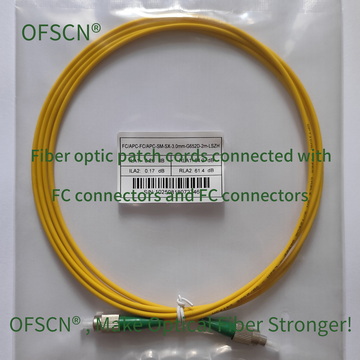
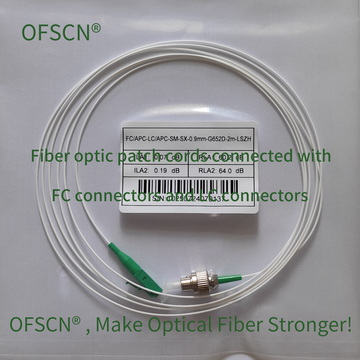
OFSCN® Standard Fiber Patch Cord: Utilizes standard high-precision zirconia ceramic ferrules. Under proper cleaning and maintenance, it exhibits excellent mating consistency and an ultra-long working life.
-
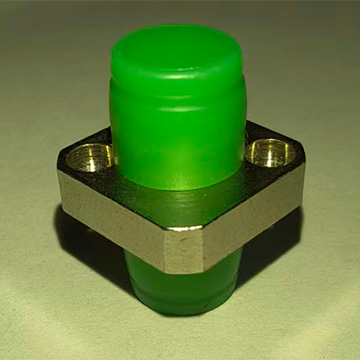
OFSCN® High Temperature Resistant Fiber Optic Adapter: A high-performance fiber optic flange (adapter) resistant to temperatures up to 300℃. It employs a high-precision alignment sleeve internally, ensuring precise alignment and mating stability in harsh industrial environments and situations with drastic temperature fluctuations.
-
OFSCN® High-Temperature Fiber Optic Connector Series: For extreme environment applications, OFSCN® also designs fiber optic connectors with high mechanical stability and high-temperature resistance. These connectors are less prone to expansion or deformation at high temperatures or under complex working conditions, effectively preventing mechanical positioning looseness caused by environmental changes and ensuring mating alignment accuracy: