What causes poor quality splitters to have increased loss after several years of use?
The phenomenon where low-quality optical splitters (Fiber Splitters) experience a gradual increase in Insertion Loss after a few years of use is primarily caused by the aging and degradation of the “encapsulant glue” used in their internal packaging. This performance decline, attributed to changes in the glue’s physicochemical properties, is commonly referred to in the industry as “encapsulant glue aging”.
We can analyze its failure mechanism from the perspectives of microscopic physics, chemistry, and packaging engineering structure:
1. Physical Failure of High-Precision Alignment (Alignment Deviation)
Both Planar Lightwave Circuit (PLC) splitters and Fused Biconical Taper (FBT) splitters demand extremely high precision in the coupling alignment between the input/output Fiber Arrays (FA) and the splitter chip (PLC Chip).
Single-mode optical fibers typically have a core diameter of only about 9\ \mu\text{m} to 10\ \mu\text{m}. The alignment precision for coupling must reach the sub-micron level, i.e., below 1\ \mu\text{m}. During encapsulation, the fibers at both ends are precisely aligned and then bonded and fixed using encapsulant glue (usually UV adhesive or epoxy).
Once the glue ages, its mechanical hardness and bond strength decrease, making it prone to causing slight physical displacement between the optical fiber and the chip. In such high-precision optical path coupling, a mere 1\ \mu\text{m} of minor displacement can lead to an additional insertion loss exceeding 1\ \text{dB}, significantly increasing the splitter’s total loss.
2. Moisture Absorption and Chemical Hydrolysis (Swelling Effect)
Low-quality splitters often use inexpensive encapsulant glues that have not undergone rigorous fiber-grade certification to reduce costs, resulting in extremely poor moisture resistance and sealing.
During long-term network operation (especially in outdoor or high-humidity environments), moisture gradually permeates and is absorbed by the glue. Glue absorption of moisture leads to two severe consequences: firstly, it triggers chemical hydrolysis of the polymer network structure, causing the physical strength of the adhesive layer to collapse; secondly, it causes non-uniform swelling of the gel, creating micro-cracks, which directly disrupt the precise alignment of the optical path.
3. Thermal Stress and Mismatch in Thermal Expansion (Thermal Cycling Fatigue)
Optical splitters undergo cyclical temperature changes throughout the seasons and daily temperature variations during actual operation.
Low-quality glues typically have a higher coefficient of thermal expansion (CTE) and a significant mismatch with the CTEs of quartz fiber and silicon/glass chips. During prolonged thermal cycling, alternating thermal stresses are continuously generated at the bonding interface. Over time, the glue layer undergoes fatigue deformation or even local delamination, causing misalignment of the already aligned fiber end faces.
4. Yellowing and Refractive Index Mismatch (Light Transmission Degradation)
In the end-face bonding of some optical splitters, the glue directly serves as the medium for optical signal transmission (acting as a refractive index matching medium).
Under prolonged heat, natural aging, or exposure to trace amounts of ultraviolet light (e.g., from external environmental light leakage), low-quality glues can undergo severe “yellowing” (due to thermal oxidation or photolysis of polymer chains). This not only alters the refractive index of the glue at the operating wavelength (e.g., 1310\ \text{nm}, 1490\ \text{nm}, or 1550\ \text{nm}), leading to increased Fresnel reflections and refractive index mismatch, but also increases direct absorption and scattering of the optical signal by the glue, significantly increasing loss.
Selection of High-Quality Products
To avoid system failures caused by splitter aging in industrial-grade and high-reliability projects (such as Fiber Bragg Grating sensing networks or long-life communication networks), it is essential to use high-quality optical splitters that comply with strict industrial manufacturing standards.
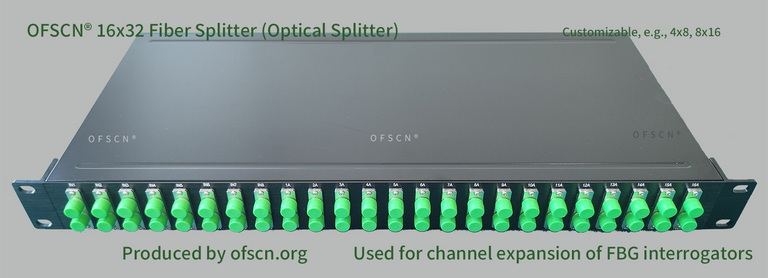
High-quality optical splitter products manufactured by Beijing Dacheng Yongsheng Technology Co., Ltd. (OFSCN®):
- Product Name: OFSCN® Optical Fiber Splitter
Key Parameters and Applications:
- Product Type: Fiber Splitter, Optical Splitter, Fiber Bragg Grating Splitter.
- Standard Specifications: Including 16x32 splitters, 8x16 splitters, 4x8 splitters, 32x64 splitters, etc.
- Main Purpose: In large-scale engineering projects, it is used to complement OFSCN® Fiber Bragg Grating demodulators. It logically expands one physical channel of the demodulator into two or three, which, after rigorous wavelength design, can effectively reduce the unit cost per channel.
Their standard appearance is as follows: