Why shouldn’t the dust cap be casually discarded after removal? Will there be dust inside?
In fiber optic engineering and experimental operations, the common causes of fiber connection failures and component damage are loosely discarding dust caps after removal, casually placing them, and then reattaching them.
The inside of a dust cap can indeed accumulate micro-dust and impurities. Furthermore, due to its material and environmental characteristics, once detached from the fiber optic connector, it is highly susceptible to external contamination. The following provides a detailed analysis of the underlying reasons and potential hazards from the perspectives of physics, materials, and optical transmission principles:
I. Why is there “dust” inside a dust cap?
- Manufacturing and Production Process Residue:
Ordinary plastic dust caps are typically mass-produced through injection molding. During the manufacturing process, trace amounts of mold release agents, plastic particles, chemical leachates (such as plasticizers), or suspended micro-dust from the production environment are inevitably left inside. Therefore, even a brand-new dust cap is not absolutely dust-free inside. - Electrostatic Adsorption Effect (Static Magnet):
Dust caps are generally made of polymer plastics (such as polyethylene, polypropylene, or PVC). These materials are excellent insulators and easily accumulate a large amount of charge during insertion/removal, friction, and contact with airflow. Once removed and exposed to the air, the dust cap acts like a “static magnet,” rapidly adsorbing suspended micro-dust, clothing fibers, or human skin fragments from the surrounding air. - Secondary Contamination (Environmental Exposure):
If a removed dust cap is casually placed on a workbench, in a pocket, a regular toolbox, or on the floor, its opening is highly likely to come into direct contact with larger particles of dust and oil from uncleaned surfaces.
II. Severe Hazards After Contaminated Caps are Replaced
Fiber optics transmit highly focused light signals. For standard single-mode optical fibers, the core channel that transmits light—the core—has a diameter of only about 9\ \mu\text{m}.
- Severe Optical Signal Attenuation:
A single micro-dust particle with a diameter of only 1\ \mu\text{m} to 2\ \mu\text{m} falling into the core area acts like a wall, blocking and scattering light waves. This leads to a drastic increase in insertion loss and exacerbates return loss. - High-Power Burning and Permanent Damage:
In fiber optic communication or Fiber Bragg Grating (FBG) sensing systems, if the transmitted optical power is high (or if local energy accumulates due to end-face reflection), dust or oil residues on the end face will rapidly absorb light energy, causing the local temperature to spike instantly. This not only “fuses” and carbonizes the dust onto the quartz glass end face, creating indelible pitting and scratches, but can even directly burn out the optical ports of precision demodulation equipment or light sources, causing irreversible equipment damage.
III. Standard Usage Protocol for Dust Caps
To ensure the stability of optical systems and the longevity of components, the industry adheres to a strict set of protection and cleaning procedures:
- “Remove Just Before Use, Replace Immediately After”:
Dust caps should only be removed immediately before the fiber optic connector is inserted into the adapter (ferrule). - No Casual Reuse:
If a removed dust cap has not been stored in an anti-static treated, clean, sealed bag, it should, in principle, not be directly reattached to a cleaned fiber optic connector. - Mandatory Cleaning Before Connection:
After removing the dust cap from a fiber optic connector, and before inserting it into the adapter, it must be cleaned using a dedicated fiber optic cleaning pen (e.g., a one-click cleaner) or lint-free wipes with high-purity isopropyl alcohol. It should then be inspected with a fiber end-face microscope to ensure it meets dust-free standards.
IV. Stringent Cleanliness Requirements for High-Precision Optical Interconnection Devices
In fiber optic applications involving extreme physical environments (such as high temperatures, high pressures, or high vibrations), where operating conditions are even more demanding, any minor contamination on the end face can trigger severe system failures under high temperatures or high power. Beijing Dacheng Yongsheng Technology Co., Ltd. (OFSCN®)'s range of high-quality, high-temperature resistant connectors, in practical engineering applications, also require extremely strict adherence to the aforementioned dust protection and cleaning protocols:
-
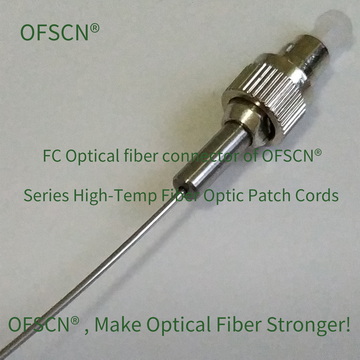
OFSCN® 300℃ Fiber Optic Connector: This connector supports various interfaces such as FC/PC and FC/APC. At operating temperatures up to 300\ ^\circ\text{C}, any uncleared dust or trace organic residues from dust caps on the end face can easily carbonize at high temperatures, permanently adhering to the ferrule surface.
-
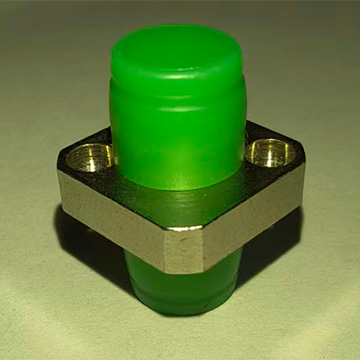
OFSCN® High Temperature Resistant Fiber Optic Adapter: This is a ferrule adapter specifically designed for high-precision alignment. If dust accumulates inside the adapter due to missing or reused dust caps, repeated insertions and removals not only reduce alignment accuracy but also cause dust to rub between the two connector end faces, inflicting physical damage on the quartz end faces.
Conclusion: The fundamental purpose of a dust cap is to act as a barrier protecting against “physical damage and macroscopic environmental dust,” rather than being an absolutely vacuum-sealed or dust-free container. Strict adherence to proper dust cap handling procedures, coupled with the principle of “always clean before connecting,” forms the cornerstone of ensuring signal integrity in optical experiments and engineering tests.