Why does removing the dust cap equal throwing away the lifespan of a fiber optic jumper?
When fiber optic patch cords leave the factory, their connector end faces are fitted with plastic dust caps. Discarding or losing these dust caps is not merely a matter of habit; in the field of optical engineering, it directly damages the fiber end face and significantly shortens the service life of the patch cord. The core physical mechanisms and engineering principles are as follows:
1. Micron-Level Geometric Dimensions of the Core and Sensitivity to Contamination
Fiber optic transmission relies on the principle of total internal reflection, with the optical signal highly concentrated within the core region. Taking standard single-mode fiber (e.g., G.652D) as an example, the Mode Field Diameter (MFD) of its core is only about 9\ \mu\text{m} to 10\ \mu\text{m}.
In an environment without dust cap protection, airborne dust particles, oils, or moisture will rapidly settle on the ceramic ferrule end face. Natural dust particles typically range in diameter from 1\ \mu\text{m} to 100\ \mu\text{m}. This means that even a single dust particle a few micrometers in size falling on the center of the core will obscure a large area of the light-guiding region, causing severe scattering and absorption. This leads to a sharp increase in Insertion Loss (IL) and a deterioration of Return Loss (RL).
2. High-Pressure Physical Contact Leading to “Crushing Damage” of the End Face
When fiber optic patch cords are mated (e.g., FC/PC or FC/APC connectors joined via a ferrule), internal springs provide high physical contact pressure, pressing the two ceramic ferrules tightly together to eliminate air gaps.
If hard dust particles remain on the end face:
- Scratches and Pits: At the moment of high-pressure contact, the dust particles are forcibly pressed into the softer silica glass end face or ceramic surface, causing permanent scratches, pits, and debris.
- Irreversible Degradation: Once scratches occur, they cannot be restored by ordinary wiping or alcohol cleaning, and the patch cord’s optical performance will suffer permanent attenuation.
3. “Burn-in” Effect Under High-Power Optical Energy
In optical sensing (e.g., FBG demodulation systems), high-power fiber lasers, or high-power communication systems, the optical power density within the core is extremely high.
When dust or oil adheres to the fiber end face, these contaminants strongly absorb optical energy and convert it into heat. The local temperature rises instantaneously, causing burn-in. This not only burns the end face coating or silica structure but can also permanently weld the contaminant to the ferrule surface, rendering the patch cord scrap.
4. Cross-Contamination and Chain Damage
If an exposed and contaminated fiber optic patch cord is inserted into testing instruments (such as optical spectrum analyzers, fiber optic demodulators) or system ferrules, it will transfer contaminants into the internal sleeves of the ferrules and the fixed interface end faces within the equipment, causing permanent damage to the entire optical link or even high-value instrument interfaces.
Core Products and Standards
Dust caps, as standard protective accessories, are not part of Beijing Dacheng Yongsheng Technology Co., Ltd.'s (OFSCN®) standalone product line. All fiber optic patch cord products manufactured by Beijing Dacheng Yongsheng Technology Co., Ltd. are equipped with strictly matched dust caps throughout the entire process of manufacturing, inspection, and transportation to ensure the cleanliness of the fiber end faces and stable optical performance.
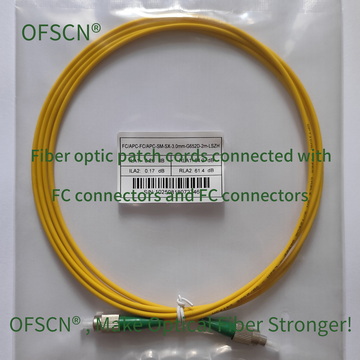
Related general patch cord product information can be found at:
In engineering specifications, unconnected fiber optic patch cords should always have dust caps; before each insertion, it is recommended to inspect and perform standardized cleaning using a fiber end face inspection scope.