How much higher does the signal need to be than the noise for the measurement to be considered reliable?
In the fields of optical precision measurement and Fiber Bragg Grating (FBG) sensing, the physical essence of “reliable measurement” is the ability to stably, with high precision, and without jumps, demodulate the center wavelength of the reflection spectrum (\lambda_B).
In practical engineering and academic applications, for a measurement to be truly “reliable” (high stability, high repeatability, low wavelength jitter), the signal (reflection peak) must be at least 15\ \text{dB} above the noise floor (system noise and background stray light).
Below, we will conduct an in-depth analysis of the relationship between “Signal-to-Noise Ratio (SNR)” and “Measurement Reliability” from three dimensions: physical mechanism, mathematical fitting error, and engineering classification.
I. Theoretical Analysis: Why are 3\ \text{dB} or 10\ \text{dB} Far from Enough?
From a signal detection perspective, a 3\ \text{dB} power difference means the signal is twice the noise. However, in FBG-based wavelength demodulation, we are not merely “detecting the presence of a reflection signal”; instead, we need to determine the center wavelength of the reflection peak.
To achieve ultra-high resolution better than 1\ \text{pm}, fiber Bragg grating demodulators generally employ peak-finding algorithms such as Gaussian Fitting, Centroid Algorithm, or Quadratic Fitting.
According to the physical formula for peak-finding uncertainty, the relationship between the standard deviation of wavelength fitting (jitter error) \sigma_{\lambda} and the signal-to-noise ratio generally satisfies:
\sigma_{\lambda} \approx k \cdot \frac{\Delta \lambda_{3\text{dB}}}{\sqrt{SNR_{\text{linear}}}}
(where \Delta \lambda_{3\text{dB}} is the 3\ \text{dB} bandwidth of the grating, SNR_{\text{linear}} is the linear signal-to-noise ratio, and k is the fitting factor)
- If the SNR is extremely low (e.g., \lt 10\ \text{dB} ): Noise significantly modulates the peak of the reflection spectrum randomly. This causes the center point calculated by the fitting algorithm to drift randomly with the noise. On the demodulator, you will observe that even if the temperature or strain has not changed at all, the wavelength reading still fluctuates wildly within tens of picometers ( \text{pm} ), rendering the measurement inaccurate.
- If the SNR \ge 15\ \text{dB}: The amplitude of system noise is suppressed outside the fitting interval, allowing the fitting algorithm to very accurately recover the center of the Gaussian envelope, thereby achieving ultra-high measurement stability of better than 1\ \text{pm} or even 0.1\ \text{pm}.
II. Engineering Experience: Measurement Performance Classification at Different SNRs
Based on feedback from the application of FBG demodulators in actual industrial settings, the difference between the signal reflection peak and the noise floor can be classified into the following tiers:
| Signal-to-Noise Ratio ( SNR ) Range | Measurement Reliability | Actual Performance |
|---|---|---|
| ** \lt 6\ \text{dB} ** | Extremely Unreliable | Algorithm easily misjudges noise as signal or experiences “missed detection”; the demodulator may frequently report errors, lose lock, and fail to read normal wavelengths. |
| ** 6\ \text{dB} \sim 10\ \text{dB} ** | Low Reliability | Although the reflection peak can be identified, the wavelength data jumps significantly (jitter can exceed 10\ \text{pm} ), making it unsuitable for precise micro-strain or high-resolution temperature sensing. |
| ** 10\ \text{dB} \sim 15\ \text{dB} ** | Basically Reliable | Suitable for general static measurements where high accuracy is not critical and sampling rates are low. Wavelength jitter is present and typically requires averaging multiple data points to smooth the data. |
| ** \ge 15\ \text{dB} ** | Highly Reliable (High-Quality Range) | Signal profile is clear and symmetrical, with extremely small wavelength jitter (less than 1\ \text{pm} ). It fully unleashes the hardware’s ultimate performance limits for high-speed demodulation. |
III. Official Technical Specifications: OFSCN®'s Engineering Practice
To ensure highly “reliable” wavelength measurements from the hardware source, OFSCN® sets the \ge 15\ \text{dB} standard as the golden criterion for design and factory output, for both sensors and interrogators:
1. Sensor Side: Ensuring High Side Mode Suppression Ratio (SMSR)
For the bare gratings and grating strings produced by OFSCN®, during the grating writing and annealing processes, the Side Mode Suppression Ratio (SMSR) of the reflection spectrum is customized by default to \ge 15\ \text{dB}:


2. Interrogator Side: Ultra-High System Wavelength Resolution
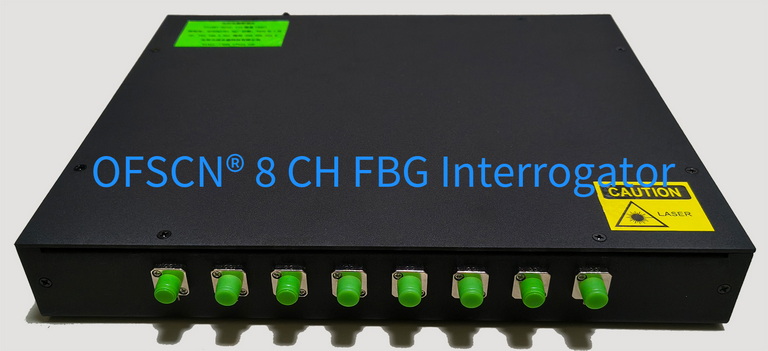
This interrogator has a default wavelength resolution of 1\ \text{pm} and can be customized to a higher 0.1\ \text{pm}.
In practical use, if the signal reflected by the front-end sensor is too weak (e.g., due to large fiber bends, high splicing loss, or the grating itself having low reflectivity, resulting in a return power difference below 15\ \text{dB} compared to the interrogator’s noise floor), the wavelength data will degrade due to environmental noise, regardless of the interrogator’s hardware capabilities. Therefore, maintaining an input signal SNR \ge 15\ \text{dB} is the physical cornerstone for ensuring its high-resolution probing capability.