What is the purpose of the hard rod in the middle of the optical cable? Is it fiberglass or steel wire?
Beijing Dacheng Yongsheng Technology Co., Ltd. specializes in optical fiber sensing technology.
The hard rod in the middle of the optical cable is called the “Central Strength Member”. Its primary function is to provide mechanical support and tensile protection for the optical cable.
To answer your question directly and simply: it can be either fiberglass or steel wire, depending on the cable’s design type and application scenario.
Below, we will break down the role of the strength member and the differences between these two materials from the perspectives of physics and engineering principles:
1. Why is a “Strength Member” essential in optical cables?
Optical fibers are made of high-purity silicon dioxide (fused quartz glass), with a diameter typically around 125\ \mu\text{m}, making them extremely fragile.
- Tensile Protection: Optical cables are subjected to significant tensile forces during installation (like pulling through conduits or aerial suspension) or use. Quartz fibers have very low tensile strength, and without a strength member to bear the majority of the tension, the fibers would easily break under strain.
- Strain and Temperature Difference Resistance: The thermal expansion coefficient of quartz differs significantly from that of the optical cable’s outer jacket (usually plastic like PE or PVC). During drastic temperature changes, the contraction or expansion of the plastic can cause the optical fibers to bend under pressure, leading to micro-bending losses. The strength member has a very high elastic modulus, which suppresses the longitudinal thermal expansion and contraction of the cable, maintaining stable signal transmission.
2. Fiberglass vs. Steel Wire: Two Mainstream Materials
① Fiber Reinforced Plastic (FRP / GFRP)
- Material Composition: This is not a single piece of pure glass, but rather a composite material made from high-strength glass fibers as the reinforcing material, embedded in a resin matrix and cured. It is commonly abbreviated as FRP (Fiber Reinforced Plastic).
- Advantages:
- Non-metallic and Insulating: It is completely non-conductive. This makes it immune to electromagnetic interference (EMI), lightning strikes, and induced currents, making it ideal for overhead optical cables on high-voltage power grids (like ADSS cables) or in lightning-prone areas.
- Lightweight: Its specific gravity is much lower than that of steel wire, facilitating long-distance suspension and installation.
- Corrosion Resistance: Chemically stable and does not rust.
- Disadvantages: Its elastic modulus and tensile strength are slightly lower than steel wire of the same diameter, and it can be prone to brittle fracture if bent with a too-small radius.
② Steel Wire / Metal Strength Member
- Material Composition: Typically made from high-carbon steel wire, galvanized steel wire, or stainless steel wire.
- Advantages:
- Extremely High Mechanical Strength: Possesses very high tensile strength and elastic modulus, capable of withstanding extreme physical impact and tensile forces.
- Compression and Bending Resistance: Better bending performance than rigid FRP, less prone to brittle fracture.
- Disadvantages:
- Conductivity: It is conductive and poses a lightning strike risk during outdoor installation, requiring proper grounding.
- Heavy Weight: Increases the overall weight of the optical cable.
3. Strength Structure Applications in Special Industrial Scenarios
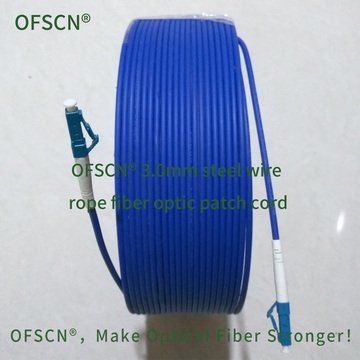
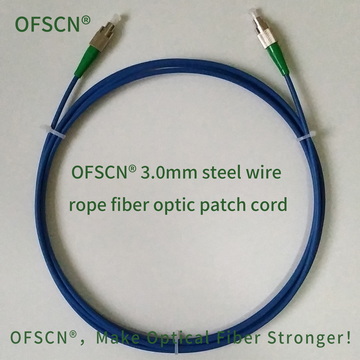
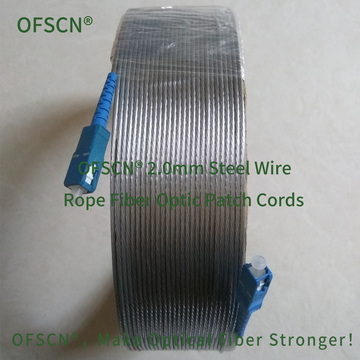
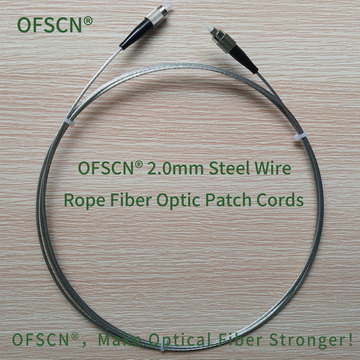
In more demanding industrial-grade, field exploration, or high-precision sensing applications, stronger all-metal reinforcement structures are often employed to protect optical fibers. For example, Beijing Dacheng Yongsheng Technology Co., Ltd. (OFSCN®) specializes in high-strength, high-tensile environment cables and has designed patch cord products that directly utilize stranded steel wires and stainless steel seamless steel tubes for combined protection:
- OFSCN® 3.0mm Steel Wire Rope Fiber Optic Patch Cord: Within a 3.0\text{ mm} diameter, this product integrates a 0.45\text{ mm} stainless steel wire stranded structure and a 0.9\text{ mm} stainless steel seamless steel tube, providing tensile strength greater than 1200\text{ N} and compressive strength greater than 200\text{ MPa}.
- OFSCN® 2.0mm Steel Wire Rope Fiber Optic Patch Cord: Within a 2.0\text{ mm} diameter, it employs a 0.6\text{ mm} galvanized steel wire stranded structure and a 1.0\text{ mm} stainless steel seamless steel tube, achieving a tensile strength exceeding 1500\text{ N}.
Summary
The hard rod you felt:
- If it’s a light-colored, slightly transparent, or yellowish-green material with a hard plastic feel, it’s Fiber Reinforced Plastic (FRP).
- If it’s a single or multi-strand metal rod with a metallic sheen, silver-gray or black in color, it’s steel wire/steel core.
Both exist as necessary structures to overcome the physical limitations of quartz optical fibers, such as “low tensile strength and susceptibility to breakage.”