Are the spliced areas more prone to breaking than the original fiber? How should they be protected?
In fiber engineering and physical optics applications, bare fusion splices exhibit significantly lower mechanical strength compared to the original fiber, making them highly susceptible to brittle fracture when subjected to tensile, bending, or shear stress.
I. Physical Mechanisms Leading to Splice Fracture
- Mechanical Damage and Micro-cracks
Before fiber splicing, the protective coating (such as polyacrylate or polyimide) outside the quartz cladding must be stripped using a fiber stripper. During this mechanical stripping process, microscopic contact friction can easily introduce tiny mechanical scratches and micro-cracks on the quartz glass surface. - Thermal Stress and Surface Thermochemical Corrosion
The localized high temperatures generated by the arc discharge of the fusion splicer (approximately 1800^\circ\text{C} \ \text{to} \ 2000^\circ\text{C}) melt and reconstruct the quartz glass. However, this creates significant temperature gradients at the heat conduction interface, leading to residual thermal stress in the splice zone. Concurrently, water vapor in the air at high temperatures can corrode the exposed quartz surface, accelerating the propagation of micro-cracks. - Strength Degradation Comparison
The tensile strength of the original fiber (with its intact coating and having passed quality screening) typically reaches over 100 \text{ kpsi} (approximately 0.7 \text{ GPa}). In contrast, the tensile strength of an unprotected bare splice after fusion often drops to 20\% \ \text{to} \ 50\% or even lower than the original fiber strength.
II. Protection and Engineering Solutions for Splice Joints
To enable splice joints to withstand long-term mechanical stress and environmental influences, structural protection must be implemented:
1. Common Engineering Protection Methods
- Heat-shrinkable Splice Sleeves
The most common conventional protection method. The sleeve consists of a heat-shrinkable outer tube, a hot-melt adhesive inner tube (EVA/PE), and a rigid stainless steel strength member (or quartz pin). Upon heating, the hot-melt adhesive fills gaps and expels air, while the stainless steel strength member bears the external mechanical tensile and bending stresses. - UV Recoating
Re-applying UV-curable acrylate or polyimide resin to the bare fiber section and curing it with UV light restores the fiber’s original 250 \ \mu\text{m} coated diameter. This method is suitable for applications with strict requirements on volume and outer diameter.
2. Industrial-Grade and Sensor-Grade High-Strength Protection
In industrial monitoring, high-strain applications, and harsh environments (such as fiber Bragg grating sensing systems), conventional heat-shrinkable sleeves may not be sufficient to meet compressive and tensile strength demands. In such cases, seamless metal tube armoring or non-damaging inscription techniques are typically employed:
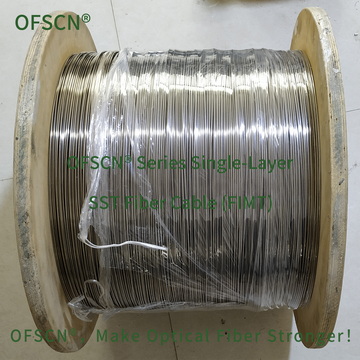
- Seamless Steel Tube Encapsulation Armoring
This involves metal protection of the fiber and splice using seamless stainless steel tubes, completely isolating external bending and extrusion stresses. For example:
OFSCN® 85°C Seamless Steel Tube Fiber Cable
- High-Strength Non-Stripping Processing (Reducing Splice Weaknesses at the Source)
For sensors like Fiber Bragg Gratings (FBGs), femtosecond laser inscription technology can be used to inscribe gratings directly onto the fiber core point-by-point through the coating. This eliminates the need for stripping the protective layer and splicing, thereby perfectly preserving the original fiber’s high tensile strength:
OFSCN® High-Strength Fiber Bragg Gratings / FBG Strings (Bare)
