Buried underground or installed on poles, can it guarantee 20 years of durability?
Under conditions of industrial-grade manufacturing, engineering design, and adequate external sheath protection (e.g., fabricated into communication fiber optic cables, direct buried in conduits, or aerial lashed), the designed service life of communication-grade silica (\text{SiO}_2) optical fibers can typically reach 20 to 25 years, or even exceed 30 years in suitable environments.
However, the inherent physical fragility of bare optical fiber means that ensuring 20 years of uninterrupted signal transmission or signal integrity hinges on the following core physical principles and engineering protection factors:
I. Physical and Chemical Mechanisms Determining Fiber Lifespan
1. Static Fatigue & Stress Corrosion
High-purity quartz glass possesses extremely high theoretical tensile strength. However, during the fiber drawing process, nanoscale surface defects (microcracks) are inevitably introduced.
Under the combined action of long-term mechanical tensile stress (such as the pulling force from aerial suspension or bending stress) and ambient moisture (\text{H}_2\text{O}), chemical bonds at the crack tips break, leading to slow crack propagation. This phenomenon is known as static fatigue.
In engineering physics, the static fatigue crack propagation parameter, n value (required to be n \ge 20 for communication fibers), is typically used to predict the long-term mechanical lifespan of optical fibers. As long as the long-term residual tensile stress applied to the fiber is controlled within a safety threshold of 20% to 30% of the proof test stress, the fiber can maintain its mechanical integrity for over 20 years.
2. Coating Polymer Material Aging
The silica fiber core is coated with a primary polymer coating layer (e.g., polyacrylate), which serves to insulate against moisture and physical abrasion. Over time, this coating can undergo thermal oxidative aging or depolymerization due to temperature-humidity cycling or UV exposure. If the coating peels off and loses its protective function, the bare glass surface exposed to humid air will experience an exponentially increasing crack propagation rate.
3. Hydrogen-Induced Attenuation
Free hydrogen molecules in the environment can diffuse into the silica glass lattice and react with defects to form hydroxyl ( -\text{OH} ) absorption peaks, significantly increasing optical attenuation near the 1383\text{nm} wavelength. Modern standard communication fibers (such as those compliant with ITU-T G.652D specifications) have eliminated the water peak issue through optimized fiber preform and anti-hydrogen processes, thus ensuring optical transmission stability over a 20+ year service life.
II. Protection Guarantees in Actual Engineering Environments
When deployed via direct burial or aerial lashing on poles, bare optical fibers must never be directly exposed to the environment. Engineering practices require the fiber optic cable structure to provide multiple physical barriers:
- Direct Buried Conduits: The cable’s exterior must include water-blocking grease/tape to prevent groundwater ingress, a rodent-resistant metallic armor layer, and an outer sheath to withstand soil settlement and pressure.
- Aerial Installation: The cable must utilize a strength member (e.g., steel wire or FRP) to bear wind loads, ice loads, and its own weight, and the outer sheath material must possess excellent resistance to ultraviolet (UV) aging.
III. Examples of Relevant Official Standard Optical Fibers and Protective Structures
In standard-compliant optical fiber communication and sensing networks, common fiber optic products and armored protective structures include:
- OFSCN® G.652D Optical Fiber: Standard G.652D single-mode optical fiber with a core diameter of 9\ \mu\text{m}, cladding diameter of 125\ \mu\text{m}, and coating diameter of 255\ \mu\text{m}. It features low water peak attenuation and standard high mechanical strength screening indicators, specifically designed for long-life communication and foundational fiber optic sensing networks.

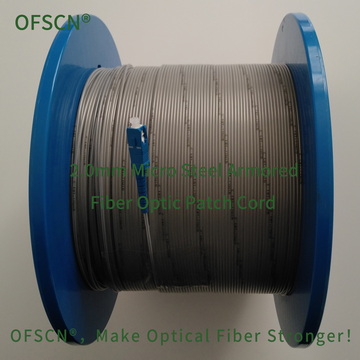
- OFSCN® 2.0mm Micro Steel Armored Fiber Optic Patch Cord: For signal transmission or connections in complex environments, this structure incorporates a 0.6mm stainless steel seamless steel tube and PVC sheath. It boasts a tensile strength of >1500N and compressive strength of >150MPa, providing a mechanical barrier for long-term operation of optical fibers in harsh physical environments.