On equipment with severe vacuum pump vibration, will the flange connection loosen and leak?
On equipment experiencing severe vibrations from vacuum pumps, flange connections do indeed carry a significant risk of loosening and causing vacuum leaks if specific engineering protections are not implemented.
This analysis, from the perspectives of vacuum physics, mechanical structure, and fiber optic vacuum-sealed flanges (feedthroughs), will academically dissect the physical mechanisms behind vibration-induced leaks and outline preventive measures:
I. Physical and Engineering Mechanisms of Vibration-Induced Leaks
-
Alternating Stress at the Mechanical Connection Level (Thread and Clamp Failure)
Vacuum pumps (such as mechanical, turbo, or Roots pumps) generate continuous high-frequency or low-frequency alternating vibrations during operation.- For KF Quick Release Flanges: Sealing relies on a central centering ring, an O-ring, and external aluminum clamps for tightening. The lateral shear forces generated by vibrations can cause the clamps to gradually exhibit minor displacements or slippage, thereby reducing the axial clamping force on the O-ring.
- For CF Ultra-High Vacuum Flanges: These employ multiple bolts for rigid connection. If the bolts are not secured against loosening, the alternating stress can overcome the frictional torque between threads, leading to a decrease in bolt preload and connection looseness.
-
Micro-dynamic Deformation at the Sealing Interface Level (Seal Material Degradation)
- Polymer O-rings (KF Series): In a vibrating environment, micro-relative displacements occur between the rubber or fluoroelastomer O-ring and the flange sealing surface. This micro-dynamic friction not only accelerates the aging of the sealing material but also, due to viscoelastic hysteresis, creates localized micro-gaps during intense vibration transients, leading to gas permeation.
- Metal Copper Gaskets (CF Series): CF flanges achieve sealing by the knife-edge of the flange mating surface cutting into a copper gasket, causing plastic deformation. Although its vibration resistance is significantly superior to polymers, extreme long-term vibrations can induce bolt creep or micro-mechanical fatigue at the knife-edge sealing interface of the metal gasket.
-
Internal Structure Fatigue of Fiber Optic Feedthroughs (Core Risk Point)
For fiber optic vacuum flanges, beyond the sealing of the flange itself, the most critical aspect is the transition seal between the fiber glass body and the metal flange hole. This seal is typically achieved through low outgassing vacuum epoxy resin, low-melting point glass sintering, or metallization and brazing.- Shear Stress Concentration: If the external fiber optic patch cord lacks proper fixation and stress relief support, vibrations are directly transmitted through the patch cord to the sealing layer. This creates immense shear stress at the interface between the extremely hard glass fiber core and the metal housing of the flange, leading to micro-cracking of the sealing layer and subsequent micro-leaks.
II. Engineering Solutions to Mitigate Vibration-Induced Leakage Risks
To ensure system vacuum integrity in high-vibration scenarios, the following preventive measures are typically adopted in engineering design:
- Addition of Flexible Physical Isolation (Vacuum Bellows): Vacuum metal flexible bellows must be installed between the vacuum pump inlet and the chamber to maximally absorb and attenuate mechanical vibrations transmitted from the pump body to the flange end.
- Prioritize CF Flange Structures: In applications with strong vibrations, CF series metal hard-seal flanges should be preferred over KF series clamp flanges. CF flanges, rigidly locked by bolts, offer excellent overall resistance to vibration and mechanical fatigue.
- Incorporate Fastener Anti-Loosening Design: When installing CF flange bolts, Belleville washers must be used to maintain constant preloading, and a torque wrench must be employed to strictly follow diagonal tightening steps to the standard preload torque.
- Implement Patch Cord Stress Relief: Flexible fixation (e.g., using cable ties, mounting brackets) should be applied to the fiber optic patch cords entering and exiting the vacuum flange to prevent excessive swaying due to equipment resonance, which would directly impose mechanical bending moments on the flange sealing point.
III. Official Related Products and Technical Specifications
For fiber optic introduction needs in vacuum and ultra-high vacuum environments, Beijing Dacheng Yongsheng Technology Co., Ltd. designs and manufactures the OFSCN® Fiber Optic Vacuum Sealed Flange. This product is optimized in its structure and material selection for harsh physical environments:
- Technical Parameters and Sealing Grades:
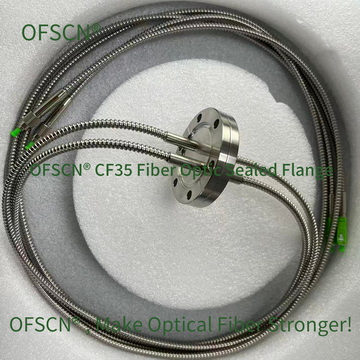
- CF Series: Its sealing structure is compatible with standard oxygen-free copper gaskets, achieving vacuum levels better than 1 \times 10^{-9}\text{ Pa}. It can withstand rigid high-pressure bolting and exhibits excellent resistance to vibration and mechanical fatigue.
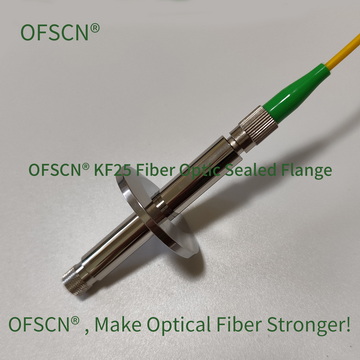
- KF Series: Utilizes high-quality fluoroelastomer O-rings and a centering ring structure, achieving vacuum levels better than 1 \times 10^{-7}\text{ Pa}, suitable for low-vibration or quick-disassembly vacuum systems.
- Fiber Optic Coupling End: Supports single-head or multi-head customization. The internal structure is precision-encapsulated with special low-outgassing hard sealing materials, which effectively resist mechanical stress accumulation caused by environmental micro-vibrations while meeting ultra-high vacuum specifications.
Below are official standard images of this product: