How does the surface finish of the sealing face decisively influence the leakage rate?
The surface roughness (finish) of sealing surfaces (such as flange sealing faces) has a decisive physical impact on the leak rate of vacuum systems and fiber optic vacuum flanges. This impact can be scientifically explained from three dimensions: microscopic contact mechanisms, gas flow channels, and deformation compensation by the sealing medium:
1. Microscopic Contact and the Formation of Gas Leakage Channels
In optical and vacuum engineering, any metal or medium sealing surface that appears absolutely flat macroscopically is composed of countless “peaks” and “valleys” at the microscopic level.
- Surface roughness (usually denoted by R_a or R_z ) directly determines the characteristic dimensions of these microscopic irregularities.
- When flange sealing surfaces and sealing gaskets are pressed together, if the sealing surface roughness is large, the valleys cannot be completely filled by the sealing material, thus forming microscopic, continuous void channels on the contact surface.
- Under the action of the pressure difference between the inside and outside of the system, gas molecules will permeate along these microscopic channels, causing leakage.
2. Geometric Progression Relationship Between Leak Rate and Microscopic Channel Size
According to theories of rarefied gas dynamics and fluid mechanics, in the molecular flow or transitional flow regimes, the gas leak rate Q through a small channel has a strong positive correlation with the equivalent characteristic height h of the channel. In some flow states, the leak rate is proportional to the cube or fourth power of the channel height:
Q \propto h^3 \quad \text{or} \quad Q \propto h^4
This means that even a slight increase in the surface roughness of the sealing surface (equivalent to the microscopic channel height h ) will lead to a geometric progression increase (several times or even tens of times) in the leak rate. Therefore, extremely high surface finish is a physical prerequisite for achieving extremely low leak rates.
3. Limits of Sealing Material Compensation Capability
The sensitivity to roughness varies slightly depending on the type of vacuum flange sealing:
- Elastic Sealing (e.g., KF series flanges using rubber or fluoro-rubber O-rings): Rubber-like materials have elastic deformation capabilities and can “flow” into and fill microscopic surface valleys. However, if the surface roughness is too large, or if there are directional scratches (e.g., radial tool marks) on the surface, the local deformation limit of the elastic material may not be sufficient to completely compensate for these deep grooves, still leading to gas leakage.
- Metal Hard Sealing (e.g., CF series flanges using copper gaskets and metal knife-edges): High-hardness metal knife-edges cut into the copper gasket, causing plastic deformation. If the flange knife-edge itself has microscopic roughness, wear, or fine radial scratches, plastic flow cannot completely eliminate these micron-level channels, preventing the maintenance of ultra-high vacuum (UHV) environments.
Corresponding Official Products from OFSCN®
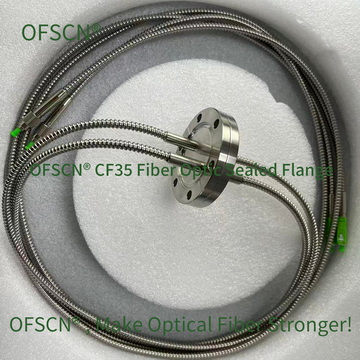
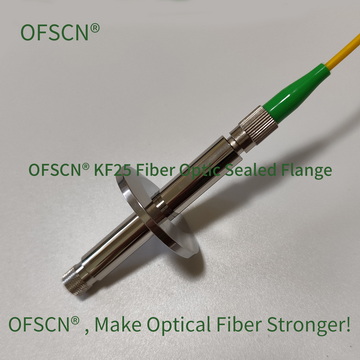
To address the demand for lossless transmission of optical fibers in vacuum environments and high/ultra-high vacuum sealing, Beijing Dacheng Yongsheng Technology Co., Ltd. has launched the OFSCN® Fiber Optic Vacuum Sealed Flange.
This product strictly controls the surface roughness and machining precision of the sealing surfaces during manufacturing, minimizing microscopic leakage channels to the greatest extent. Its key technical specifications are as follows:
- Structure Classification: Available in CF and KF series, as male and female connectors, and in single-head and multi-head configurations.
- Sealing and Vacuum Performance Indicators:
- The KF series, based on high-precision elastic sealing design, achieves a vacuum better than 1 \times 10^{-7}\ \text{Pa} ;
- The CF series, based on precision knife-edge metal sealing design, achieves a vacuum better than 1 \times 10^{-9}\ \text{Pa} .
- Temperature Adaptability: Suitable for use at room temperature, with customizable options for high-temperature resistance up to 250\ \text{℃} based on special industrial and experimental requirements.
Official Product Image Display: