What is the outer wall thickness of the steel pipe? Does increasing the thickness sacrifice sensitivity?
In the field of fiber optic sensing and cable jacketing, “wall thickness” is an extremely critical geometric and mechanical parameter for the protective layer of seamless stainless steel tubes. The following addresses the technical specifications related to OFSCN® products, explaining the steel tube wall thickness and its specific impact on sensor measurement sensitivity from the perspectives of physics and engineering mechanics.
I. How Thick is the Steel Tube’s Outer Wall (Wall Thickness)?
In OFSCN®'s core seamless stainless steel tube fiber optic cables and sensors, the wall thickness is closely related to the outer diameter of the steel tube, the application scenario, and the number of layers. The default standard specifications and customization ranges are as follows:
1. Single-Layer Seamless Steel Tube (Most common in high and low-temperature fiber optic cables and basic sensors)
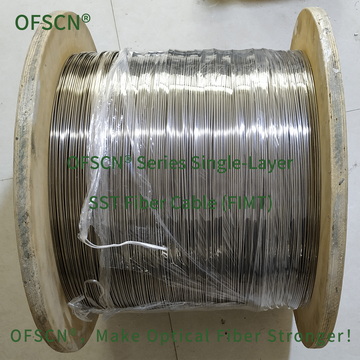
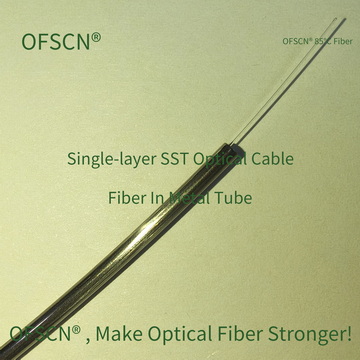
For common single-layer stainless steel (304 or 316L) seamless steel tube protective structures, such as OFSCN® 85°C Seamless Steel Tube Fiber Cable or OFSCN® 300°C Seamless Steel Tube Fiber Cable, the outer diameter and wall thickness correspond to the following standard specifications:
- Outer Diameter 2.0 mm: Default wall thickness is 0.2 mm.
- Outer Diameter 3.0 mm: Default wall thickness is 0.3 mm.
- Micro-protective tubes (e.g., for patch cords, miniature sensors): The outer diameter can be customized down to 0.9 mm, 0.6 mm, or even 0.5 mm, with thinner wall thicknesses, typically between 0.1 mm and 0.15 mm.
2. Double and Triple-Layer Seamless Steel Tubes (Often used in extreme high-pressure environments like oil wells and geothermal applications)
To cope with harsh downhole environments, multi-layer nesting processes are employed, such as in OFSCN® Double-Layer High-Temperature Downhole Fiber Optic Cable:
- Double-layer structure: The outer seamless steel tube has an outer diameter of 6.35 mm (approximately 1/4 inch) with a wall thickness of 0.9 mm; the inner seamless steel tube has an outer diameter of 3.6 mm with a wall thickness of 0.3 mm.
- Triple-layer structure: The outer layer has an outer diameter of 6.35 mm (wall thickness 0.9 mm), the middle layer has an outer diameter of 4.0 mm (wall thickness 0.3 mm), and the inner layer has an outer diameter of 3.0 mm (wall thickness 0.3 mm).
II. Does Increasing Wall Thickness Sacrifice Sensor Sensitivity?
Increasing the wall thickness significantly enhances the mechanical protection performance of the fiber optic cable against tension, compression, corrosion, and hydrogen-induced loss. However, the impact of increasing wall thickness on sensitivity varies drastically across different physical quantity sensing applications:
1. Impact on Temperature Sensing
- Static Temperature Sensitivity (Negligible Sacrifice): Under static or thermal equilibrium conditions, where heat transfer has reached equilibrium, the thickness of the tube wall does not alter the final temperature value transmitted to the internal fiber. Furthermore, the coefficient of thermal expansion of stainless steel is significantly greater than that of silica fiber. The thermal expansion force of the steel tube during temperature variations will fully drive the internal grating. Therefore, the static wavelength temperature coefficient (typically 10 pm/°C to 30 pm/°C, depending on the specific packaging) is almost unaffected by wall thickness.
- Dynamic Response Speed (Significant Delay, i.e., Sacrifice in Dynamic Sensitivity): Increasing the wall thickness increases the thermal resistance and thermal capacitance of the steel tube. When the external environmental temperature changes abruptly, the temperature field requires a longer transitional time to conduct through the thick-walled tube to the inside of the fiber. Consequently, the thicker the tube wall, the longer the sensor’s thermal response time (Time Constant), and the significantly reduced its sensitivity to transient, high-frequency temperature variations.
2. Impact on Strain Sensing
- Increased Axial Stiffness and Shear Lag (Potential Sacrifice in Sensitivity): When measuring substrate strain (e.g., surface mounting or welding), force is transmitted from the substrate to the steel tube via a shear layer (adhesive or weld) and then from the steel tube to the fiber. The axial stiffness of the steel tube is determined by the product of its elastic modulus and cross-sectional area (EA). An increase in wall thickness means an increase in A, significantly raising the stiffness of the sensor’s steel tube itself. If the measured substrate is thin (low stiffness) or the mounting adhesive layer is unstable, a thick-walled tube can cause a severe “strain shear lag effect,” resulting in the strain sensed by the fiber being less than the actual strain of the substrate.
- High-Frequency Response Limitation: Increasing the wall thickness increases the mass per unit length of the sensor, leading to greater inertia during dynamic measurements. This is disadvantageous for the precise measurement of high-frequency dynamic strains, such as those from ultrasonic waves or micro-vibrations.
3. Impact on Lateral Pressure/Stress Sensing
- Severe Sacrifice in Sensitivity: When used for lateral pressure or hydraulic pressure sensing, the fiber (or fiber Bragg grating) relies on the minute lateral compressive strain generated by the deformation of the steel tube under pressure to perceive the pressure. The resistance of the stainless steel tube to radial deformation is highly non-linearly correlated with its wall thickness. An increase in wall thickness drastically attenuates the radial deformation of the steel tube under the same pressure. Therefore, the greater the wall thickness, the exponentially lower the wavelength shift sensitivity for pressure sensing.
Conclusion
In practical engineering applications, the selection of wall thickness must be a trade-off between “mechanical protection performance” and “sensing performance.” For excellent physical protection (e.g., in oil wells, deep seas, or heavy-load structures), double-layer thick-walled construction is recommended. If rapid thermal response or high-precision micro-strain measurement is desired, ultra-thin-walled packaging should be chosen (e.g., 0.9 mm or 0.6 mm outer diameter specifications), provided basic moisture and pressure resistance requirements are met.
Below are detailed references for OFSCN® single-layer seamless stainless steel tube fiber optic cables (2.0 mm outer diameter / 0.2 mm wall thickness or 3.0 mm outer diameter / 0.3 mm wall thickness):