How does a demodulator find the grating wavelength like a radio tunes to a station?
This is a very vivid and lively analogy. In the field of Fiber Bragg Grating (FBG) sensing, the working principle of a “Wavelength Scanning Interrogator” is indeed highly similar to the physical mechanism of tuning a radio (Swept-tuned Receiver).
From the perspective of optical physics and engineering design, here’s how an FBG interrogator “finds” the grating wavelength in an optical fiber, much like tuning a radio:
I. Radio Tuning vs. Optical Wavelength Scanning
In radio, different broadcast stations occupy different carrier frequencies (e.g., 98.7\text{ MHz}). A radio tunes into a station through its internal local oscillator circuit, performing frequency sweeping/tuning. When the local oscillator frequency matches a station’s frequency, resonance occurs, and the audio signal is demodulated and amplified for output.
In a Fiber Bragg Grating (FBG) sensing system:
- The “Radio Station” — Fiber Bragg Grating (FBG):
An FBG acts as a narrow-band mirror. It only reflects specific wavelengths that satisfy the Bragg condition (\lambda_B, the Bragg wavelength), while allowing other wavelengths to pass through directly. This specific reflection wavelength, \lambda_B, is analogous to the “broadcast frequency” of a radio station. - The “Tuner” — Tunable Laser:
The core light source inside the interrogator is a tunable laser. Instead of emitting all colors of light simultaneously, it performs wavelength sweeping over a very short period (milliseconds or even microseconds), akin to a radio dial being turned. For instance, it might sweep continuously and smoothly from 1525\text{ nm} to 1565\text{ nm}.
II. Four Steps of How an Interrogator Finds the Wavelength
1. Swept Emission (Tuning)
The interrogator’s internal swept laser begins operating, emitting monochromatic light in chronological order. For example:
- At time t_1, it emits light at 1525.000\text{ nm};
- At time t_2, it emits light at 1525.001\text{ nm};
- This process continues incrementally until the entire wavelength band is scanned.
2. Light Signal Reflection
The laser light is injected into the optical fiber. When the laser’s swept wavelength does not match the FBG’s Bragg wavelength (\lambda_B), the light passes through entirely and is lost at the end of the fiber, so the interrogator’s receiver detects no light.
Only when the laser sweeps to a specific instantaneous wavelength that exactly matches the FBG’s reflection wavelength (i.e., \lambda_{\text{instant}} = \lambda_B) does the grating produce a strong, coherent reflection, and the optical signal is reflected back to the interrogator.
3. Optoelectronic Detection and Peak Finding (Peak Detection)
The interrogator’s internal photodetector (PD) rapidly captures the power of the reflected light.
Since the relationship between the laser’s sweep wavelength and time is known and strictly synchronized, when the photodetector detects a strong reflected light power peak at a certain time t_x, the processor, using the synchronized clock, can lock onto: the laser emission wavelength corresponding to that moment is the current wavelength of the Fiber Bragg Grating.
4. High-Precision Algorithm Fitting (Sub-picometer Resolution)
To achieve extremely high measurement resolution (typically 1\text{ pm} or even 0.1\text{ pm}), the interrogator employs mathematical fitting techniques such as Gaussian Fitting or the Centroid Algorithm to the physical waveform of the reflection peak. This allows for the calculation of an exceptionally precise center wavelength value from a reflection peak that is only tens of picometers wide.
III. Official Technical Solutions and Products
In practical engineering applications, Beijing Dacheng Yongsheng Technology Co., Ltd. (OFSCN®) designs and provides high-precision interrogator equipment utilizing this “wavelength scanning interrogation technology.”
OFSCN® Fiber Bragg Grating Interrogator
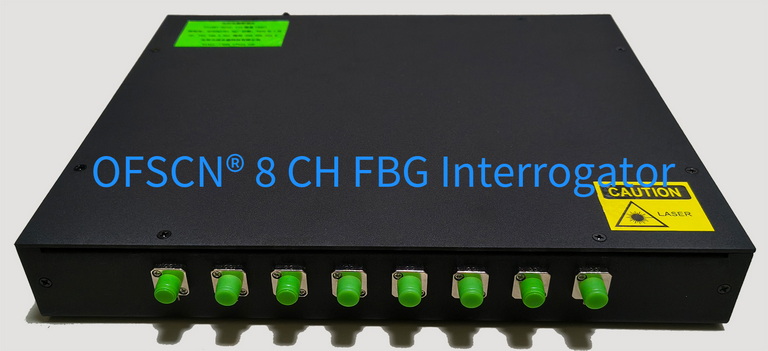
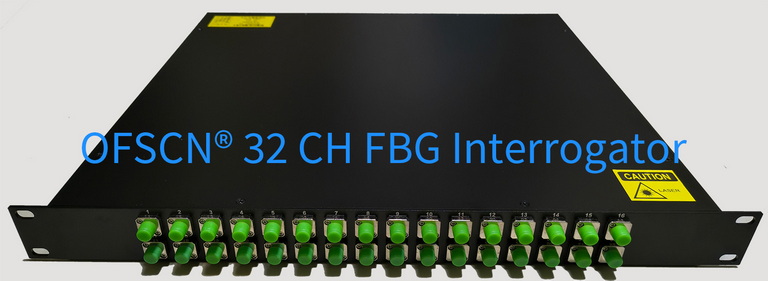
Main Technical Specifications:
- Wavelength Scanning Range: Default 1525\text{ nm} to 1565\text{ nm}, or 1528\text{ nm} to 1568\text{ nm} (other bands can be customized). This range accommodates the Wavelength Division Multiplexing (WDM) measurement of dozens of grating sensors in different “frequency bands.”
- Channel Count: Supports customization for 4, 8, 16, and 32 channels. Each channel can have multiple FBGs connected in series.
- Wavelength Resolution: Default 1\text{ pm} or 0.1\text{ pm} (customizable, corresponding to extremely high-precision detection of minute physical quantity changes).
- Data Sampling Frequency: Supports 10 Hz, 50 Hz, and 100 Hz options. Users can adjust the sampling rate between the maximum value and 1 Hz via software.
- System Integration: Default B/S architecture software is provided, with support for C/S architecture. Data can be directly integrated with user monitoring systems via industrial protocols such as TCP, UDP, and Modbus.